
IOR ENFORCEMENT BEGINS SEPTEMBER 18 | REVIEW MY IOR NOW


In This Article:


A bonded warehouse is a CBP-authorized facility where importers can store dutiable goods without paying duties immediately. Duties usually become due only when the goods are withdrawn for U.S. consumption, which makes bonded storage useful for delayed distribution, customs holds, and re-export strategies.
While historically associated with the importation of spirits, modern bonded warehouses benefit importers of all types of goods.
U.S. Customs and Border Protection defines a bonded warehouse as “a building or other secured area in which imported dutiable merchandise may be stored, manipulated, or undergo manufacturing operations without payment of duty for up to five years from the date of importation”.
Bonded warehouses that do allow manufacturing can only do so for goods intended to be exported from the United States. Foreign Trade Zones (FTZs) do allow manufacturing of goods that will enter the U.S. market.
The degree to which merchandise can be modified while stored in bond differs from one warehouse class to another. If you’re uncertain whether your goods should be stored in bond, we recommend scheduling consultation time with one of our experienced customs brokers.
Importers usually use bonded warehouses when they need to defer duty payments, move held cargo out of the port, store goods that may later be re-exported, or perform limited manipulation such as sorting, cleaning, or repackaging.
Shipments that have missing or incorrect information on their respective entry forms or importer security filings can be placed on hold by CBP. Partner government agencies (PGA), such as the U.S. Food and Drug Administration, may also hold shipments pending investigations into the permissibility of importing the goods in question.
While those goods sit in port, they can incur costly demurrage fees. However, importers can have their shipments moved into a bonded warehouse (via bonded transport) to avoid those fees and more easily access their shipment once they resolve a customs hold.
Under 19 CFR 19.1, storing your goods in a bonded warehouse gives you up to five years to address issues of import permissibility. While your shipment is in bond, you can apply for missing licenses, PGA approvals and submit or correct missing/incorrectly filled-out documents.
A bonded warehouse reduces port storage pressure because the importer can move cargo under bond while resolving documentation issues, agency reviews, or admissibility questions.
The main financial benefit of storing imported goods in a bonded warehouse is the deferral of duties. You won't have to pay duties on your goods until you withdraw them for consumption.
This quality of bonded warehouse storage is particularly beneficial for:
Using a bonded warehouse in either of these scenarios will help you save an exceptional amount of upfront import costs before clearing your shipment.
Importers who need to repackage, re-sort, or clean goods in storage can do so in a bonded warehouse and maintain duty deferral. Since these actions are considered manipulation rather than manufacturing, you won’t need to store your goods in a FTZ.
However, if you do need to manufacture, assemble, or substantially transform your imported goods, an FTZ is a better option.
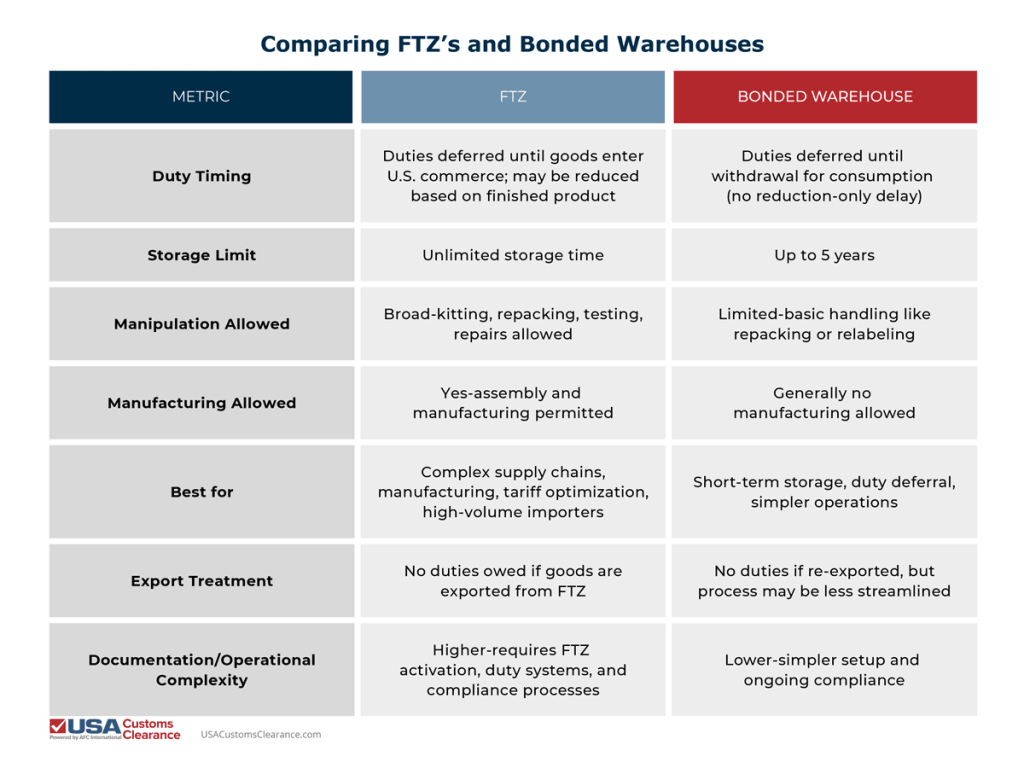
To provide clarity about the differences between a bonded warehouse and an FTZ, we’ve created a graphic comparing the two across different metrics.
If you’ve decided a bonded warehouse is the right choice for your importing and storage needs, you’ll need to know what to expect when depositing, storing, and retrieving your merchandise.
The process for storing and retrieving goods from a bonded warehouse can be broken down into three simple steps:
Each step requires importers to follow specific customs procedures.
CBP recognizes 11 classes of bonded warehouses. Some warehouses are dedicated to storing specific goods, such as grain, bulk liquids and even animals. As such, prior to admission, you should make sure your chosen warehouse is equipped to store your goods.
You’ll also need to use entry type 21-warehouse on your 7501 entry summary to indicate the shipment is intended for bonded storage.
Some products can only be stored in bonded warehouses that have been approved by the PGA in charge of regulating certain types of imported goods. Some common examples include:
The facility must meet the associated PGA’s regulatory standards to be suitable for warehousing these goods.
Note: Before choosing a bonded warehouse, you should confirm that the facility is approved for the product category, storage conditions, and any PGA requirements that apply to your goods.
The maximum allowable storage time for goods stored in a bonded warehouse is five years from the date of importation. During that time, you’ll need to follow two important rules:
Importers who want to manufacture in bond for the purposes of tariff shifting should store their goods in an appropriate Foreign Trade Zone.
When goods leave a bonded warehouse, the customs outcome depends on why the goods are withdrawn.
Withdrawal for consumption is the entry type associated with taking goods out of the bonded warehouse for sale or use in the U.S. market. Duties will come due at the time of withdrawal. As such, it is the most common reason to remove goods from a bonded warehouse, but not the only one.
If your goods are to be re-exported, duties will not be due since the goods never make it to the U.S. marketplace. The same holds true if you destroy your goods under CBP supervision.
A bonded warehouse is ideal when you want to defer duties, manage cash flow, store goods before sale, handle compliance delays, or re-export inventory. It’s especially useful for high-value imports, uncertain demand, or global distribution strategies requiring flexibility. To highlight its usefulness, we’ve provided some examples where they can be utilized.
Example 1:
A retailer imports holiday decorations months early and stores them in a bonded warehouse, delaying duties until inventory is released closer to peak selling season.
Example 2:
A food importer holds a shipment in a bonded warehouse while awaiting FDA clearance, avoiding duty payment until the goods are approved for entry.
Example 3:
A distributor imports electronics into a bonded warehouse and later ships a portion to international buyers, avoiding U.S. duties on goods that never enter domestic commerce.
There’s a variety of mistakes that importers often make that you should avoid, such as:
Keeping an eye out for these mistakes will help avoid serious problems that could arise in the future when using a bonded warehouse.
Need help deciding whether bonded storage is the right fit? Our licensed customs brokers can review your shipment, documentation status, PGA requirements, and withdrawal plan to help you choose between a bonded warehouse, FTZ, or immediate entry.
Call us at (855) 912-0406 or reach out to us on our contact page to find out how we can streamline your importing experience.
Sources
What is a Customs Bonded Warehouse?, U.S. Customs and Border Protection, November 2025
Detention & Hearing, U.S. Food and Drug Administration, revised October 2024
Classes of customs warehouses, Code of Federal Regulations, Title 19, Subsection 19.1, amended April 2026
Q: How long can I store my goods in a bonded warehouse?
A: Goods can be stored for up to five years after being imported.
Q: When do I pay duties on goods stored in bond?
A: Duties come due once the merchandise is withdrawn for consumption.
Q: What is the main difference between a bonded warehouse and an FTZ?A: Manufacturing processes cannot take place in a bonded warehouse, but they can in Foreign Trade Zones.
 Copy URL to Clipboard
Did you find this article helpful?
See more of our coverage on Google.
Add usacustomsclearance.com as a preferred source!
Add usacustomclearance.com as a preferred source!
See more of our coverage in Google's Top Stories.

Add your first comment to this post