
IOR ENFORCEMENT IS NOW IN EFFECT | REVIEW MY IOR




If you’re an importer looking for legal ways to defer duty and tariff payments, you may need to decide between a bonded warehouse vs FTZ. Making an informed decision between these two options requires knowledge of the features and advantages they offer, as well as their potential shortcomings. Our Licensed Customs Brokers offer invaluable consulting services for business owners putting together a profitable and compliant import strategy.
A bonded warehouse, also known as a customs warehouse, is a facility licensed or operated by US Customs and Border Protection (CBP) in which many imported goods can be stored for up to five years. While stored, importers don’t have to pay duties on the goods until they’re withdrawn for sale or consumption.
In an FTZ, importers can also store goods in the same fashion as a bonded warehouse, but with far more options available. Assembly and manufacturing processes that can’t be accomplished in a bonded warehouse can be performed within an FTZ, which opens up opportunities for savvy importers to not only defer duties, but sometimes pay a more preferable rate for finished products.
FTZs are also under the supervision of CBP and administered by the Foreign-Trade Zones Board (FTZB). Each of these options offer advantages to importers looking for ways to manage payment of certain customs fees.
Ultimately, FTZs are best for high-volume manufacturers and bonded warehouses are best for importers seeking to delay payment of duties and storage.
Related: Bonded Warehouses and Their Benefits for Importers
Some of the primary advantages of storing your goods in a bonded warehouse include:
Two limitations of customs warehouses worth mentioning are the maximum five-year storage time and limited options for manufacturing, kitting, and cleaning processes. Importers who need longer-term storage and the option to perform transformative manufacturing processes will find more of what they’re looking for in an FTZ.
In foreign trade zones, importers have a wide array of options available, not just storage. Some benefits of importing to a foreign trade zone are:
Like bonded warehouses, some goods regulated by PGAs can only be stored in an FTZ with special licensing or permission. It’s also important to note that neither option completely eliminates an importer’s responsibility to pay duties: however, they do give businesses the option of paying duties only once merchandise is withdrawn.
Related: What Is a Foreign Trade Zone?
When choosing between a foreign trade zone and a customs bonded warehouse, it’s important to start by identifying specific needs you have or suspect you’ll have regarding your imported goods. To assist with that process, I’ve put together a decision making table with some common hurdles importers need to overcome, along with how each facility can meet those needs.
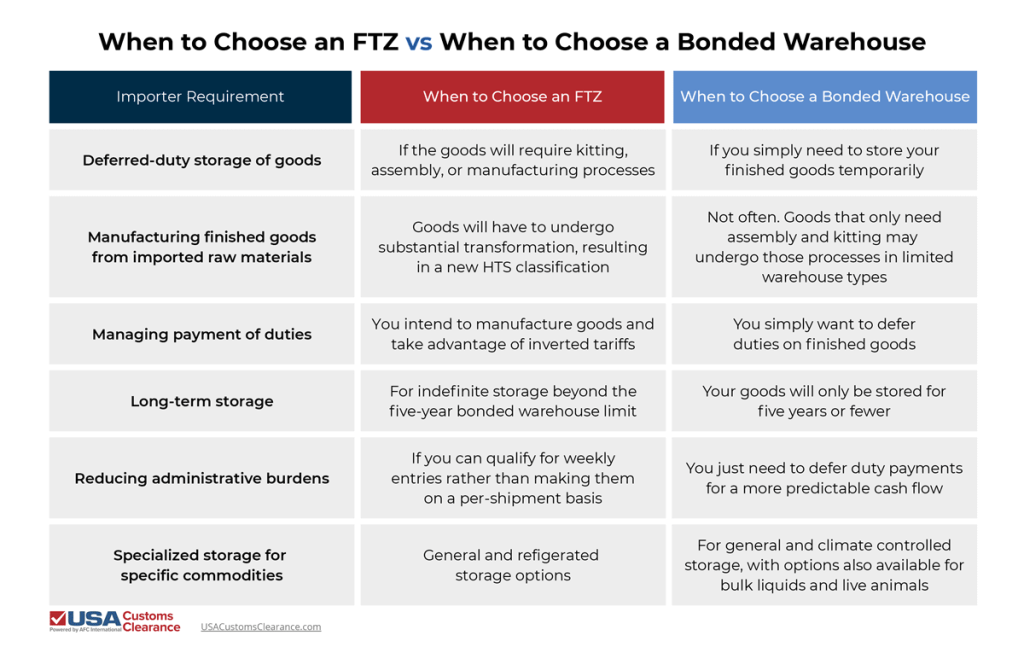
If you’re still unsure which option best suits your import strategy, our Licensed Customs Brokers offer expert consultations that will provide you with the knowledge you need to build a plan that meets your specific goals.
To better compare the differences between bounded warehouses and FTZs, let’s take a look at some examples of them in action. We’ll start with a bonded warehouse example.
A major retailer has imported seasonal goods six months before Christmas. Rather than pay the duties and fees on products they’re not ready to sell, they keep their goods stored in a bonded warehouse. The retailer removes the seasonal goods from the warehouses once they’re ready to stock their stores.
Here’s an example of an importer using a foreign trade zone.
Let’s say there’s a 3% tariff on car parts, but a 6% tariff on the raw materials used to make them. To avoid paying the 6% rate on the materials, an automotive company imports them into a foreign trade zone, where they’re manufactured into vehicle components. When the parts leave the foreign trade zone, the automotive company is only responsible for paying the 3% tariff.
Give us a call at (855) 912-0406 or submit a contact form online to get started on the path to trouble-free, compliant, and profitable importing.
 Copy URL to Clipboard
Did you find this article helpful?
See more of our coverage on Google.
Add usacustomsclearance.com as a preferred source!
Add usacustomclearance.com as a preferred source!
See more of our coverage in Google's Top Stories.
Sign up for VIP email alert access.
Licensed customs support for importers across a wide range of U.S. entry needs. USA Customs Clearance provides Customs Bonds, Consulting, Customs Brokerage, Manifest Confidentiality, Importer of Record support, and Guides & Resources to help importers prepare for U.S. Customs and Border Protection (CBP) requirements and customs clearance with regulatory compliance, greater clarity, and confidence.
With licensed broker support, transparent service information, and secure checkout, we help importers take the right next step.

We know the importing process and requirements can be confusing, but they don't have to be.
We're here to help.
When purchasing a product from our website, you can feel confident knowing our team can help if you accidentally select the wrong product. We'll guide you through the correct purchase and any applicable refund process.
Important Refund Policy Information
Eligible refunds are subject to a $50 processing fee, which will be deducted from your original purchase amount. Please allow up to 90 days for refunds to be processed, as refunds are handled quarterly by our Accounting Department.
Refunds are available only if you have not yet:
Additional Refund Terms
You have 90 days from the date of purchase to submit your bond application. After 90 days, bond fees are forfeited and are nonrefundable.
All eBook sales are final and nonrefundable.
Add your first comment to this post