
IOR ENFORCEMENT IS NOW IN EFFECT | REVIEW MY IOR




Tariff engineering refers to changing a product before importation so the finished product falls under a different tariff classification, and this guide is for importers, supply chain managers, and licensed customs brokers who want to reduce import duties while staying compliant with U.S. Customs and Border Protection (CBP) regulations.
Tariff engineering is an importing strategy that involves designing, manufacturing, or modifying products so they qualify them for reduced duties, a principle recognized in U.S. customs treatment when the imported article genuinely differs in its final form. This helps importers lower their overall import costs.
U.S. Customs and Border Protection (CBP) requires importers to pay tariffs, duties, and other customs expenses as these taxes are levied by the federal government.
Tariffs and duties are determined by factors like:
CBP monitors each shipment that comes into the U.S. and verifies these details to assess your import bill. The importer or their hired Licensed Customs Broker is solely responsible for the calculation of their import bill, which means inaccuracy can lead to overpaying or underpaying in tariffs and duties, the latter leading to potential CBP violations and penalties.
Tariff rates fluctuate based on the country the commodity is imported from. Importers who manufacture or produce goods in other countries may benefit from tariff engineering to lower their tax burden.
Tariff engineering is a legal strategy that changes a product before importation so the finished goods may qualify for a different tariff classification. This approach works only when the product itself has materially changed and the documentation supports the new classification.
In the next section, we’ll discuss when this strategy is an appropriate, CBP-compliant method to use to lower your import bill.
Tariff engineering is a legal method to alter a product’s design and manufacturing for lower tariff rates. It is not a method to amend a product’s tariff classification to any lower tariff rate.
CBP may penalize importers for negligent, grossly negligent, or fraudulent misstatements on entry documents. To reduce risk, importers should document why a product’s design change supports a new tariff classification.
Let’s take a look at scenarios when it’s appropriate to utilize this strategy.
Importers applying this strategy to their imported goods do so by altering the design of the product. These slight alterations in product design decisions include:
Importers can use our HTS Code Look Up Tool to easily find the appropriate HTS code for these new product alterations.
By making these small alterations, importers can lower their tariff burden by designing their product to legally fit in a different tariff classification or Free Trade Agreement (FTA), a preferential program between countries to reduce or eliminate tariffs.
Tariff engineering is a strategy that requires consistent or repeatable documentation to validate the imported goods’ tariff classification.
CBP requires the following importing documentation for all shipments:
Importers who apply this approach to their goods must be able to provide these customs documents with the same and accurate information for the product that was altered to fit a reduced tariff rate.
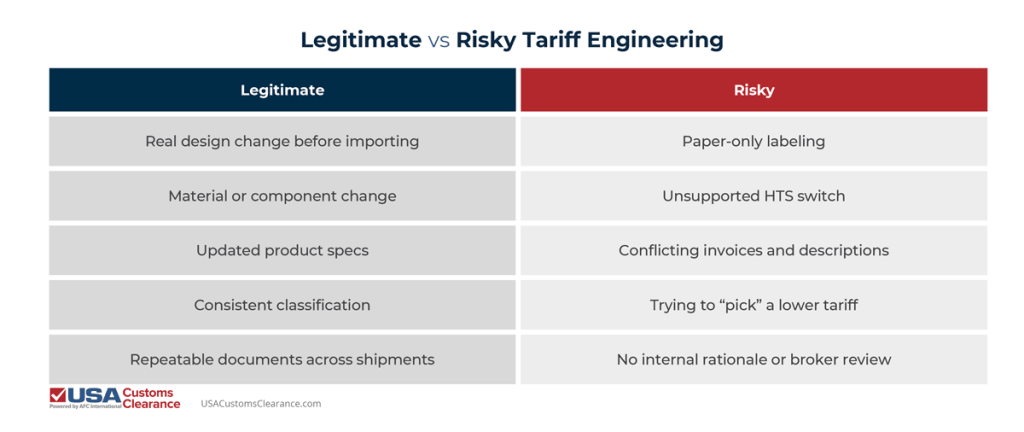
Tariff engineering is legitimate when an importer changes the product itself before importation and the finished product genuinely fits a different tariff classification. It becomes risky when the importer changes only the paperwork, description, or claimed classification without a real product change.
Legitimate tariff engineering usually involves a real design or production decision. That can include changing a component, swapping one material for another, adding or removing a feature, or altering the product’s construction in a way that changes how the finished product is classified under the tariff schedule. These changes must be commercially real, repeatable, and reflected in production records.
This strategy becomes risky when the importer changes the paperwork more than the product. If the imported item has not materially changed, but the importer tries to claim a lower-duty classification anyway, that moves from lawful planning into potential misclassification.
The biggest red flag is when the entry narrative says one thing, but the product’s actual characteristics say another.
We’ve provided a graphic that compares legitimate classification with risky classification.
Now that you understand the lawful approach, use this checklist to plan your next shipment:
If you need help reviewing a tariff strategy, the Licensed Customs Brokers at USA Customs Clearance can help.
You should obtain a Licensed Customs Broker when the classification outcome isn’t obvious, the duty difference is significant, or the product change sits close to the line between two provisions.
Broker review is especially useful when a product includes mixed materials, multiple functions, or design changes intended to support a lower-duty classification. Validating the approach before importation is usually easier and less costly than correcting entries after customs review.
The examples below show how product design and legal category definitions can affect tariff classification outcomes.
Let’s look into what changed in U.S. federal regulations for imported goods that led to these case examples.
In August 2025, the executive branch of the U.S. eliminated the CBP Section 321 programs for de minimis, a rule that allowed importers to ship goods to the U.S. duty free if the shipment’s value was $800 or less.
Now that shipments valued at $800 or less are subject to tariff taxes like any other high-value good, importers sought tariff rate strategies to lower their customs fees.
At USA Customs Clearance, we know navigating federal regulations is complex. You can rely on our Licensed Customs Brokers to help you find the correct HTS code and calculate your tariff rate to clear customs without breaking the bank.
Need help with tariff classification? The Licensed Customs Brokers at USA Customs Clearance are here to help. Call (855)-912-0406 to reach out to our team or submit your questions through our contact page. We’re happy to help you clear customs without the guesswork.
Sources:
 Copy URL to Clipboard
Did you find this article helpful?
See more of our coverage on Google.
Add usacustomsclearance.com as a preferred source!
Add usacustomclearance.com as a preferred source!
See more of our coverage in Google's Top Stories.
Licensed customs support for importers across a wide range of U.S. entry needs. USA Customs Clearance provides Customs Bonds, Consulting, Customs Brokerage, Manifest Confidentiality, Importer of Record support, and Guides & Resources to help importers prepare for U.S. Customs and Border Protection (CBP) requirements and customs clearance with regulatory compliance, greater clarity, and confidence.
With licensed broker support, transparent service information, and secure checkout, we help importers take the right next step.

We know the importing process and requirements can be confusing, but they don't have to be.
We're here to help.
When purchasing a product from our website, you can feel confident knowing our team can help if you accidentally select the wrong product. We'll guide you through the correct purchase and any applicable refund process.
Important Refund Policy Information
Eligible refunds are subject to a $50 processing fee, which will be deducted from your original purchase amount. Please allow up to 90 days for refunds to be processed, as refunds are handled quarterly by our Accounting Department.
Refunds are available only if you have not yet:
Additional Refund Terms
You have 90 days from the date of purchase to submit your bond application. After 90 days, bond fees are forfeited and are nonrefundable.
All eBook sales are final and nonrefundable.
Add your first comment to this post