
IOR ENFORCEMENT IS NOW IN EFFECT | REVIEW MY IOR




Type 86 was a Customs and Border Protection (CBP) entry option available to importers who brought shipments valued at $800 or less into the country. Under Type 86 entries, importers were able to avoid paying duties on a wide variety of merchandise. The $800 threshold was referred to as the de minimis value for Type 86 entries.
While Type 86 entries are no longer available due to 19 u.s.c. 1321(a)(2)(c) being overridden by an executive order in August 2025, understanding how it worked is still beneficial for importers as legal actions taken by businesses in the U.S. may eventually lead to the restoration of duty-free entries.
A Type 86 entry was an electronic customs entry filed with U.S. Customs and Border Protection (CBP) for low-value shipments that qualified for duty-free status under the Section 321 de minimis exemption in the Tariff Act of 1930.
For shipments to qualify as duty-free, the maximum value of the imported merchandise could not exceed $800.
For a shipment to be eligible for a Type 86 entry, the total valuation of the imported goods had to be no more than $800. It was not permitted for higher-value purchases to be broken down into shipments valued at or below the $800 threshold.
Eligibility also depended on admissibility. Goods that are regulated by Partner Government Agencies (PGA) or subject to trade remedies and tariff quotas might not have been eligible for Type 86 entry.
For example, highly regulated imports, such as plants regulated by the U.S. Dairy Administration’s Animal and Plant Health Inspection Service (APHIS) were often excluded from Type 86 entries since they require more intense inspections than average consumer goods.
In practice, importers used Type 86 entries for shipments sent through standard post rather than freight shipping. While no limitation on weight and size was specified for Type 86 shipments, the United States Postal Service (USPS) usually limits parcels to a weight of approximately 70 lbs.
USPS weight limits made it less than ideal to use Type 86 for large, bulky shipments even if they were at or below the $800 threshold. Small goods that could be easily shipped in parcels were more suitable for this entry type.
As mentioned previously, products under PGA regulations were sometimes not permitted to enter the U.S. under entry Type 86 due to the potentially dangerous nature of those products.
Examples include:
These items require importers to hold a customs bond and were therefore often subject to formal entries rather than being permitted under Type 86.
Type 86 data quality mattered because CBP evaluated low-value filings for both eligibility and admissibility, not just declared value.
While these entries were less complex than formal entries, they were still required to be accompanied by documentation showing information such as:
U.S. Customs and Border Protection often found this information missing or lacking on Type 86 entries. If those entries become available again, importers should have the following specific information regarding the shipment in question.
The parties that needed to be identified on a Type 86 entry were the consignee (usually the buyer of the products) and the seller.
Additional details required from the consignee were:
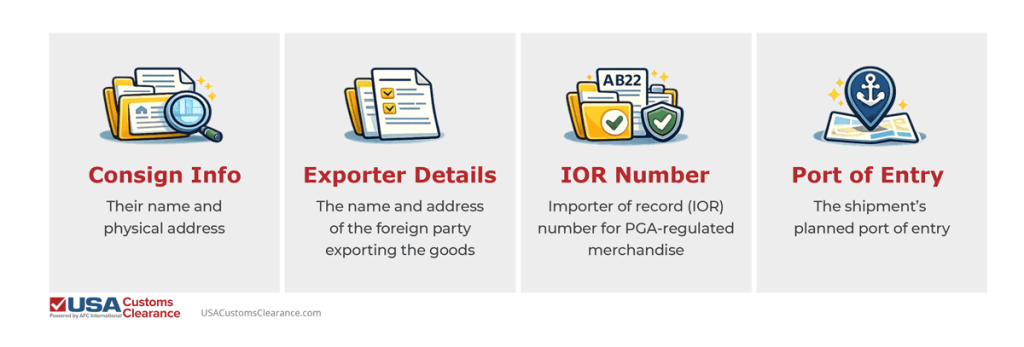
Failure to include these details caused some shipments to be held without release.
Type 86 filings generally required the full 10-digit Harmonized Tariff Schedule (HTS) classification, even though traditional Section 321 releases did not require it. The goods also required a product description more detailed than simply “shirt” or “shoes”.
The HTS has thousands of codes, and importers who don’t follow the General Rules of Interpretation precisely run the risk of misclassifying their imports. This was also true of Type 86 entries. For instance, computer monitors can be classified under several different codes based on the diagonal measurements of their screens.
Even an honest mistake in the HTS classification process can lead to punitive actions from U.S. CBP. Partnering with an experienced customs broker significantly reduces the chances of making expensive mistakes while importing.
The last three data points required on Type 86 entries were:
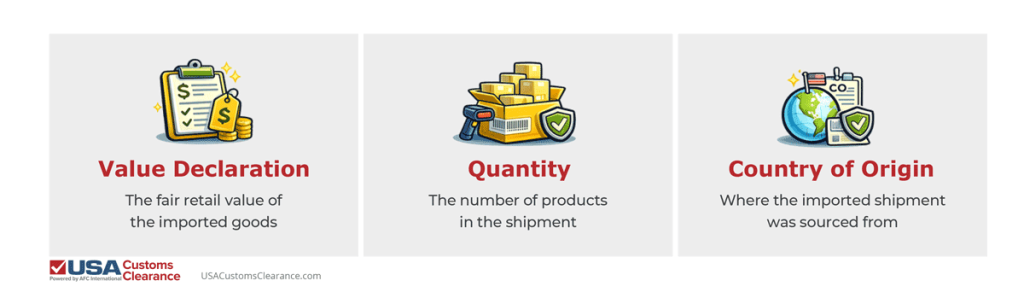
Type 86 entries that did not have the correct information and documentation ran the risk of rejection by CBP.
Type 86 did not eliminate compliance review. CBP still screened these filing for accuracy, consistency, and admissibility. Erroneous or missing information could lead to rejected filings and CBP refusing to release the shipment.
Below are several of the most common reasons CBP would reject a Type 86 entry.
Type 86 entries relied on several key shipment data points. This includes valuation and consignee information used to determine whether a shipment was eligible for the Section 321 de minimis exemption.
If these details conflicted with the commercial invoice, packing list, or carrier manifest, CBP may have flagged the entry for hold or inspection just as they would a formal entry with similar problems.
Some of the most recurring data mismatch issues included:
CBP didn’t always require a commercial invoice on Type 86 entries, but importers were still expected to have a reliable basis for valuing their shipments.
Preventing these issues is usually a simple matter of double-checking all of your documentation for accuracy prior to submission. Consistency across shipping and customs documents is crucial to ensure trouble-free customs clearance.
Some Type 86 entries contained goods that could not be released under Section 321. CBP could reject or reroute the filing if the goods were regulated by a PGA and required permits, licenses, certifications, or additional agency data.
Other admissibility problems were:
Since these goods required more documentation than standard shipments, they usually didn’t qualify for the Type 86 process.
Preventing an admissibility issue isn’t difficult if you research your imported goods thoroughly beforehand. Find out if a PGA regulates the items in question and get the necessary permits before you start the transaction, and use the International Trade Commission’s AD/CVD proceeding’s page to find out if your goods are subject to these increased duties.
Insufficient product descriptions can easily trigger a shipment hold by CBP. Some examples of an insufficient description are:
A useful product description answers three basic customs questions:
Additionally, using the wrong HTS code to classify your merchandise can cause problems during customs clearance. Type 86 entries required the full 10-digit HTS code associated with the product, and using the wrong code is an easy mistake to make given the complexity of the Harmonized Tariff Schedule.
To ensure your product description is sufficient, include details from your supplier’s specifications. If you’re uncertain as to which HTS code to use, your best option is to consult with a Licensed Customs Broker.
Importers must now use formal or informal entry types based on shipment value, PGA regulation, and AD/CVD applicability, as no duty-free alternative to Type 86 currently exists.
There are still legal ways to minimize duties. A Free Trade Agreement(FTA) is a legally binding treaty between one or more nations that gives importers the opportunity to import goods at reduced rates of duty, sometimes with no duties owed whatsoever. The United States-Mexico-Canada Agreement (USMCA) is an FTA frequently used by U.S. importers purchasing goods from these two vital trade partners.
To take advantage of these opportunities, you’ll need assistance from a Licensed Customs Broker who is familiar with the intricacies of the many trade agreements the U.S. shares with its trading partners.
Reach out to us at (855) 912-0406 or reach out to us on our contact page to find out how you can save money on your imported shipments regardless of Type 86 entries being unavailable.
Are Type 86 entries still available to U.S. importers?
No, they were done away with by executive orders from the president in August 2025.
What was the maximum value allowed for a shipment to be cleared under Type 86?
The maximum value for these shipments was $800.
Sources
Administrative Exemption on Value Increased for Certain Articles, Code of Federal Regulations, 8/26/2016
Fact Sheet: Entry Type 86 Guidance, U.S. Customs and Border Protection, 4/8/2024
Parcel Size, Weight & Fee Standards, United State Postal Service, 2026
Harmonized Tariff Schedule, United States International Trade Commission, revised 2026
Data Visualization: ADCVD Proceedings, International Trade Commission
 Copy URL to Clipboard
Did you find this article helpful?
See more of our coverage on Google.
Add usacustomsclearance.com as a preferred source!
Add usacustomclearance.com as a preferred source!
See more of our coverage in Google's Top Stories.
Licensed customs support for importers across a wide range of U.S. entry needs. USA Customs Clearance provides Customs Bonds, Consulting, Customs Brokerage, Manifest Confidentiality, Importer of Record support, and Guides & Resources to help importers prepare for U.S. Customs and Border Protection (CBP) requirements and customs clearance with regulatory compliance, greater clarity, and confidence.
With licensed broker support, transparent service information, and secure checkout, we help importers take the right next step.

Add your first comment to this post