
IOR ENFORCEMENT BEGINS SEPTEMBER 18 | REVIEW MY IOR NOW


In This Article:


Incoterms® are internationally recognized trade rules that are important for international transactions because they help determine responsibilities between buyers and sellers. By assigning these responsibilities before a shipment begins, Incoterms® help reduce misunderstandings and risk between importers and exporters.
Incoterms® are intentionally recognized trade rules that define the responsibilities of buyers and sellers during international transactions. This helps buyers and sellers reduce misunderstandings, manage risk, and clearly identify their responsibilities.
The ICC created and published Incoterms® in order to set clear-cut rules that outline how sellers and buyers should conduct themselves during the importing process. There are many important ways that Incoterms® are used to facilitate smooth and easy trade.
Incoterms clarify responsibilities by defining which party handles specific costs and obligations during an international shipment.
Depending on the chosen term, the buyer or seller may be responsible for:
Who takes responsibility for certain tasks at different points in the transaction varies between Incoterms®. Since there are a variety of Incoterms® to choose from, sellers and buyers have the ability to negotiate and select the one that’s most beneficial for their transaction. However, because there are so many options available, it’s usually a good idea to work with a customs broker to help you find the best one for your transaction.
Incoterms® provide standardized trade rules that buyers and sellers can use across different countries, cultures, and languages. Because the terms are globally recognized, both parties can use the same framework to discuss responsibilities and reduce communication errors.
Universal acceptance of Incoterms® also makes negotiation between buyers and sellers easier because both parties will already have a basic understanding of how each term functions.
Incoterms® reduce risk by defining when responsibility for goods transfers between buyer and seller and who must arrange insurance when required. Clear allocation of these responsibilities helps both parties understand who bears certain risks if goods are damaged or lost during transit.
Incoterms® help buyers and sellers estimate which transportation, customs, insurance, and logistics costs they will be responsible for paying. Knowing these costs in advance allow the seller and buyer to more easily assess what they will be spending based on the Incoterms® chosen.
The buyer and seller can use that information to guide their decision on which Incoterms® to settle on.
Incoterms® help manage shipments by assigning responsibility for specific transportation tasks and costs to either the buyer or seller. The selected term can determine who arranges transportation, pays shipping expenses, handles customs requirements, and manages other stages of the shipment.
Picking Incoterms® that are most beneficial to you as an importer is extremely important. Our Licensed Customs Brokers can look at your situation and help you pick the best ones.
Incoterms® are applied throughout all three parts of the import/export process. During the importing/exporting process, the sellers and buyers have to perform their unique duties dictated by the Incoterms® that they chose for the transaction.
The pre-carriage stage is the first part of the importing/exporting process. During this process, the goods being shipped must be moved from their starting point to the location where they'll be loaded onto a transport vehicle.
Moving goods from their starting point to the airport or ocean port for loading costs money. The Incoterms® that are decided on for the transaction dictate who’s responsible for paying these costs.
Once the goods arrive at the airport or ocean port, the seller and buyer have to determine who will pay to have the goods loaded. It costs money to store goods onto a plane or cargo ship for transport.
When these costs are paid and the goods are loaded, there will likely be additional surcharges throughout the duration of the journey. Incoterms® determine who pays the loading costs and surcharges when they’re applied.
Most countries don’t let cargo into their borders without some sort of Customs paperwork accompanying it. Goods that don’t make customs are usually held there until proper requirements are met or when the goods are disposed of.
As with the parts of the import/export process, Incoterms® dictate whether the seller or buyer will cover applicable costs that will ensure goods are cleared by Customs. This means that the party responsible for clearing the import through Customs will need to provide the proper documentation for Customs and Border Protection (CBP).
In total, there are 11 different types of Incoterms® that set out guidelines for sellers and buyers to follow. Incoterms® are separated into two different categories.
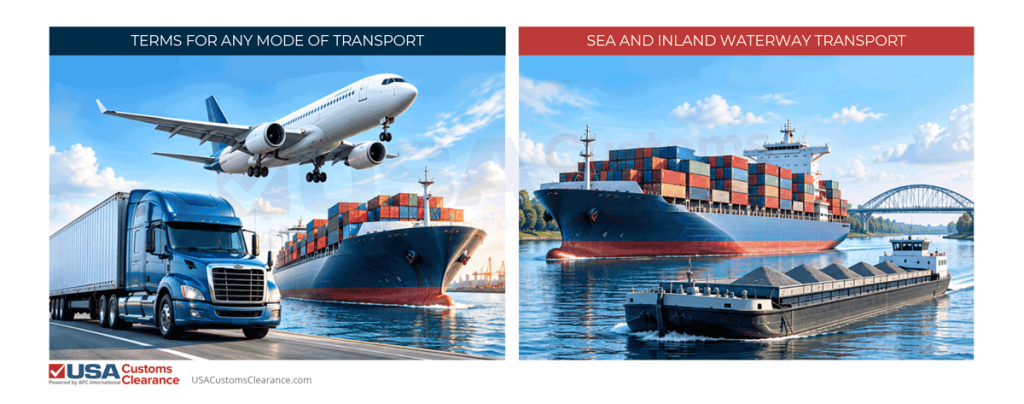
Seven Incoterms® can be used with any mode of transportation, while four can only be used for inland waterway and ocean transport. We’ll list the Incoterms® for each category and explain their intricacies in the following sections.
The first category of Incoterms® applies to any mode of transport. As the name implies, these terms can be used regardless of the method of transportation the buyer and seller agree to use for the goods.
There are seven Incoterms® in this category:
Since they can be used for any mode of transport, they provide buyers and sellers more flexibility in their transactions.
The last four Incoterms® can only be used for imports arriving by sea or inland waterway transport. The Incoterms® in this category of transportation are:
To learn more about the specificities of these 11 Incoterms®, consult our article that discusses each one and how they work.
Common Incoterms® mistakes include confusing ownership with risk, using DDP incorrectly, selecting a term for the wrong transport mode, using different Incoterms® versions, and failing to specify an exact definition.
Incoterms® don’t regulate the passing of ownership (title) between buyer and seller. They’re only responsible for determining who’s responsible for risk at certain points in a transaction and when it transfers to the other party.
The DDP Incoterm® places nearly all responsibility for a transaction on the seller. This includes covering import costs, duties, and being familiar with import regulations. The process for paying import expenses and adhering to customs regulations can vary based on the buyer’s country.
Sellers unfamiliar with the importing protocols in another country can make DDP a bad choice for an international transaction.
Incoterms® are separated by the mode of transportation that they’re used for; such as FOB being used for any type of transport shipment. Despite this distinction, certain Incoterms® have fairly similar definitions that can often confuse sellers and buyers.
For example, the CIF and CIP Incoterms® each apply to different modes of transportation. Each of them has fairly similar descriptions that buyers and sellers mix up. Unfortunately, confusion like this can cause unnecessary costs for both sellers and buyers during the importing process.
Incoterms® are updated every 10 years, with the most current form being the 2020 version. Buyers and sellers can still use 2010 Incoterms® or older versions. Unfortunately, there are occasions where each party uses a different iteration of Incoterms® for their transaction. That’s why it’s essential you and the seller you’re transacting with are using the same version.
When sellers and buyers have agreed to use certain Incoterms®, the buyer must provide the exact location the goods need to be delivered to. Incoterms® like FOB need extremely specific details about the delivery location.
If the destination is not provided or is recorded incorrectly, then the imported goods can arrive at the wrong destination, or not at all. This will cause an unnecessary delay.
It can be difficult figuring out which Incoterms® work best for you. Thankfully, customs brokers can help you quickly identify which one is best for your unique importing situation.
Incoterms® aren’t mandatory, but they are beneficial for both sellers and buyers in international trade. The decision to use these rules comes down to the preferences of the buyer and seller that are involved.
It’s certainly advisable to use Incoterms® conditions for an international shipment. Without designating specific rules and conditions of a shipment, accountability is left up in the air. This can lead to disputes and other problems when trying to reconcile damages or loss. Language barriers can also lead to communication issues between buyers and sellers.
Some advantages of Incoterms® that will help importers overcome these challenges include:
Despite not being required, it’s best to use these terms when importing goods from a seller from overseas.
In our many years of experience, we’ve encountered many importers that have no idea that Incoterms® exist or the importance of using them; especially first-time importers. At USA Customs Clearance, we can show you why it’s so important to use Incoterms® for any international transaction you enter into.
We can also answer any questions that you might have regarding Incoterms® and consult you through the negotiation process with a seller. Our team of Licensed Customs Brokers has an extensive amount of experience that will be invaluable to you.
For answers to any other customs clearance-related questions, reach out to our team. They will be able to answer them and help you determine your next step in the importing process.
 Copy URL to Clipboard
Did you find this article helpful?
See more of our coverage on Google.
Add usacustomsclearance.com as a preferred source!
Add usacustomclearance.com as a preferred source!
See more of our coverage in Google's Top Stories.
Licensed customs support for importers across a wide range of U.S. entry needs. USA Customs Clearance provides Customs Bonds, Consulting, Customs Brokerage, Manifest Confidentiality, Importer of Record support, and Guides & Resources to help importers prepare for U.S. Customs and Border Protection (CBP) requirements and customs clearance with regulatory compliance, greater clarity, and confidence.
With licensed broker support, transparent service information, and secure checkout, we help importers take the right next step.

Add your first comment to this post