
IOR ENFORCEMENT IS NOW IN EFFECT | REVIEW MY IOR


In This Article:


Canadian customs brokerage is the service of preparing, submitting, and managing import-entry paperwork, tariff classification, duties, and compliance requirements for goods entering Canada. Importers can clear goods themselves, but many hire a customs broker to reduce errors, avoid delays, and manage Canada Border Service Agency (CBSA) requirements.
Canadian customs brokerage is a service provided by professionals authorized to perform customs work such as inspecting and submitting import documentation on behalf of their clients, which are usually importers.
A Canadian customs broker performs customs work on behalf of clients, such as import/export businesses. This work includes submitting documents and remitting duties to the CBSA, classifying commodities for the purposes of calculating tariffs, and interpreting the dense legal language of pertinent trade agreements like the Canada-United States-Mexico Agreement (CUSMA).
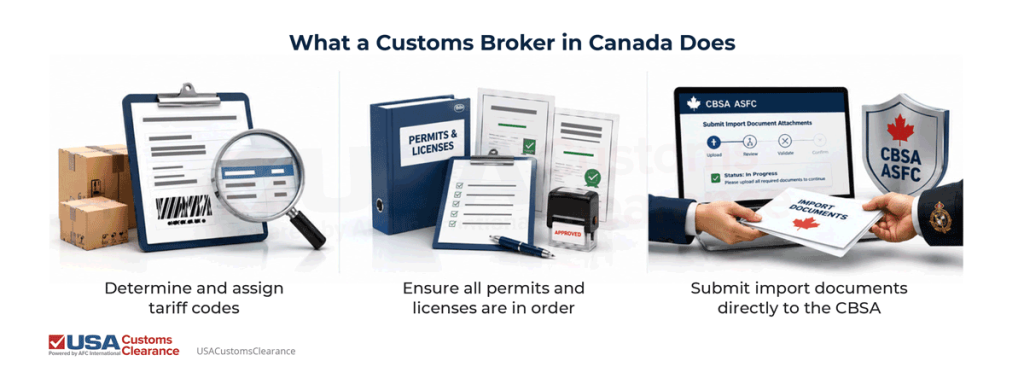
According to the CBSA, importers can clear their own goods or authorize a customs broker to act on their behalf. However, Canadian importers often choose to work through a broker due to their expertise in the complexities of customs documents, regulations, and procedures.
For example, a common reason for an importer in Canada to hire a customs broker is to ensure the correct tariff classification for imported goods. The Canadian Customs Tariff contains commodity classification codes that also denote rates of duty, and importers who use the wrong code on importing documents risk fines assessed under the Administrative Monetary Penalty System (AMPS).
You should hire a Canadian customs broker when your shipments involve complex tariff classification, regulated goods, duty relief claims, CUSMA origin issues, or recurring entries that require accurate accounting and CBSA compliance.
Here’s an importing scenario where hiring a Canadian customs broker might be helpful:
A Toronto apparel importer bringing in mixed-fabric garments needs to classify their imports, confirm origin treatment under CUSMA, and file the required data through the CBSA Assessment and Revenue Management (CARM) system. The slightest error can change the duty rate and trigger penalties, document corrections, or shipment delays from the CBSA or other relevant government agencies.
In Canada, a pre-arrival notice (BF732) is one of the most common documents associated with importing. Its function is similar to that of the Importer Security Filing (ISF) used in the U.S., though more parties are involved in filling out the pre-arrival notice.
The submission deadline for form BF732 varies according to the mode of transportation and the role of the individual submitting the form:
Other documents and requirements that Canadian importers need to be familiar with include the following:
Canada also has several participating government agencies (PGAs) that regulate specific commodity classes and require additional paperwork or licensure.
Customs brokerage fees and import taxes are calculated based on factors like the type of goods being imported, their value, and the complexity of the shipment.
Common influencing factors include:
Importers remit their customs fees to the CBSA through the CARM portal, which is comparable to the Automated Commercial Environment (ACE) used by U.S. Customs and Border Protection (CBP).
CARM changes Canadian import accounting by shifting more responsibility for accounting, payment, and financial security from brokers to importers.
Certain tasks, like posting of customs bonds (known in Canada as a financial security agreement) must be handled directly by the importer rather than an outside service.
Changes to the Release Prior to Payment Program (RPP):
Before CARM was fully implemented, it was common for importers to have a third party, such as a customs broker, use their credentials on behalf of the importer and secure clearance of goods before a full accounting of duties was completed.
This is known as the Release Prior to Payment (RPP) program and was set up so businesses could post financial securities that show they have the calculated duties for a shipment covered.
Importers in Canada must fulfill the following responsibilities with respect to the RPP program:
CARM was designed to integrate with financial systems, facilitating a simple process for remitting duties. The CARM portal also gives importers access to dispute resolution solutions and provides real-time visibility on current import transactions.
When choosing a Canadian customs broker, importers should verify the broker’s authorization status, industry experience, commodity specialization, and familiarity with CARM processes. It is also important to compare service fees, communication standards, and the broker’s ability to manage complex entries, duty relief claims, or regulated imports.
If you have questions about importing goods into Canada, call us at (855) 912-0406 or fill out a contact form online today.
Sources
Import Commercial Goods Into Canada, Canada Border Services Agency, Government of Canada
Customs Tariff 2026, Canada Border Services Agency, Government of Canada
MEMORANDUM D1-4-1, In Brief, CBSA Invoice Requirements, Canada Border Services Agency
Requirements by Client Type, Canada Border Services Agency, Government of Canada
Permits, Licenses, and Regulations, Government of Canada
 Copy URL to Clipboard
Did you find this article helpful?
See more of our coverage on Google.
Add usacustomsclearance.com as a preferred source!
Add usacustomclearance.com as a preferred source!
See more of our coverage in Google's Top Stories.
Licensed customs support for importers across a wide range of U.S. entry needs. USA Customs Clearance provides Customs Bonds, Consulting, Customs Brokerage, Manifest Confidentiality, Importer of Record support, and Guides & Resources to help importers prepare for U.S. Customs and Border Protection (CBP) requirements and customs clearance with regulatory compliance, greater clarity, and confidence.
With licensed broker support, transparent service information, and secure checkout, we help importers take the right next step.

Add your first comment to this post