IMPORT TARIFFS - LATEST NEWS & UPDATES

CBP Entry Types Explained: Find Your Entry

Author Photo
Written by Jacob Lee
A cargo ship bringing in containers to a port. This image is relevant, because many entry types travel aboard a vessel.

In This Article:

google G icon logo

Did you find this article helpful?

See more of our coverage on Google.

Add usacustomsclearance.com as a preferred source!

Key Takeaways:
Not sure which CBP entry type you need? Use this step-by-step guide to match your shipment purpose, triggers like quota or AD/CVD, and required documents to find the right entry type.

An import entry type is-a U.S. Customs and Border Protection (CBP) code that tells CBP what kind of entry you are filing and why the goods are entering the United States. Common entry types include consumption, storage in a bonded warehouse, admission to a Foreign Trade Zone, or movement in-bond to another port. CBP uses the entry type to route your filing, determine what rules apply, and validate required data in the Automated Commercial Environment (ACE). 

This guide is for importers, eCommerce sellers, logistics teams, and compliance managers who need a practical decision path to identify the most likely CBP entry type for a shipment, understand the triggers that can force a different entry type, and prepare the minimum documents and data a broker or self-filer will need.

Key takeaways

  • Your entry type decision starts with the purpose of your shipment.
  • Certain entry triggers can override your default choice, especially quota/visa requirements and antidumping/countervailing duties (AD/CVD) exposure.
  • As of Aug. 29, 2025, the United States suspended duty-free de minimis treatment under Section 321 for shipments entering the country, changing how importers must enter and assess many low-value parcels.
  • The fastest way to avoid delays is to confirm value and channel, regulatory flags, and by providing accurate documentation.

Now, let’s walk through the decision guide and then map the most common situations to the entry types you’ll see in real-world filings.

30 Minute Licensed Expert Consulting Will Personally Guide You
USA CUSTOMS CLEARANCE
Get the Correct CBP Entry Type

Our Expert Licensed Customs Brokers take your shipment purpose and product details and then verify the correct CBP entry type so your entry isn’t delayed or rejected. Quick initial review-no obligation.

Confirm Entry Type >

Your Decision Guide

Identifying the purpose of your shipment, different entry triggers, and the value and channel your freight travels will help you determine the best entry type for your imports. 

Shipment Purpose

There are four shipment purposes an entry will fulfill when it comes into the United States. 

  1. Goods are entering U.S. commerce immediately.
    1. Applies to goods for sale, distribution manufacturing, or use in the U.S..
    2. Typically qualifies as a Consumption entry.
  2. The importer will store the goods before consumption.
    1. Applies when you want to defer duty payment, stage inventory, or support re-export workflows.
    2. Typically qualifies as a Warehouse entry.
  3. Goods moving under CBP control to another port or exporting without entering commerce.
    1. Typically qualifies as a Transportation & Exportation entry.
  4. Goods are entering temporarily without duty for an approved temporary use.
    1. Typically qualifies as a Temporary Importation Under Bond (TIB) entry.

Determining the purpose of your import will narrow down your option of entry types and make selecting the correct one easier. 

Different Entry Triggers

Even if your entry type seems obvious after narrowing down your options, you should still consider what could trigger a different entry type. 

  • Quota or Visa-Controlled Commodity: Some products require quota reporting or visa documentation, which can move you toward a Consumption—Quota/Visa entry. 
  • Subject to AD/CVD: If the goods are within the scope of an AD/CVD order, the import may require Consumption—AD/CVD entry. 
  • Foreign Trade Zone (FTZ): If the goods relate to FTZ admission or consumption processes, the importer will use an FTZ entry.

If a trigger applies to your imports, treat your entry type as tentative until you’ve validated the eligibility of your goods. 

Confirm Value and Shipping Channel

The value of your goods and method of transportation can influence whether your goods should be handled as a formal or informal entry. A formal entry is an import with a value of $2,500 or more and is typically covered by a customs bond. Most formal entries come into the U.S. on an ocean vessel, air transport, or rail. 

An informal entry is an import that has a value below $2,500. These entries typically come to the U.S. via postal or express courier. 

Find Your Entry Type

We’ve provided an entry type decision table to help you find the one you need. 
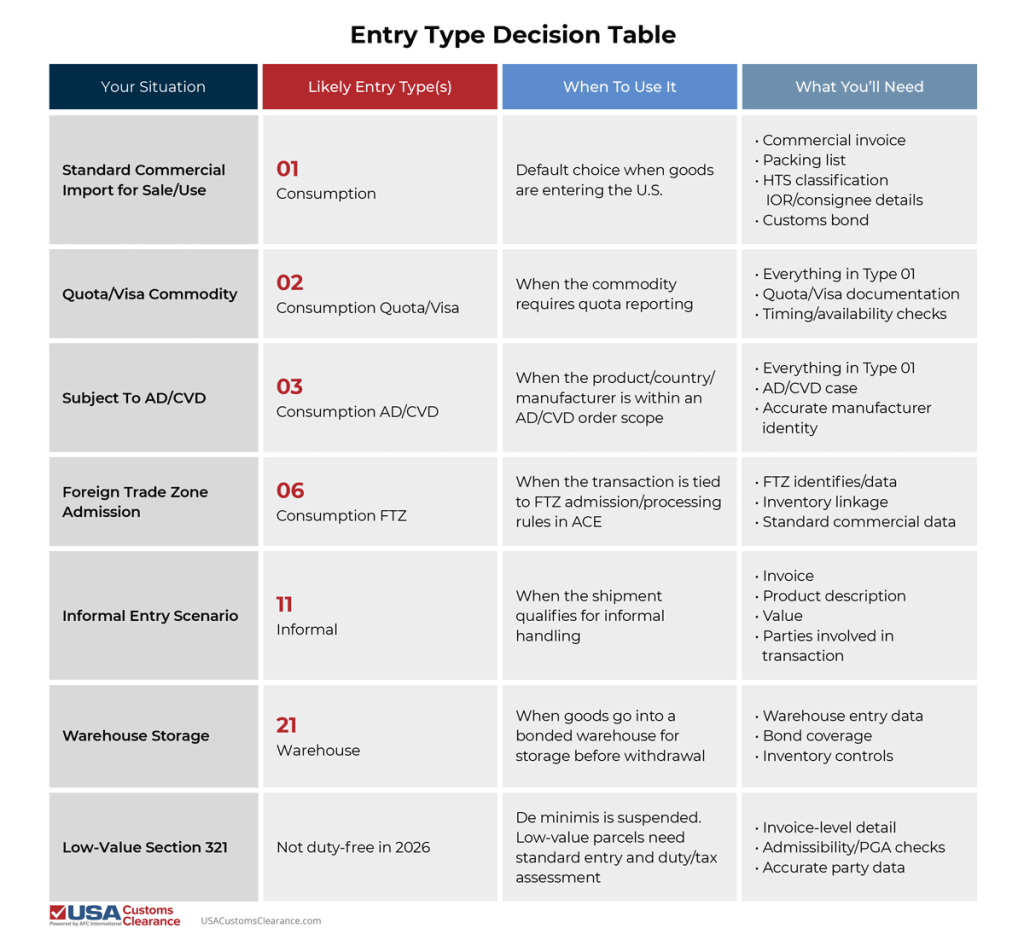
The graphic shows an entry type decision table. The table is relevant because it will guide readers to the entry type they require. The column starting from the left lists an importer's situation, the next column lists the corresponding entry type, the next column lists when to use it, and final column lists what importers will need.

Disclaimer: These are the most common entry types that importers use. We've broken down the other variants categorically in the following sections.

Types of Entries

To find your entry, you’ll need to know which one to use. We’ll break down the different types in the following section. 

Consumption

A consumption entry is a type of entry used when products enter for us in the U.S. and go directly into the country’s commerce without any restrictions of time or use placed on them.

Here are the different types of consumption entries:

  • Type 01 - Consumption: This is a baseline consumption entry for goods going directly into U.S. commerce. 
  • Type 02 - Consumption Quota/Visa: This is a consumption entry for goods that are entering the U.S. that are subject to import quotas.
  • Type 03 - Consumption AD/CVD: This is a consumption entry for goods subject to AD and CVDs. 
  • Type 06 - Consumption FTZ: This is a consumption entry for goods that will spend time in a FTZ. 

Best use:

Consumption entries are best for goods intended for sale or distribution in the U.S., manufacturing, or capital equipment and business-use imports. 

Warehouse

A warehouse entry is an entry used to place imported merchandise into a bonded warehouse. You should select this entry type when you want to defer the payment of duties on your goods to a later date. 

Types of warehouse entries include:

  • Type 21 - Warehouse is a standard entry for goods going into a bonded warehouse
  • Type 22 - Re Warehouse is an entry used to transfer goods from one bonded warehouse to another.
  • Type 31 - Warehouse Withdrawal Consumption is an entry for the withdrawal for goods subject to quota considerations. 
  • Type 32 - Warehouse Withdrawal Quota is an entry for the withdrawal for goods subject to quota considerations. 
  • Type 34 - Warehouse Withdrawal - AD/CVD is an entry for the withdrawal for goods subject to antidumping/countervailing duties (AD/CVD). 
  • Type 38 - Warehouse Withdrawal AD/CVD and Quota/Visa Combination is an entry for the withdrawal combining AD/CVD with quota/visa-related conditions (as applicable).

Best use:

The warehouse entry is perfect for staging seasonal inventory or holding goods while resolving labeling and admissibility disputes. 

Transportation & Exportation, Immediate Transportation, and Immediate Exportation

Transportation & Exportation (T&E), Immediate Transportation (IT), and Immediate Exportation (IE) are a set of entry movements that are part of the in-bond entry family. 

Here’s what sets them apart:

  • Type 61 - IT is an entry type that allows cargo to move under bond from the first U.S. port of arrival to another port where filling for the formal entry occurs.
  • Type 62 - T&E is an entry type that allows importers to move cargo under bond from one U.S. port and export it from a different U.S. port without entering the country for commerce.
  • Type 63 - IE is an entry type that exports cargo directly from the U.S. port where it arrives. 

Best use:

Type 61 is best for high-volume goods or industrial parts and components moving to a U.S. plant or hub. Use a Type 62 entry when you need to export goods that are destined for another country. Finally, use the Type 63 for time-sensitive export-connections or cargo that’s already booked to export. 

Temporary Importation Under Bond

A Type 23 TIB import is a type of entry that allows goods to enter the U.S. without payment of duties. Imports entering with a TIB cannot be sold and must be re-exported or destroyed at a specified time. 

Best use: The TIB entry is a great option when you’re importing goods for trade show booths, machinery for testing, or product samples

Other Entry Types

There are some lesser known entry types that you may encounter as well. They tend to show up when you’re using special programs, closing out previously filed entries, or importing under government/defense procurement workflows. 

  • Type 08 - Duty Deferral is a program entry type used when claiming duty deferral treatment under eligible frameworks. 
  • Type 09 - Reconciliation Summary is a filing that allows importers to flag data elements at the time of entry and submit the final, corrected values.
  • Type 11 - Informal is an entry type used for shipments handled under informal entry processing. 
  • Type 12 - Informal Quota/Visa is an entry type used for shipments that fit the informal process, but the commodity requires quota and or visa handling. 
  • Type 47 - Drawback is an ACE filing code for drawback claims.
  • Type 51 - Defense Contract Administration service Region (DCASR) is an entry type for goods imported on behalf of the Department of Defense (DoD). 
  • Type 52 - Government - Dutiable is an entry type used for government transactions that are treated as dutiable and filed under government-related entry processes. 
  • Type 86 - De Minimis is an entry type that was used for low-value shipments, but was eliminated on August 29th, 2025

While they’re less common, you should take a careful look at your imports to ensure these types don’t apply to your goods. 

30 Minute Licensed Expert Consulting Will Personally Guide You
USA CUSTOMS CLEARANCE
Get the Correct Filing Documents

Our Expert Licensed Customs Brokers give you the exact documents and data fields you need for your entry type before arrival. Quick initial review- no obligation.

Ready for Consultation >

What You’ll Need for Each Entry

Regardless of which entry applies to your imports, you’ll need to have a variety of import documents and data points ready. 

This includes:

  • Commercial invoice: This document has an accurate description, value, currency, and terms of the buyer and seller.
  • Packing list: Contains much of the same information included on the commercial invoice. 
  • Bill of lading (BoL) or Air waybill: The BoL is used for ocean shipments while the air waybill is used for imports traveling by air. 
  • Harmonized Tariff Schedule (HTS) Classification: A 10-digit code used to assess duties on your goods.
  • Party Data: Importer of Record (IOR), consignee, manufacturer/supplier.
  • Country of Origin: Where your products originate
  • Bond Information: The type of customs bond you’re using

Nearly every type of import will require these documents and data elements to successfully make into the country. 

Common Entry Mistakes To Avoid

Having so many entry types to choose from can increase your risk of picking the wrong one. We’ve provided a list of the common entry mistakes made by importers. 

  • Picking Type 01 by default:
    • While most goods enter the U.S. for consumption, you should consider the multiple consumption entries that could apply to your goods.
  • Missing country of origin or manufacturer information:
    • This information is essential for determining the duties, tariffs, and AD/CVDs that apply to your goods. 
  • Underestimating in-bond complexity:
    • Not strictly adhering to the terms of your bond can lead to penalties from CBP.
  • Using outdated assumptions about de minimis:
    • De minimis no longer applies, which means you’ll still need to pay duties on goods that are under $800. 

For the best compliance results, consider hiring a Licensed Customs Brokers to ensure your goods enter the country smoothly. 

Pick the Correct Entry Type with USA Customs Clearance

What we do:

  1. Collect basic information about your shipment. 
  2. Confirm the purpose of your imports
  3. Screen for entry type triggers
  4. Validate whether your import needs informal or formal handling
  5. Tell you exactly what documents you’ll need. 
  6. Deliver a recommendation for the entry type you need and steps to file

Timeline: We start researching your imports the same business day. 

What you’ll need: The import documentation we’ve already discussed that we can also help you obtain. 

Why choose us: Our team of Licensed Customs Brokers have 90 years of combined experience. Their knowledge leads to accurate and effective results. 

You can also reach out to us on our contact page with any questions about the services we have to offer.

Jacob Lee
Jacob Lee

Jacob Lee uses his degree and experience in International Relations in his capacity as a Content Strategist to ensure that information remains relevant to the global trade community. His time in Customs and international logistics research, combined with hands-on experience within the shipping industry, allows Jacob to provide detailed and easy to understand information for all importers.

Read Full Bio
Share This Article
copy-link-to-clipboard Copy URL to Clipboard
[DISPLAY_ULTIMATE_SOCIAL_ICONS]

Did you find this article helpful?

See more of our coverage on Google.

Add usacustomsclearance.com as a preferred source!

Add usacustomclearance.com as a preferred source!
See more of our coverage in Google's Top Stories.

Leave a Reply

Add your first comment to this post

USA Customs Clearance - Powered by AFC International
Licensed Customs Broker / Customs Clearance Services

Licensed customs support for importers across a wide range of U.S. entry needs. USA Customs Clearance provides Customs Bonds, Consulting, Customs Brokerage, Manifest Confidentiality, Importer of Record support, and Guides & Resources to help importers prepare for U.S. Customs and Border Protection (CBP) requirements and customs clearance with regulatory compliance, greater clarity, and confidence.

With licensed broker support, transparent service information, and secure checkout, we help importers take the right next step.

USA Customs Clearance Logo white-blue
Company
USA Customs Clearance
Powered by AFC International
Licensed Customs Broker /
Customs Clearance Services
magnifiercross

Privacy policy
