
IOR ENFORCEMENT IS NOW IN EFFECT | REVIEW MY IOR




Export controls are trade restrictions that limit how certain goods, software, and technical data can be exported, reexported, transferred, or shared. For U.S. importers, these rules matter when imported products are resold abroad, repaired, modified, or linked to controlled technology.
If you own such a business, understanding U.S. export controls and those imposed by other governing bodies in different countries is essential to doing business compliantly and within regulations from partner government agencies (PGA).
Export controls are strict regulations that govern how certain goods, software, technology, and technical data can be exported, reexported, transferred, or released. They often apply to military, defense-related, and dual–use items, but the exact restrictions depend on the item, destination, end use, and end user.
If you run an import/export business, particularly one where assembly takes place in multiple countries, you might discover that some of your exported goods are governed by these regulations. You may also find yourself subject to another country’s export controls, such as the ones China put in place in 2025 as retaliation against reciprocal tariffs.
Three U.S. agencies administer and enforce most export control rules relevant to importers:
I’ll discuss how export controls work in the following section.
In the United States, export controls help restrict the transfer of sensitive goods, software, and technical data to prohibited destinations, restricted end users, and certain controlled end uses.
U.S. importers usually need to answer one threshold question first: is the item controlled under the Export Administration Regulations (EAR) or the International Traffic in Arms Regulations (ITAR)? That distinction affects classification, licensing, and reexport risk.
The EAR is administered by the U.S. Department of Commerce. These regulations govern many commercial, dual-use, and some military-related items.
The ITAR is set by the U.S. State Department to govern the exportation of defense articles and associated technical data.
The table below provides a clear side-by-side comparison of EAR and ITAR focused on how they impact importers.
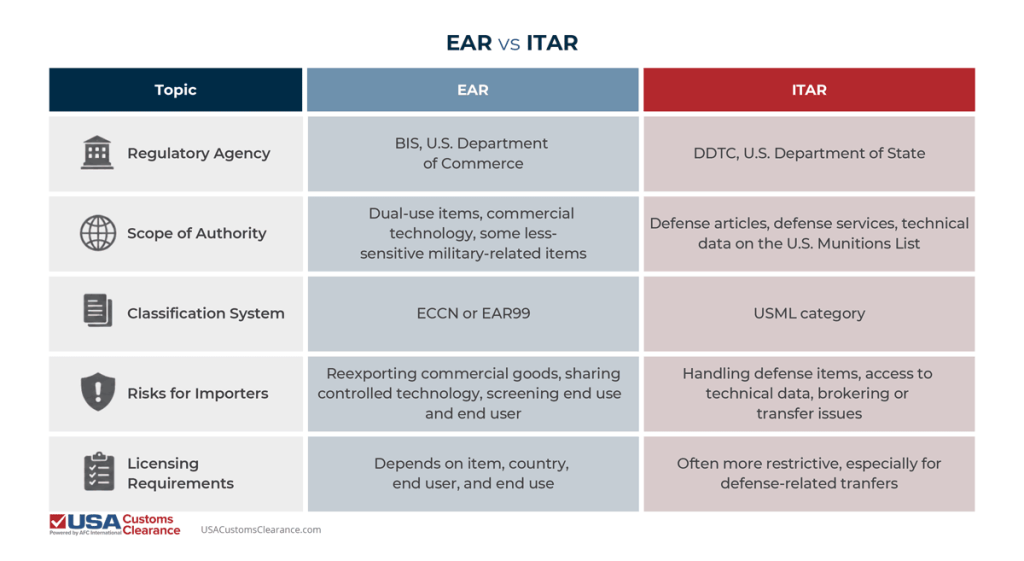
If your exported goods are governed by EAR, you will need to look up their Export Control Classification Numbers (ECCN) to determine whether you need a license or permit to export them.
BIS explains that ECCNs identify items on the Commerce Control List and the reasons they are controlled. The BIS maintains the Commerce Control List within the EAR.
ECCN classification matters to importers because it affects what happens after you import your goods.
For example, a U.S. company may import sensors, industrial valves, software, or electronics for domestic use, then later decide to resell those items to a foreign trade partner like Canada or South Korea. If those items have a specific ECCN, the company may need to review the destination, the Country Chart, the end use, and the end user before exporting them.
According to the BIS, a deemed export occurs when controlled technology or source code is released to a foreign national in the United States. Under U.S. export control rules, that release is treated as an export to the person’s country of citizenship or permanent residence.
Examples of businesses and other entities that often deal with these goods include:
Goods regulated under ITAR usually require the exporter to have a license due to their strict defense applications.
If your business model involves temporarily importing goods designated as deemed exports for modification or repair prior to reexportation, you might wonder if a license is still necessary.
Sometimes. License requirements depend on whether the item is controlled under EAR or ITAR, plus the destination, end user, and end use.
Goods regulated under EAR can sometimes be temporarily imported without a special import license. Products governed by ITAR generally require an export license from the DDTC, even when imported on a temporary basis.
China’s rare-earth restrictions show that foreign export rules can disrupt U.S. importers even when the goods are not subject to a U.S. prohibition. According to the White House’s 2025 fact sheet, changes in U.S.-China trade relations affected rare-earth export access, which matters for importers that rely on those materials.
During the 2025 trade war, one of China’s most common retaliatory tactics against U.S. tariffs involved tightening export controls on rare earth minerals, which are instrumental to the manufacturing of everything from cell phones to computers and even the car you drive.
The deal reached between China and the U.S. in 2025 involved a tariff reduction on goods imported from China on our side, with China once again relaxing export restrictions on rare earth minerals.
How This Affects Importers: Even with the trade deal reached between the U.S. and China, importers of rare earth minerals should be prepared for the possibility that China will use this export control tactic for leverage in future negotiations.
Another trading partner with noteworthy export controls is Japan. Their Ministry of Economy, Trade, and Industry (METI) exerts export control authority through the Foreign Exchange and Foreign Trade Act (FEFTA). Japan’s October 9, 2025 FEFTA updates tightened controls on certain dual-use exports, which can slow sourcing and compliance checks for U.S. importers that depend on Japanese suppliers.
According to METI, Japan’s FEFTA updates tightened controls for certain dual-use exports. For instance, Japan has a dual-use categorization similar to our own, but it’s now divided into two subcategories: core goods and catch-all goods. The practical upshot of this recategorization was to establish stricter rules on certain dual-use exports, which now require Japanese exporters to confirm the intended end use of the goods in question.
Those exporters need a special license to deal with dual-use goods, and customs officials in Japan scrutinize these shipments more so than in the past to support the updates to FEFTA.
How This Affects Importers: If you have imported dual-use items from Japan in the past and now find that the process has become more difficult, export controls are likely a contributing factor. You should contact your suppliers or manufacturers in Japan to find out what they’re doing to maintain compliance with their country’s export controls.
Before reexporting your goods, confirm the following compliance details:
These steps help importers perform a more complete export control review before reexporting goods, but complex transactions may still require guidance from a qualified professional.
Need help evaluating reexport risk? Start by reviewing the item classification, end user, destination, and supplier-country restrictions. If any of those points are unclear, a Licensed Customs Broker or trade compliance professional can help you assess the shipment before it moves.
Call us today at (855) 912-0406 to cut through the red tape of U.S. customs regulations.
Sources:
Deemed Export, BIS, 2025
EAR Regulations, BIS, 2025
The International Traffic in Arms Regulations (ITAR), DDTC
Export Control Classification Number ECCN/Export License, CBP, 2026
Fact Sheet: President Donald J. Trump Strikes Deal on Economic and Trade Relations with China, The White House, 2025
Ministry of Economy, Trade and Industry, METI
 Copy URL to Clipboard
Did you find this article helpful?
See more of our coverage on Google.
Add usacustomsclearance.com as a preferred source!
Add usacustomclearance.com as a preferred source!
See more of our coverage in Google's Top Stories.
Licensed customs support for importers across a wide range of U.S. entry needs. USA Customs Clearance provides Customs Bonds, Consulting, Customs Brokerage, Manifest Confidentiality, Importer of Record support, and Guides & Resources to help importers prepare for U.S. Customs and Border Protection (CBP) requirements and customs clearance with regulatory compliance, greater clarity, and confidence.
With licensed broker support, transparent service information, and secure checkout, we help importers take the right next step.

We know the importing process and requirements can be confusing, but they don't have to be.
We're here to help.
When purchasing a product from our website, you can feel confident knowing our team can help if you accidentally select the wrong product. We'll guide you through the correct purchase and any applicable refund process.
Important Refund Policy Information
Eligible refunds are subject to a $50 processing fee, which will be deducted from your original purchase amount. Please allow up to 90 days for refunds to be processed, as refunds are handled quarterly by our Accounting Department.
Refunds are available only if you have not yet:
Additional Refund Terms
You have 90 days from the date of purchase to submit your bond application. After 90 days, bond fees are forfeited and are nonrefundable.
All eBook sales are final and nonrefundable.
Add your first comment to this post