
IOR ENFORCEMENT IS NOW IN EFFECT | REVIEW MY IOR




When the FDA notices a shipper or product has an established pattern of import regulation non-compliance, their imports could be hit with an FDA import alert, and a notice is issued to each US port via its Harmonized Real-Time Alert System. What happens if your freight gets refused entry or detained, resulting in your company being listed on FDA import alert? Working with trusted customs brokers like our team at USA Customs Clearance will help you avoid these pitfalls for a stress-free customs clearance process.
FDA import alerts come about when a company, product, manufacturer, or country of origin is flagged at the port of entry. Alerts aren't issued after a one-time violation. Instead, they arise because a pattern of non-compliance.
While the type of violation can vary, usually, FDA import alerts are issued to freight with manufacturing or product errors, such as sanitary violations in the facility where it was made, or the product includes hazardous materials.
Imported goods and documentation are screened electronically for precision. The FDA uses the Nationalized Entry Review Program (NER) to ensure each shipment follows compliance to complete the customs process.
Electronic tools like the Predictive Risk-based Evaluation for Dynamic Import Compliance Targeting (PREDICT) and System for Entry Review and Import Operations (SERIO+) analyze shipments for the following:
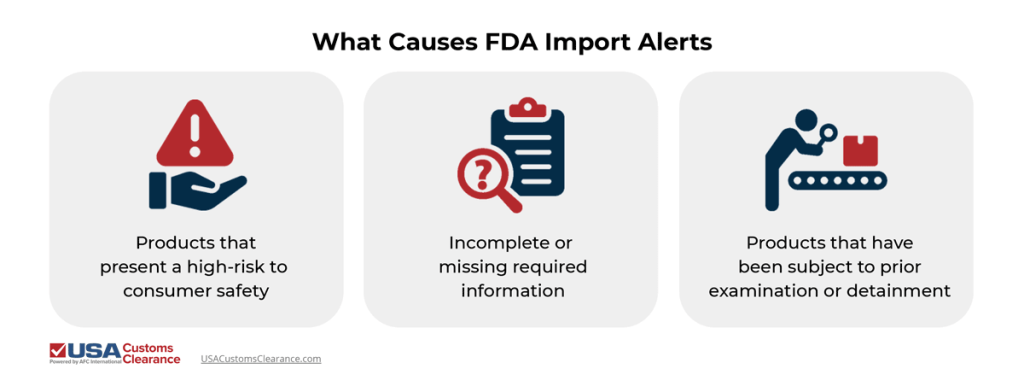
Although the FDA won't place an alert on your goods for a one-time violation, you should still follow their guidelines every time.
An FDA can hold can occur if your goods are suspected of violating their regulations. If this occurs, they'll send you a Notice of Action if they're detaining or refusing your entry.
When the FDA places a hold on your import, it may or may not stay at the port as they inspect or take samples for testing before proceeding with the customs clearance process.
If it appears your products are adulterated or otherwise hazardous to consumers, FDA may refuse your entry and detain them. In this case, your products may be destroyed under the supervision of the FDA and CBP.
In both incidents, the FDA sends a nationwide import alert and notifies the importer of record or point of contact about the decision. You can search import alerts for existing violations using the FDA database.
Related: FDA Customs Hold: How To Set Your Goods Free From Captivity
While goods that are subject to DWPE appear on FDA import alert, not every alert can be a stain on your business. There are three types of import alerts to be aware of during the import process.
Products, shippers, countries, or manufacturers that appear on the green list are exempt from DWPE. These companies have satisfied Good Manufacturing Practices (GMP) and are clear to proceed in the customs clearance process.
Products, shippers, countries, or manufacturers on the yellow list are not exempt from DWPE but require more surveillance or examination before being released.
Products, shippers, countries, or manufacturers on the red list are subject to DWPE, and a Notice of Action is then escalated to a Notice of Detention that must be responded to within 10 business days.
Related: CBP Clearance Process: A Guide for Importers
Once you’re notified with a Notice of Action that your products are on the import list and are subject to DWPE, here’s what happens next.
First, your Notice of Action will include a letter detailing the potential violation of your product, such as adulterated ingredients or unsanitary conditions at the facility where it was manufactured.
Next, the FDA will perform one of the three inspections that your product violated.
Then, the FDA will proceed with these inspections. There isn’t a specific timeline for the FDA to complete them. However, if the entity deems your products are in violation, they are refused entry and you have 90 days to destroy them under FDA and CBP supervision.
The importer of record or point of contact for a shipper can request to be removed from the red import alert list by submitting a petition for removal.
Your request should include a cover letter, a letter of authorization, and supporting evidence that your product was not in violation of any regulations.
If the FDA accepts this petition and your products pass testing, they will be released and cleared from the red or yellow import list.
When FDA import alerts halt your freight from entry, it can be a costly delay that slows down operations while waiting to sort it out. When you partner with our specialized customs brokers at USA Customs Clearance, we’re dedicated to making your customs clearance process a smooth one.
Call us with your questions at (855) 912-0406 or speak with an expert consultant here.
 Copy URL to Clipboard
Did you find this article helpful?
See more of our coverage on Google.
Add usacustomsclearance.com as a preferred source!
Add usacustomclearance.com as a preferred source!
See more of our coverage in Google's Top Stories.
Licensed customs support for importers across a wide range of U.S. entry needs. USA Customs Clearance provides Customs Bonds, Consulting, Customs Brokerage, Manifest Confidentiality, Importer of Record support, and Guides & Resources to help importers prepare for U.S. Customs and Border Protection (CBP) requirements and customs clearance with regulatory compliance, greater clarity, and confidence.
With licensed broker support, transparent service information, and secure checkout, we help importers take the right next step.

We know the importing process and requirements can be confusing, but they don't have to be.
We're here to help.
When purchasing a product from our website, you can feel confident knowing our team can help if you accidentally select the wrong product. We'll guide you through the correct purchase and any applicable refund process.
Important Refund Policy Information
Eligible refunds are subject to a $50 processing fee, which will be deducted from your original purchase amount. Please allow up to 90 days for refunds to be processed, as refunds are handled quarterly by our Accounting Department.
Refunds are available only if you have not yet:
Additional Refund Terms
You have 90 days from the date of purchase to submit your bond application. After 90 days, bond fees are forfeited and are nonrefundable.
All eBook sales are final and nonrefundable.
Add your first comment to this post