
IOR ENFORCEMENT IS NOW IN EFFECT | REVIEW MY IOR



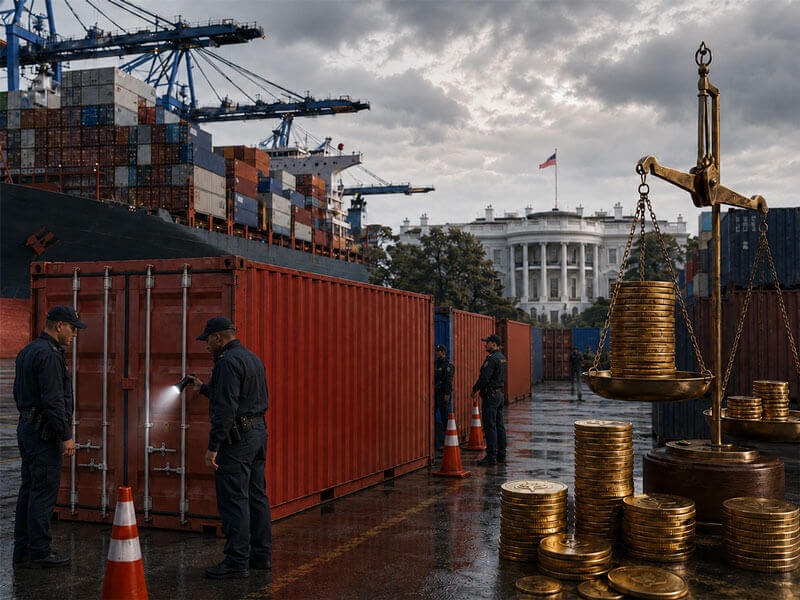


Section 338 of the Tariff Act of 1930 is a retaliatory trade provision that allows the U.S. president to impose tariffs on imports from countries that discriminate against U.S. commerce. For importers, the main concern is that Section 338 could raise duties on goods from a specific country if the president determines that country’s trade practices are unfair and acting would serve the public interest.
Section 338 of the Smoot-Hawley Tariff Act is a statutory trade enforcement provision that authorizes the President of the United States to impose additional or retaliatory tariffs on imports from foreign countries that discriminate against U.S. commerce or impose unequal trade restrictions, when such action is determined to be in the public interest.
Like Section 301 tariffs, any tariffs assessed via Section 338 would be on a country-by-country basis rather than being levied on trade partners as a whole. This contrasts with Section 122 tariffs, which must be applied uniformly to all U.S. trade partners when invoked.
Section 338 allows the president to set duties “...not to exceed 50 per centum ad valorem or its equivalent” on countries engaged in unfair trade practices with the U.S.
According to the statutes in the act, Section 338 can be invoked when:
Legal analysts have opined that Section 338 offers significant latitude to the president for regulating trade. Per an analysis by John K. Veroneau and Catherine H. Gibson from Law 360, “…presidential authority under Section 338 appears less dependent on factfinding or investigations of government agencies or commissions, and instead lies at the discretion of the president alone.”
Like any act under which tariffs may be enacted, importers in the U.S. should be aware of how Section 338 tariffs could impact their businesses.
The president can levy tariffs of up to 50% against countries deemed to be participating in unfair trade practices against the U.S. using Section 338. While the section has not been used in that capacity as of April 10, 2026, the invocation of Section 122 to levy tariffs for the first time highlights importers’ need to be aware of dated mechanisms for executive changes to tariffs and international trade regulations.
The circumstances under which Section 338 can be used are best illustrated by example.
Assume Ho Chi Minh City in Vietnam is a massive textile transshipment hub for the rest of Southeast Asia. Over the course of three months, U.S. exporters report that their shipments have been subject to vaguely defined “port administration fees” of 15% ad valorem that don’t apply to shipments from other countries. Exporters also report more holds and delays than those experienced by other foreign suppliers and manufacturers.
This scenario pulls both statutory triggers for Section 338:
Helping American businesses is in the public interest, so the president proclaims a 20% tariff on textiles imported from Vietnam to the United States. This makes it less attractive for U.S. importers to source textiles from Vietnam. Retaliation via Section 338 therefore sets the stage for negotiations between the two countries.
The White House imposed 50% tariffs on certain goods from Canada via Section 338 on September 22, 2026. These additional duties apply to goods that usually benefit from preferential tariff treatment under the USMCA.
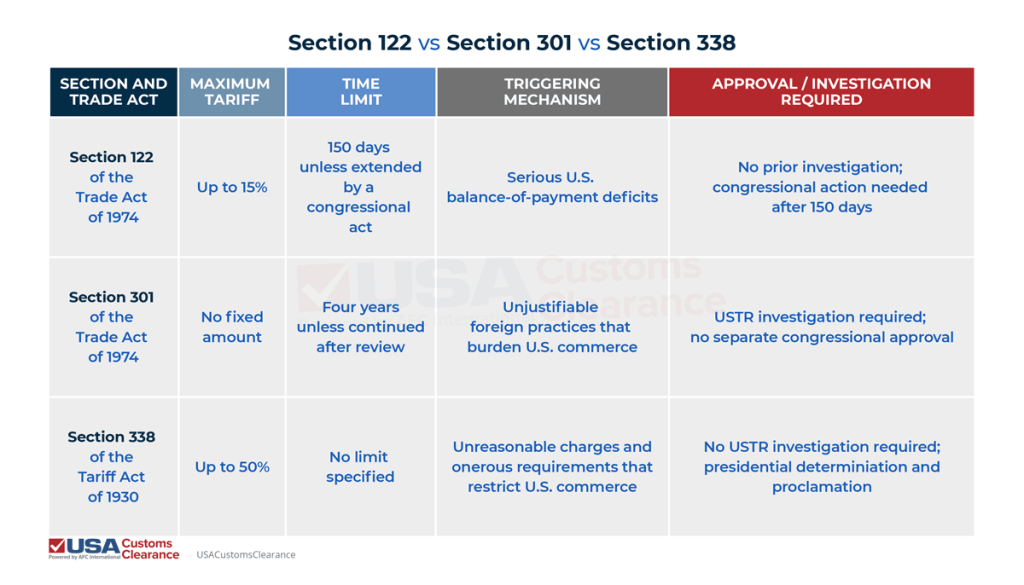
Notably, the president can invoke Section 338 tariffs without congressional approval or a preliminary investigation by the U.S. Trade Representative (USTR). Further distinctions between Section 338, 122, and 301 are listed below.
Importers who are unfamiliar with Section 338 can prepare for the possibility of its use by knowing what foreign trade practices it was designed to address.
For importers, preparing for Section 338 tariffs comes down to recognizing scenarios under which the section may be invoked and having contingencies in place if one of your supplying countries suddenly gets hit with double-digit tariff increases.
Since Section 338 is meant to be invoked on a per-country basis, worldwide market adjustments are not likely to be a basis for using this section of the act. What importers should look out for is specifically anti-U.S. trade policies enacted by trade partners with whom they do business.
Unfair trade policies include but aren’t limited to:
Importers need to be able to adapt when tariff uncertainty threatens their bottom line. Recognizing the potential for Section 338 tariffs is one thing: reacting to them requires importers to have strategies in place before the tariffs are proclaimed.
Because Section 338 actions would likely affect sourcing decisions, landed-cost planning, and customs strategy, importers should review their exposure before any country-specific tariff action occurs. If you have questions about how Section 338 tariffs could raise duties you owe on imported goods, call us at (855) 912-0406 or contact our team through the site today.
Sources
19 U.S. Code § 1338 - Discrimination by foreign countries, Cornell Law School, June 17, 1930
The President’s Long-Forgotten Power To Raise Tariffs, Law 360, John Veroneau and Catherine Gibson, December 14, 2016
 Copy URL to Clipboard
Did you find this article helpful?
See more of our coverage on Google.
Add usacustomsclearance.com as a preferred source!
Add usacustomclearance.com as a preferred source!
See more of our coverage in Google's Top Stories.
Get Customs, Tariffs, and Compliance Alerts at Your Fingertips
Sign up for VIP email alert access.
Licensed customs support for importers across a wide range of U.S. entry needs. USA Customs Clearance provides Customs Bonds, Consulting, Customs Brokerage, Manifest Confidentiality, Importer of Record support, and Guides & Resources to help importers prepare for U.S. Customs and Border Protection (CBP) requirements and customs clearance with regulatory compliance, greater clarity, and confidence.
With licensed broker support, transparent service information, and secure checkout, we help importers take the right next step.

We know the importing process and requirements can be confusing, but they don't have to be.
We're here to help.
When purchasing a product from our website, you can feel confident knowing our team can help if you accidentally select the wrong product. We'll guide you through the correct purchase and any applicable refund process.
Important Refund Policy Information
Eligible refunds are subject to a $50 processing fee, which will be deducted from your original purchase amount. Please allow up to 90 days for refunds to be processed, as refunds are handled quarterly by our Accounting Department.
Refunds are available only if you have not yet:
Additional Refund Terms
You have 90 days from the date of purchase to submit your bond application. After 90 days, bond fees are forfeited and are nonrefundable.
All eBook sales are final and nonrefundable.
Add your first comment to this post