
IOR ENFORCEMENT IS NOW IN EFFECT | REVIEW MY IOR


In This Article:


The Customs Trade Partnership Against Terrorism (CTPAT) program is one of Customs and Border Protection’s (CBP’s) many programs designed to protect American consumers from bad actors and criminals in international trade. This program also has tangible benefits for importers who choose to get CTPAT certification. As a company that helps importers, we’ve seen firsthand the utility of CTPAT. We’ll explain what you can expect when you take advantage of the program.
The Customs Trade Partnership Against Terrorism (CTPAT) is a program designed by U.S. Customs and Border Protection (CBP) to protect American consumers from bad actors and criminals in international trade. This program also offers tangible benefits for importers that obtain CTPAT certification.
CTPAT is a voluntary agreement made between CBP and qualified applicants to find gaps in supply chain security, implement measures to address them, and ensure best practices to avoid vulnerabilities going forward.
CTPAT is best for businesses that are actively involved in international trade and want to reduce avoidable customs clearance issues by strengthening supply chain security practices.
While any qualifying business could benefit from CTPAT membership, it makes even more sense for high-volume importers for whom possible delays from seizures and inspections cause crippling operational drag.
An importer who routinely brings in shipments on a steady, scheduled basis operates on a fixed timetable between receiving, storing, and distributing imported goods. CBP can inspect containers seemingly randomly, but becoming certified as a CTPAT participant increases CBP’s trust level with an importer and lowers the chance of cargo exams that have a negative impact on a business’s bottom line.
CTPAT is also a strong fit for companies that need to meet higher internal or external expectations around supply chain security, process discipline, and trade reliability.
Participation requires serious preparation: applicants are expected to perform a comprehensive risk analysis, complete a supply chain security profile, and show that their operation meets or exceeds CBP’s Minimum Security Criteria (MSC).
That means the program is best for businesses that can support formal compliance ownership and ongoing security oversight. According to CBP, applicants must designate a company official to act as the cargo security officer, obtain leadership buy-in, create a supply chain security auditing program, and maintain a workplace culture that treats security as a proactive responsibility.
From a customer-facing standpoint, CTPAT may be especially worthwhile for companies that want to show trading partners and government stakeholders that they take supply chain integrity seriously. CTPAT participation can serve as a trust-building measure that can support credibility with CBP while also helping businesses pursue smoother and more predictable cargo movement.
The benefits of CTPAT certification can be divided into two categories:
The benefits of CTPAT certification fall into two broad categories: faster customs processing and stronger trust with CBP.
CBP specifically names the following program benefits:
Another benefit is stronger trust with CBP and, potentially, customs officials in other countries. Between benefiting importers and improving national security, the CTPAT partnership is a wise move for a qualifying company. It shows a willingness to go the extra mile to help secure the U.S. supply chain, which builds trust and credibility with CBP.
CTPAT requirements that are consistent from one business type to another are as follows:
From here, requirements differ from one business to another. The following sections list the requirements that are specific to each of the 12 business types that can apply and qualify for CTPAT certification according to CBP.
CBP names the following 12 business types as those that can qualify to participate in CTPAT.
Air Freight Carriers:
Consolidators Including Non-Vessel Operating Common Carrier (NVOCC):
Customs Brokers:
Exporters:
Manufacturers in Foreign Countries:
Highway Carriers:
Importers:
Mexico-Based Long Haul Carriers:
Marine Port Authority/Terminal Operators:
Rail Freight Carriers:
Ocean Freight Carriers:
Third Party Logistics Providers (3PLs):
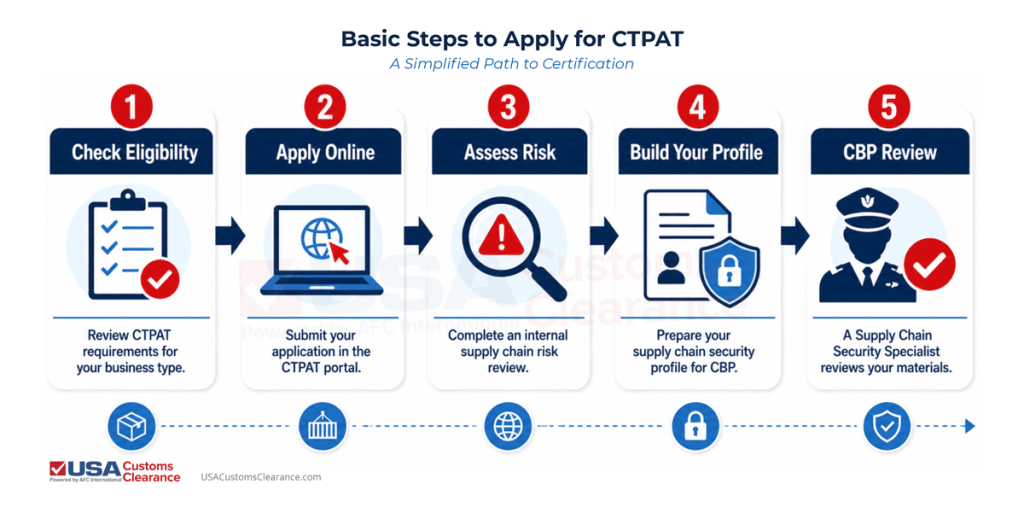
An importer’s roadmap to CTPAT registration and certification looks like this:
Once these steps are complete, the rest of the registration process falls to CBP.
CTPAT Certification takes up to 90 days once the review is complete, and validation occurs within one year of certification.
If you have questions about certifying your business with CTPAT, call our team of customs experts at (855) 912-0406 or submit a contact form online to get started.
Sources:
Customs Trade Partnership Against Terrorism (CTPAT), U.S. Customs and Border Protection, last modified May 01, 2026
CTPAT Portal, U.S. Customs and Border Protection, last modified May 30, 2025
Applying for CTPAT, U.S. Customs and Border Protection, last modified Jun 12, 2025
 Copy URL to Clipboard
Did you find this article helpful?
See more of our coverage on Google.
Add usacustomsclearance.com as a preferred source!
Add usacustomclearance.com as a preferred source!
See more of our coverage in Google's Top Stories.
Get Customs, Tariffs, and Compliance Alerts at Your Fingertips
Sign up for VIP email alert access.
Licensed customs support for importers across a wide range of U.S. entry needs. USA Customs Clearance provides Customs Bonds, Consulting, Customs Brokerage, Manifest Confidentiality, Importer of Record support, and Guides & Resources to help importers prepare for U.S. Customs and Border Protection (CBP) requirements and customs clearance with regulatory compliance, greater clarity, and confidence.
With licensed broker support, transparent service information, and secure checkout, we help importers take the right next step.

We know the importing process and requirements can be confusing, but they don't have to be.
We're here to help.
When purchasing a product from our website, you can feel confident knowing our team can help if you accidentally select the wrong product. We'll guide you through the correct purchase and any applicable refund process.
Important Refund Policy Information
Eligible refunds are subject to a $50 processing fee, which will be deducted from your original purchase amount. Please allow up to 90 days for refunds to be processed, as refunds are handled quarterly by our Accounting Department.
Refunds are available only if you have not yet:
Additional Refund Terms
You have 90 days from the date of purchase to submit your bond application. After 90 days, bond fees are forfeited and are nonrefundable.
All eBook sales are final and nonrefundable.
Add your first comment to this post