
CUSTOMS BONDS MADE SIMPLE | GET MY BOND QUOTE




A Foreign-Trade Zone (FTZ) is a secure area under U.S. Customs and Border Protection (CBP) supervision where imported merchandise can be admitted before formal customs entry and duty payment. Importers use FTZ’s to delay duty payments, reduce duties in some manufacturing scenarios, eliminate duties on certain exports or scrap, and simplify entry processing through programs such as weekly entry.
A foreign-trade zone is a designated location in the United States where companies can use special customs procedures before goods formally enter U.S. commerce.
Zone activity happens under the supervision of CBP, and the FTZ program is overseen by the Foreign-Trade Zones Board within the U.S. Department of Commerce.
Using an FTZ allows importers to enjoy the following benefits:
Importers use FTZs to store or modify imported merchandise before deciding whether it will enter the U.S. market, move to another FTZ or leave the country.
Per CBP guidance, operations in an FTZ may include:
Production operations require advance FTZ Board authorization.
An FTZ is best for importers whose operating model creates repeated customs cost pressure.
FTZs work best in the following scenarios:
These use cases matter because FTZ value usually comes from a combination of customs savings and operational flexibility, not from a single line item.
Importers of high-duty merchandise often look first at duty deferral, but manufacturers may see a second layer of value: inverted tariff treatment. An inverted tariff scenario happens when the finished product leaving the zone carries a lower duty rate than one or more imported components that went into it.
In those approved cases, the duty can be based on the finished product rather than the higher-duty components, which can materially reduce landed cost. The U.S. Department of Commerce specifically identifies inverted-tariff treatment as a production-related FTZ benefit.
Consider this simple example:
Suppose an importer brings in components with a 7% duty rate, assembles them in an FTZ, and the finished product is dutiable at 3%. If the production activity is properly authorized and the merchandise is not required to be admitted in privileged foreign status, the company may be able to pay duty at the finished-product rate when the goods leave the zone for U.S. commerce.
The exact result depends on product classification and FTZ rules, but this is the core reason manufacturers often evaluate FTZs.
Some importers need more than a short duty delay, they need time. FTZs can be attractive for businesses that import basic materials, seasonal inventory or products tied to uneven demand. Goods can remain in the zone without the five-year storage limit that applies to bonded warehouse goods.
Commerce’s FTZ guidance states plainly that FTZs have no time limit on goods, while CBP’s importing guide says goods may remain in a bonded warehouse up to five years from the date of importation.
Security also matters. FTZ activity remains under CBP supervision, and secure controls are part of the operating framework.
Security controls vary by operator and site design, but FTZ inventory-control environments often include measures such as:
For importers holding valuable inventory, that added structure can support better control and accountability.
An FTZ is often stronger than a bonded warehouse when a company needs to do more than store merchandise.
In an FTZ, merchandise can be:
Goods may be manufactured or otherwise produced in a FTZ with the required authorization. Commerce’s FTZ program materials contrast FTZs with bonded warehouses by noting that FTZs may authorize a wide range of production activity.
That makes FTZs especially relevant for importers that build kits, rework products, combine domestic and foreign goods, or stage manufacturing workflows close to the U.S. market. An FTZ can support those workflows more naturally than a simple storage-only model.
FTZ savings usually come from several customs and operational mechanisms working together. Most importers don’t save money from one feature alone. They’re able to save because the zone changes when the duty is paid, how entries are processed, and how qualifying product, exports, scrap, or waste are treated.
The most common savings drivers are:
That mix is why FTZs can be powerful for operationally mature importers. We’ll take a look at each one in the following section.
Duty deferral is a customs timing benefit that allows an importer to postpone duty payment until imported goods leave the foreign-trade zone and formally enter U.S. commerce. The duty generally becomes payable only if and when the goods leave the zone and enter U.S. commerce.
That delay can improve cash flow, especially for companies with slower inventory turns or large inbound shipments. Commerce states that customs duties and federal excise tax may be deferred on imports in FTZs.
For many importers, the benefit is not just financial. Duty deferral reduces administrative burdens for importers when they bring their goods into the country.
When a qualifying finished product carries a lower duty rate than its imported inputs, FTZ production can reduce the duty owed at withdrawal. This is where manufacturers often see the largest upside.
Here’s an example of finished goods receiving a tariff shift upon leaving an FTZ:
An auto manufacturer imports engines and electronics into an FTZ. The manufacturer uses the engines and electronics to assemble a finished vehicle. The vehicles then leave the FTZ and the tariff rate applying to the engines and electronics no longer applies.
That is why FTZ planning should always begin with product classification, admission status, and a realistic cost model rather than a generic promise of savings.
If imported merchandise or imported components in production never enter the U.S. market, duty may never be due. Commerce states that no U.S. duty is payable on foreign-status components used in products that are subsequently exported, and no duty is payable on foreign-status components that become scrap or waste.
This matters in three common situations:
For those companies, FTZ savings can compound quickly.
Weekly entry is one of the most practical FTZ advantages. Instead of filing a separate customs entry for each shipment removed from the zone during the week, qualifying operators may file a single customs entry for that week’s removals.
Commerce notes that FTZ users may be able to file one customs entry and pay one merchandise processing fee per week rather than making multiple entries during the week.
For high-volume importers, that can reduce:
The result is often a smoother and more predictable customs workflow. Even when the duty savings are modest, the procedural savings can still justify the program.
FTZs and bonded warehouses help importers delay duty under CBP oversight. But they are not interchangeable. Commerce’s FTZ materials summarize the main FTZ differences this way: no time limit on goods, domestic and foreign goods may comingle, and a wide range of production activity may be authorized in FTZs.
We’ve provided a graphic comparing the features of FTZs and bonded warehouses to help you decide which one is right for you.
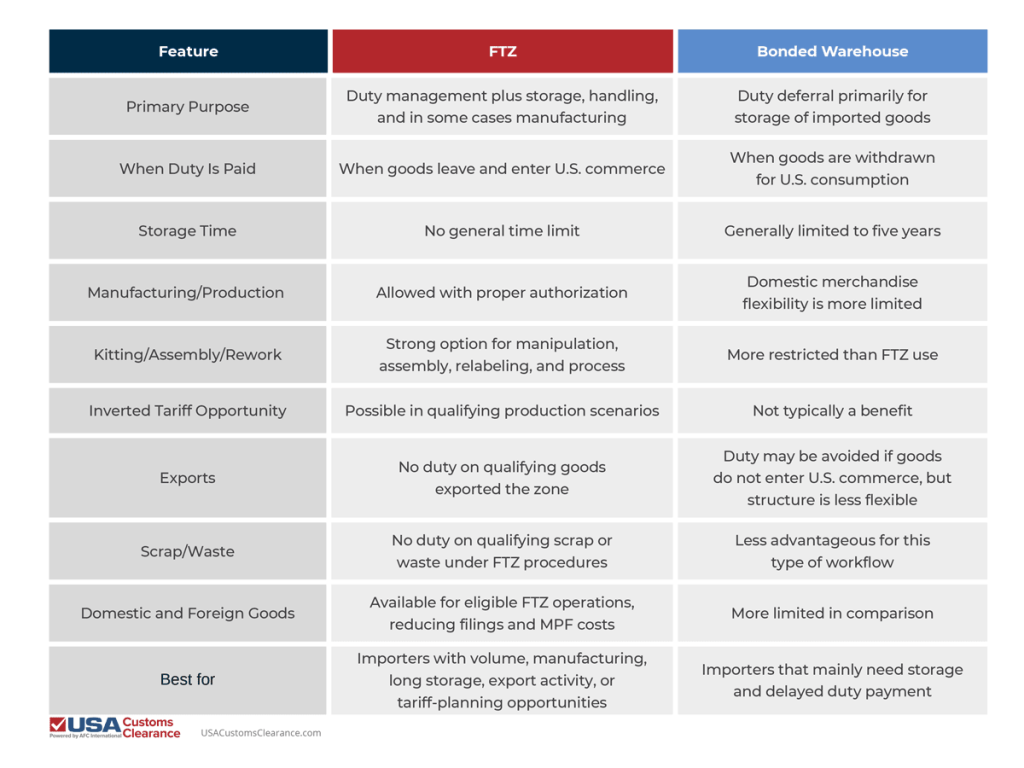
A bonded warehouse can still be a strong fit for importers whose main need is temporary storage and duty delay. But when manufacturing, kitting, export activity, or long dwell times enter the picture, an FTZ often becomes the more flexible model.
Our team of Licensed Customs Brokers have 90 years of combined experience. They’ve been helping importers navigate FTZs and find the best solution for their goods. You’ll be able to take full advantage of all the benefits that an FTZ can provide. Not only that, but we’ll ensure your goods comply with applicable regulations and that your import documents will be submitted on time.
 Copy URL to Clipboard
Did you find this article helpful?
See more of our coverage on Google.
Add usacustomsclearance.com as a preferred source!
Add usacustomclearance.com as a preferred source!
See more of our coverage in Google's Top Stories.
Licensed customs support for importers across a wide range of U.S. entry needs. USA Customs Clearance provides Customs Bonds, Consulting, Customs Brokerage, Manifest Confidentiality, Importer of Record support, and Guides & Resources to help importers prepare for U.S. Customs and Border Protection (CBP) requirements and customs clearance with regulatory compliance, greater clarity, and confidence.
With licensed broker support, transparent service information, and secure checkout, we help importers take the right next step.

Add your first comment to this post