
IOR ENFORCEMENT IS NOW IN EFFECT | REVIEW MY IOR



In This Article:


Import costs are the total landed expenses an importer must pay on their goods. These can vary drastically between countries.
China vs Vietnam import costs are differentiated by factors including manufacturing costs, freight shipping fees, and applicable tariffs that affect rates of duty. China’s historically high rate of exportation into the U.S. was muted in 2025 due to high tariffs. This guide compares China vs Vietnam import costs so you can estimate your landed cost and choose a sourcing strategy that reduces your expenses.
Freight shipping fees and customs fees, such as tariffs, are the two main costs you can expect when importing goods from China or Vietnam. In the table below, I break these import costs down further, with explanations for each type:
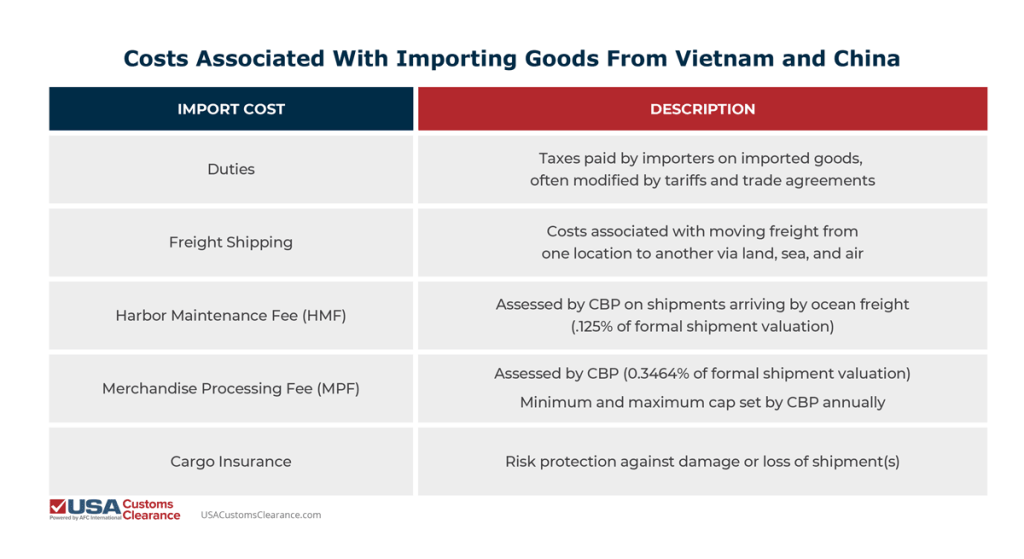
You’ll also need a customs bond on file with CBP to import commercial shipments valued at $2,500 or more or subject to Partner Government Agency (PGA) oversight. This bond is also necessary for shipments under $2,500 that are subject to trade remedies or PGA regulations.
Remember that drayage and temporary storage are part of import costs, and should be figured into your landed cost calculation when determining whether Vietnam or China is a better source for your imported goods.
As of February 24, 2026, China and Vietnam are both subject to 10% tariffs invoked under Section 122 of the Trade Act of 1974. Tariffs under Section 122 are active for 150 days unless modified or extended.
Additionally, Section 232 duties apply to the following commodities:
Duties can stack. This means a base duty rate, Section 301 tariffs, Section 122 tariffs, and AD/CVDs on an import can be added together.
The key difference between duties on shipments from China and those from Vietnam is the application of Section 301 tariffs to thousands of Chinese goods. Section 301 tariffs, invoked in accordance with the previously mentioned 1974 trade act, add 7.5 to 25% ad valorem duties to many goods sourced from China.
The list of Chinese goods affected by Section 301 is extensive. If you’re unsure whether your Chinese imports will be affected by Section 301 tariffs, consulting with a Licensed Customs Broker prior to your transaction will answer this and other import-related inquiries.
One of the most volatile costs involved in importing is freight shipping. The cost of shipping freight fluctuates based on economic factors, political stability, and even weather systems.
The table below includes spot rates for shipping 40-foot containers from Vietnam and China to one of the busiest ports in the U.S.: the Port of Los Angeles. The data is aggregated from late 2025 and early 2026 rates and shipping times.
Rate disclaimer: Ocean spot rates can change weekly and swing sharply during disruptions. Use these figures as directional ranges, not quotes.
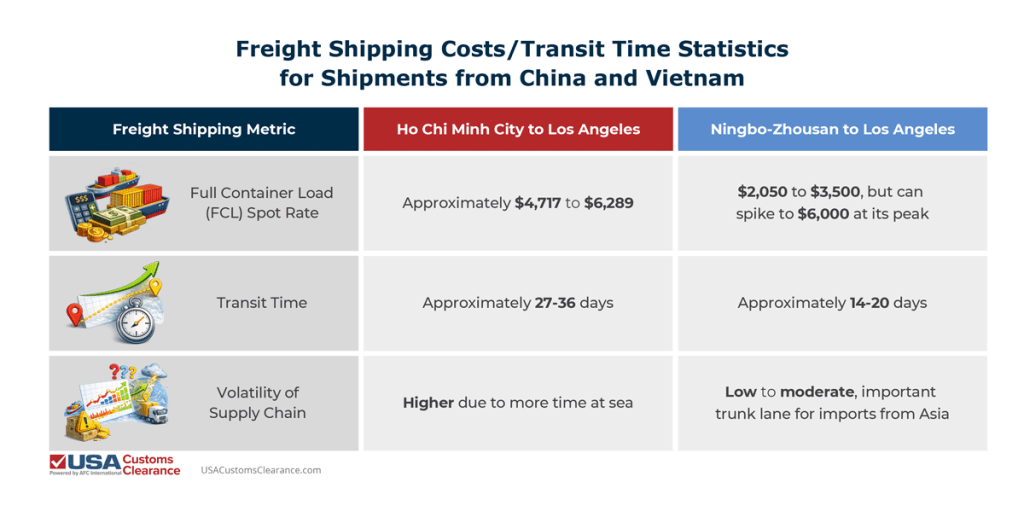
Low ocean rates can be offset by destination charges. This includes terminal handling, chassis appointments, and storage. Include these expenses in your landed cost calculations.
For the most part, China seems like the clear choice for importers, going by delivery time and affordability of freight shipping. However, CBP clearance risk and compliance costs often outweigh small freight savings for first-time importers.
Goods imported from China could be held, subsequently inspected, and even refused entry into the country by CBP if they violate the Uyghur Forced Labor Prevention Act (UFLPA). Dozens of manufacturers have been designated as violators of the UFLPA, which is intended to prevent goods manufactured with forced labor in the Xinjiang Uyghur Autonomous Region of China.
Due to potential UFLPA violations and suspicion of fentanyl being smuggled into the U.S. from China, all other things being equal, shipments from Vietnam are less likely to be flagged for holds and inspections.
Here’s a checklist of what to prepare to ensure smooth customs clearance:
With that said, Vietnam is also known as a transshipment hub for goods manufactured in China, which some unscrupulous exporters use as an opportunity to misrepresent the country of origin for their goods.
If you have fully vetted your supply chain from China and have determined it’s free of bad actors and forced labor, you may still encounter shipment holds: however, assuming CBP also determines that your merchandise isn’t subject to UFLPA actions or other trade sanctions, this will be a relatively minor delay.
Vietnam is often cheaper on duties for products that would face Section 301 when sourced from China. In December 2025, reported effective tariff rates showed China significantly higher than Vietnam, but your true duty rate depends on the Harmonized Tariff Schedule of the United States (HTSUS) classification and duty stacking.
China can still win on total landed cost when lower factory prices, better yields, or shorter lead times outweigh duty differences—especially for complex manufacturing categories.
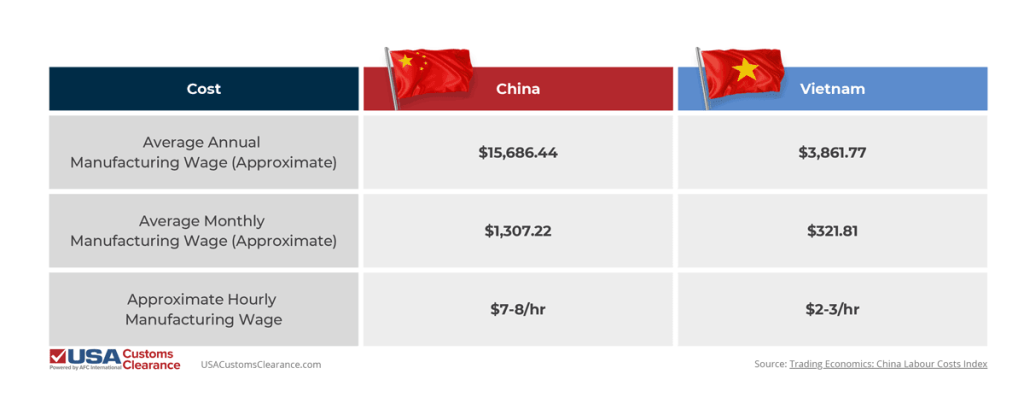
Duties and customs fees aren’t the only costs importers need to consider. Manufacturing costs and labor wages in China and Vietnam have a direct impact on the cost of your goods.
The most recent data available (accurate as of 2024) shows the costs of labor and manufacturing in Vietnam and China to be as follows:
Imports from China may also be subject to Anti-dumping/Countervailing Duties (AD/CVDs), which further increase duties due on select commodities.
Going strictly by customs fees, importing from Vietnam can be much more affordable than importing from China. However, importers should also take China’s robust manufacturing sector and experienced workforce into account when deciding on a supplier, particularly for electronic devices.
Making mistakes when calculating import costs, especially duties, can lead to fines even after your shipment is cleared and released. CBP frequently audits importer documentation, and if they determine you underpaid duties, you’ll be assessed fines on top of paying any balance due.
To avoid fines and punitive actions from CBP, avoid these common errors importers make when shipping in goods from Vietnam and China.
Be thorough by evaluating all factors, including shipping costs, duties, and what to expect during the customs clearance process. Doing so will go a long way toward making the best decision for your business when it comes to sourcing goods from China vs. Vietnam.
What we’ll help you confirm before you ship:
Our team of Licensed Customs Brokers is ready to help you make an informed decision about importing from China or Vietnam. With decades of combined experience, they have the know-how you need to start importing goods compliantly and profitably.
Call us at (855) 912-0406 to set up a consultation and get clear, informed answers about all of your importing questions.
FAQ
What fees does U.S. Customs and Border Protection (CBP) charge on imports?
CBP collects duties, Merchandise Processing Fees (MPFs), Harbor Maintenance Fees (HMFs), and other miscellaneous customs fees that apply to imported shipments.
Are tariffs always higher from China than Vietnam?
As of December 2025, Section 301 tariffs drove China’s effective tariff rate up to 33.4%, while Vietnam’s was 12.87%. Tariffs on Chinese imports tend to be higher than those of other countries since the introduction of Section 301 tariffs on China in 2018 and the implementation of over 200 AD/CVD orders.
How do I confirm the correct HTS code for my product?
Our Landed Cost Calculator can help you ascertain the correct HTS code for your imported goods. For merchandise that could potentially be classified under multiple codes, it’s best to partner with a Licensed Customs Broker who has experience with the USITC’s General Rules of Interpretation.
What is Section 301 and how do I know if it applies to my shipment?
Section 301 of the Trade Act of 1974 gives the U.S. Trade Representative authority to launch investigations into unfair trade practices and levy tariffs in response to said practices.
What is a customs bond and when do I need a continuous bond?
A customs bond is a guarantee between CBP, the importer receiving the bond, and the surety issuing the bond. It ensures that CBP will receive payment for duties and other customs fees if the importer fails to make that payment themselves. If you plan to import commercial shipments more than four times a year or into multiple ports, you’ll benefit from a continuous bond more than a single entry bond.
 Copy URL to Clipboard
Did you find this article helpful?
See more of our coverage on Google.
Add usacustomsclearance.com as a preferred source!
Add usacustomclearance.com as a preferred source!
See more of our coverage in Google's Top Stories.
Licensed customs support for importers across a wide range of U.S. entry needs. USA Customs Clearance provides Customs Bonds, Consulting, Customs Brokerage, Manifest Confidentiality, Importer of Record support, and Guides & Resources to help importers prepare for U.S. Customs and Border Protection (CBP) requirements and customs clearance with regulatory compliance, greater clarity, and confidence.
With licensed broker support, transparent service information, and secure checkout, we help importers take the right next step.

Add your first comment to this post