
IOR ENFORCEMENT IS NOW IN EFFECT | REVIEW MY IOR


In This Article:


The Lindsey O. Graham Sanctioning Russia and Iran Act of 2026, passed on September 18 of that year, compels the President of the United States to impose tariffs on goods from Russia and trade partners who purchase Russian crude oil and natural gas. The act also contains orders for non-tariff trade sanctions such as limiting legal methods of transaction from importers of Russian goods.
Originally named the Sanctioning Russia Act of 2025, the act was renamed to acknowledge sanctions against Iran and honor the late South Carolina Senator Lindsey Graham.
The Sanctioning Russia and Iran Act was passed on 9/18/26. The tariff-related language in the act compels the President to, 30 days after the act's passage, enact tariffs of up to 500% on goods imported from the Russian Federation, and tariffs of up to 100% on goods from countries who purchase specific energy products from Russia.
In addition to the aforementioned tariffs, the act imposes further sanctions and importer-facing concerns, such as:
Penalties assessed against importers found in violation of subsections 102-111 of the act will be assessed along guidelines established in the International Emergency Economic Powers Act (IEEPA).
In terms of international trade, U.S. importers who source goods from either the Russian Federation or that country’s trade partners in the energy sector are significantly impacted by the act.
Two sections of the act are of specific interest to those importers:
Each of these sections have a direct impact on the total landed cost of affected goods.
The act extends the sunset period for the Iran Sanctions Act of 1996 from 2026 to 2031. For most commercial importers in the U.S., the critical element of this act is sanctions against covered persons that can indirectly cause payment and/or transaction refusals for importers who attempt to transact with such persons, whether knowingly or unknowingly.
The biggest impact on imported goods that fall under classifications specified in the act is an ad valorem tariff of up to 500% depending on the country of origin and the amount of additional duties deemed appropriate by the President.
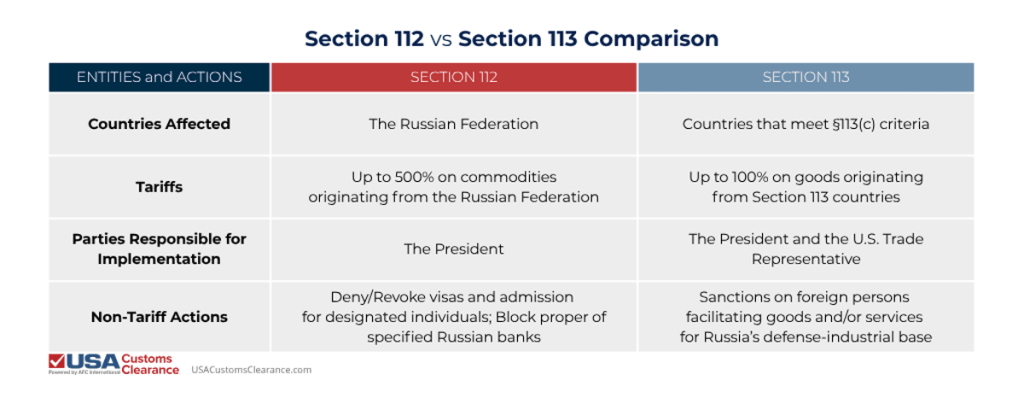
Sections 112 and 113 explain how those tariffs and sanctions are applied to Russia and its trade partners, respectively.
Section 112 of the Lindsey O. Graham Russian Sanctions Act calls for the President to take the following actions:
The next section of the act addresses actions to be taken on trade partners who purchase certain energy products from the Russian Federation.
Countries who satisfy criteria established in §113(c) of the act are also subject to additional tariffs of up to 100% ad valorem following a 10-day congressional notice from the President.
Section 113 countries are identified as follows:
The act includes an exception for countries who would otherwise fit the criteria for natural gas imports if those imports were under 15% of the Russian Federation's total exports of natural gas during that time period. Due to the specification of top 5 importers, the countries that fall under Section 113 tariffs can change during review processes that take place every 180 days.
Other departments and agencies involved in enforcement actions and consultations regarding these sections of the act include U.S. Customs and Border Protection (CBP), the Secretary of State, and the Secretary of the Treasury.
Yes, tariffs assessed under the Sanctioning Russia Act stack with additional duties, including but not limited to:
Assume a U.S. business wants to import 1,000 widgets of Russian widgets valued at $100 a piece for a customs value of $100,000. The imported goods are potentially subject to the following cumulative duties:
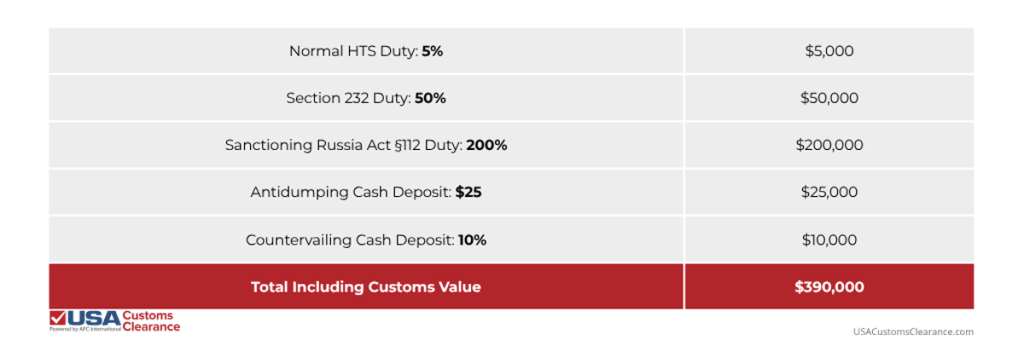
This puts the importer at an obvious disadvantage compared to purchasing goods from a country other than Russia.
For countries that fall under Section 113(c), the same transaction with an initial $100,000 customs value would be subject to a lower potential sanctioning duty, but have equal exposure to stacking from other applicable tariffs.
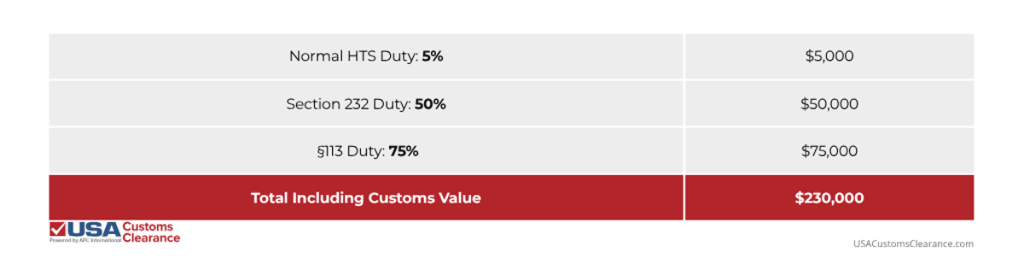
The act means customers will need to double check country of origin requirements from time to time since countries impacted by Section 113 can change during scheduled review periods.
The Sanctioning Russia Act does not establish a separate country-of-origin penalty for evading Section 112 or Section 113 duties. Rather, false or misleading origin claims used to avoid these tariffs threaten to expose importers to penalties under existing federal laws governing false statements, duty evasion, and customs fraud.
The sanctioning provisions of the act can create a scenario in which an imported good, while permissible for importation according to any relevant U.S. customs law, cannot be transacted legally even if the importer is willing to pay duties assessed via the act.
For instance, a business wants to import heavy machinery from Germany. The machinery contains no Russian-origin materials, and it is not subject to sections 112 or 113, nor is the commodity itself restricted. However, the supplier has the importer submit payment to an account from a Russian financial institution identified by the act.
Per § 103 of the act, this transaction cannot be completed even if the goods are permissible because the legality of the transaction itself is what’s at question.
The act names agricultural commodities, medical devices, and medicines, as well as transactions necessary for and related to the same, as exceptions to otherwise applicable sanctions when used for humanitarian aid in Section 114.
The President is given discretionary authority to modify or terminate sanctions and tariffs on non-Russian countries and other entities if by submitting a report to congress attesting that:
As for terminating sanctions on Russia itself, the act sets two important conditions:
The shifting nature of countries defined in Section 113 of this act makes it particularly difficult for importers to correctly calculate duties owed on goods sourced from affected countries. Licensed Customs Brokers, on the other hand, have the expertise and tools necessary to ensure accurate duty calculations and fulfill specific documentation requirements when customs regulations are at their most complex.
If you’re an importer looking for assistance with customs brokerage, (855) 912-0406 or fill out a contact form online today to find out how USA Customs Clearance can help you avoid delays, fines, and freight seizures.
H.R. 5334 - Lindsey O. Graham Sanctioning Russia and Iran Act of 2026
Iran Sanctions Act of 1996
 Copy URL to Clipboard
Did you find this article helpful?
See more of our coverage on Google.
Add usacustomsclearance.com as a preferred source!
Add usacustomclearance.com as a preferred source!
See more of our coverage in Google's Top Stories.
Licensed customs support for importers across a wide range of U.S. entry needs. USA Customs Clearance provides Customs Bonds, Consulting, Customs Brokerage, Manifest Confidentiality, Importer of Record support, and Guides & Resources to help importers prepare for U.S. Customs and Border Protection (CBP) requirements and customs clearance with regulatory compliance, greater clarity, and confidence.
With licensed broker support, transparent service information, and secure checkout, we help importers take the right next step.

Add your first comment to this post