
IOR ENFORCEMENT BEGINS SEPTEMBER 18 | REVIEW MY IOR NOW


In This Article:


Drone imports to the United States are shipments of unmanned aerial vehicles (UAV) entering U.S. commerce under federal customs and regulatory requirements. To import UAVs into the U.S., importers must ensure their products comply with Federal Communications Commission (FCC) where applicable. Importers must also accurately calculate duties, including 25 to 100% tariffs on certain imported UAVs under Section 232 of the Trade Expansion Act of 1962. Some non-tariff trade restrictions also apply to UAVs due to national security concerns.
An importer can start to determine whether a drone qualifies for import into the U.S. by verifying that its FCC ID exists in the commission’s official database. The commission restricted imports of most foreign-made drones on December 22, 2025, and importers should thoroughly vet their imports to ensure that the drones received FCC authorization before that date or meet one of the limited exceptions to the import restrictions..
UAVs are classified under the heading and subheading 8806 in the Harmonized Tariff Schedule (HTS). To determine the UAV’s full HTS code for classification and tariff calculations, importers will need to apply information such as:
For instance, an imported UAV that is unmanned, not intended for passengers, remotely controlled, and weighs between 25 and 150 kg would be classified under the HTS code 8806.24.0000. The information about thermal imaging is important for determining Section 232 tariff exposure.
Standard HTS column duties apply to imported drones, as do Section 232 tariffs of 25 to 100% on certain UAVs and their associated components per an August 13, 2026 White House proclamation.
UAVs and components affected by the Section 232 tariffs include:
Furthermore, UAVs are regulated by the FCC due to their ability to emit radio signals, and in December 2025, the commission restricted imports of many UAVs regardless of country of origin. This restriction speaks to the admissibility of an import rather than any country-specific tariff, though country of origin can impact duties owed at customs clearance as well.
Yes, country of origin affects the duties owed on imported UAVs and the overall admissibility of the product. For instance, assume an importer wants to purchase $100,000 worth of UAVs from China, and those UAVs have valid FCC authorizations predating the commission’s December 2025 restrictions.
This exposes the shipment 100% Section 301 tariffs and 25% Section 232 tariffs, resulting in $125,000 worth of duties even though the HTS lists UAVs and components as having a free rate of duty in column one.
Country of origin can also result in lower overall tariff exposure for UAVs if there is a trade agreement in place between that country and the U.S. Qualifying products from the UK are only subject to 10% additional tariffs under Section 232, and the European Union, Japan, South Korea, Taiwan, Switzerland, and Liechtenstein only receive a total of 15% ad valorem tariffs between the HTS and a “top up” from 232.
Aside from general import documents such as the ISF and CBP Form 7501, importers must have documentation to support FCC-licensing claims for their goods. If CBP questions the legitimacy of an imported shipment at customs clearance, the onus is on the importer to prove their goods are compliant.
UAV-specific documents and information importers should keep on file include but are not limited to:
These documents support accurate HTS code classification and duty calculation.
To calculate duties on imported UAVs, start by determining the customs value of the shipment followed by applying tariffs and additional customs charges like the harbor maintenance fee (HMF).
Let’s assume an importer purchases $1,000,000 worth of UAVs from a South Korean supplier. These drones have a maximum take off weight exceeding 25 kg and thermal imaging capabilities. The shipment is arriving via ocean freight.
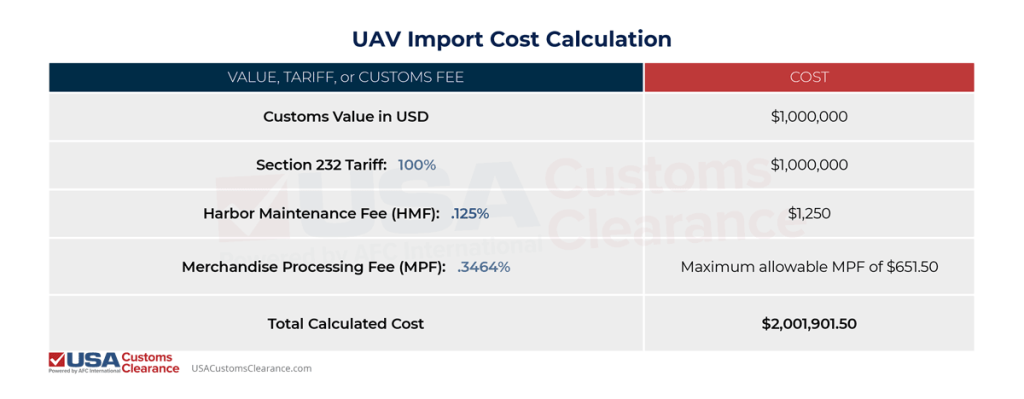
This scenario does not include freight charges, insurance, or other elements of a total landed cost calculation. Importers should also be aware of the most up-to-date trade act information when importing from specific countries to take advantage of potential tariff mitigation.
Before importing a shipment of UAVs, importers should confirm they have followed these basic steps:
If you plan to import UAVs but have concerns about CBP and/or FCC compliance violations, or you need expert customs brokerage services, our team of Licensed Customs Brokers can work with you to ensure compliance and reduce headaches at customs clearance. Call us at (855) 912-0406 or fill out a contact form online today.
FACT SHEET: FCC Updates Covered List to Include Foreign UAS and UAS Critical Components on Going Forward, Federal Communications Commission, December 22, 2025
ADJUSTING IMPORTS OF UNMANNED AIRCRAFT SYSTEMS AND UNMANNED AIRCRAFT SYSTEMS COMPONENTS INTO THE UNITED STATES, White House, August 13, 2026
 Copy URL to Clipboard
Did you find this article helpful?
See more of our coverage on Google.
Add usacustomsclearance.com as a preferred source!
Add usacustomclearance.com as a preferred source!
See more of our coverage in Google's Top Stories.
Licensed customs support for importers across a wide range of U.S. entry needs. USA Customs Clearance provides Customs Bonds, Consulting, Customs Brokerage, Manifest Confidentiality, Importer of Record support, and Guides & Resources to help importers prepare for U.S. Customs and Border Protection (CBP) requirements and customs clearance with regulatory compliance, greater clarity, and confidence.
With licensed broker support, transparent service information, and secure checkout, we help importers take the right next step.

Add your first comment to this post