
IOR ENFORCEMENT IS NOW IN EFFECT | REVIEW MY IOR




The America First Trade Policy is a presidential memorandum introduced on January 20th, 2025 that expanded tariff enforcement, tightened import compliance, and increased sourcing risk for importers in 2026.
The America First Trade Policy increased tariff exposure and expanded customs compliance requirements for U.S. importers.
The policy emphasized:
This approach increased tariff uncertainty, intensified CBP scrutiny, and forced many importers to revise sourcing strategies.
The America First Trade Policy shifted the U.S. trade policy from multilateral trade rules to a unilateralist, economic nationalist framework.
The policy prioritized reducing the U.S. trade deficit, protecting domestic industries, and enforcing stricter trade rules on key partners such as China and Mexico.
In the next sections, we’ll review the most pressing changes for importers and their logistics operations.
Section 301 tariffs are additional duties the U.S. imposes on certain imports from countries it determines engage in unfair trade practices.
Common commodities affected by Section 301 tariffs are:
Importers can monitor changes in tariff rates with our Import Tariffs Tracker tool.
De minimis was a provision of Section 321 to exclude imported goods with a value of less than $800 from duty payments.
CBP now collects duties and fees on some sub-$800 imports that previously entered under de minimis treatment, increasing costs for parcel-based importers.
The United States-Mexico-Canada Agreement (USMCA) is a trilateral free trade agreement between the three nations in North America that includes duty-free trade and non-tariff issues, like labor and digital trade.
The USMCA is due for joint review in July 2026 with the Trump Administration participating in a discussion of possible topics such as:
Importers could face changes in their preferential treatment under USMCA that increase their tax burden when sourcing specific goods from Canada or Mexico.
In 2026, the America First Trade Policy affects importers through higher tariff exposure, stricter CBP scrutiny, de minimis restrictions, and greater risk around origin, classification, and duty recovery.
In the next sections, we’ll look at these operational challenges and how to overcome them to maintain CBP compliance and streamline customs clearance.
Increased tariff and duty exposure on imported goods from countries like China, Japan, and India may increase landed costs, compress margins, and force importers to adjust sourcing decisions.
We’ve created a table to illustrate common import cost reduction strategies:
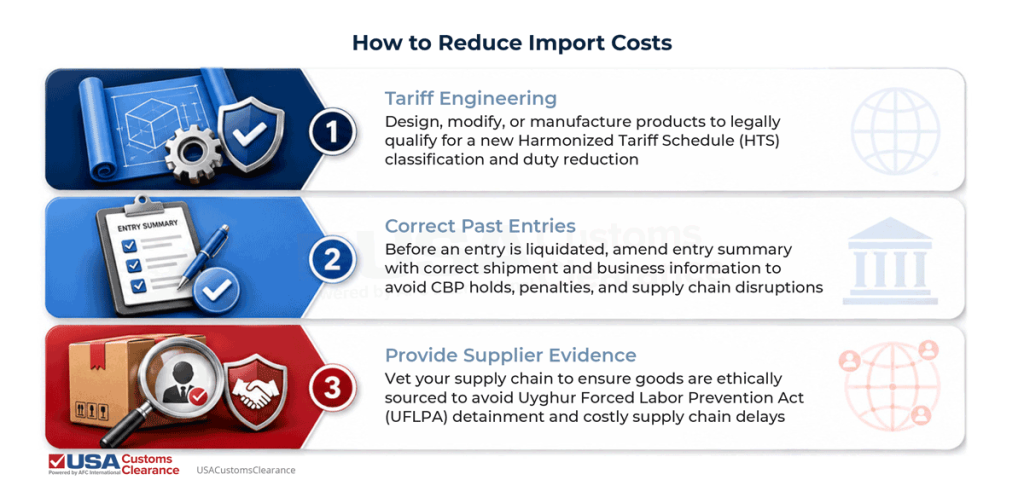
Unsure which classification your commodity falls under? Use our HTS Lookup Tool to find the tariff code for your goods and correctly calculate your customs fees obligation.
On February 20, 2026, the U.S. Supreme Court ruled that a U.S. President cannot impose tariffs under the International Emergency Economic Powers Act (IEEPA), invalidating President Trump’s reciprocal tariffs.
Importers who shipped goods subject to IEEPA tariffs, also known as reciprocal tariffs, may be eligible for an IEEPA tariff/duty refund.
CBP created the Consolidated Administration and Processing of Entries (CAPE) through the Automated Commercial Environment (ACE) portal to process IEEPA duty refunds.
To request a refund, CBP requires importers to:
CBP states that IEEPA refunds are generally issued within 60 to 90 days unless they discover compliance issues that require CBP review.
CBP enforces the America First Trade Policy with tighter import procedure scrutiny, including:
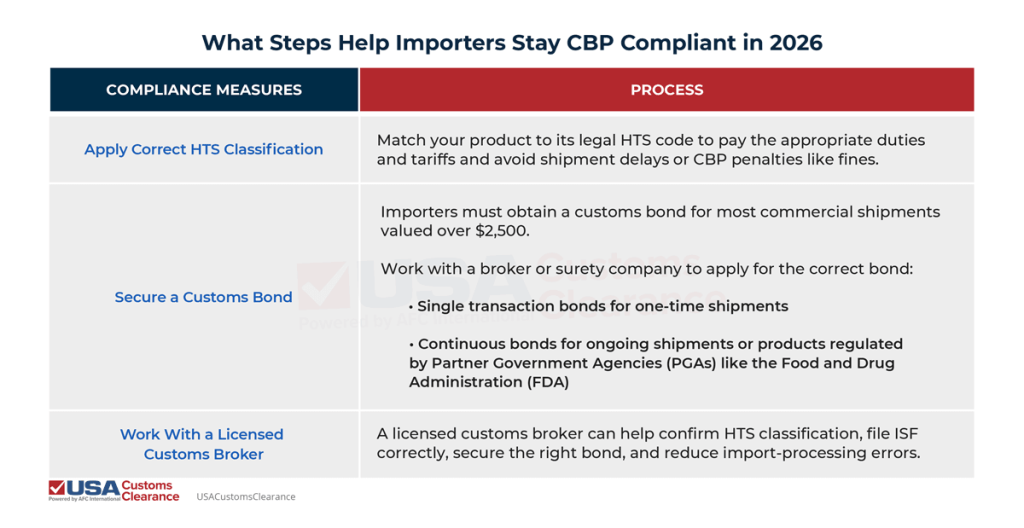
Importers navigating customs compliance and clearance should ensure all import paperwork is accurate and complete, as well as pay import fees and obtain customs bonds to avoid CBP audits, cargo holds, and supply chain interruptions.
To remain CBP compliant, importers should classify imported goods with correct HTS code, obtain a customs bond amount that matches import volume, and partner with a licensed customs broker to manage all customs documentation, payments, and clearance processes on their behalf.
Import Security Filing (ISF) is a CBP regulation to document ocean cargo imports. CBP requires importers to submit ISF documentation no later than 24 hours before the shipment arrives at your selected port of entry.
If you or your team are running into customs challenges like gathering and completing required documentation or assessing tariff exposure, call our team (855) 912-0406 for assistance. Our licensed customs brokers at your service.
Sources:
The President’s 2026 Trade Policy Agenda, United States Trade Representative, 2026
U.S. – Mexico – Canada Agreement (USMCA) Frequently Asked Questions, CBP
CONTINUING THE SUSPENSION OF DUTY-FREE DE MINIMIS TREATMENT FOR ALL COUNTRIES, The White House, 2026
Supreme Court Rules Against Tariffs Imposed Under the International Emergency Economic Powers Act (IEEPA), Congress, 2026
USMCA Joint Review: Process and Role of Congress, congress.gov
International Emergency Economic Powers Act (IEEPA) Duty Refunds, CBP, 2026
19 CFR § 134.4 - Penalties for removal, defacement, or alteration of marking.
Import Security Filing (ISF) - When to submit to CBP
 Copy URL to Clipboard
Did you find this article helpful?
See more of our coverage on Google.
Add usacustomsclearance.com as a preferred source!
Add usacustomclearance.com as a preferred source!
See more of our coverage in Google's Top Stories.
Get Customs, Tariffs, and Compliance Alerts at Your Fingertips
Sign up for VIP email alert access.

We know the importing process and requirements can be confusing, but they don't have to be.
We're here to help.
When purchasing a product from our website, you can feel confident knowing our team can help if you accidentally select the wrong product. We'll guide you through the correct purchase and any applicable refund process.
Important Refund Policy Information
Eligible refunds are subject to a $50 processing fee, which will be deducted from your original purchase amount. Please allow up to 90 days for refunds to be processed, as refunds are handled quarterly by our Accounting Department.
Refunds are available only if you have not yet:
Additional Refund Terms
You have 90 days from the date of purchase to submit your bond application. After 90 days, bond fees are forfeited and are nonrefundable.
All eBook sales are final and nonrefundable.
Add your first comment to this post