
IMPORT TARIFFS - LATEST NEWS & UPDATES





Did you find this article helpful?
See more of our coverage on Google.
Add usacustomsclearance.com as a preferred source!

US Customs and Border Protection (CBP) is a federal law enforcement agency that governs imported merchandise. Importers must submit specific data forms, meet partner government agency (PGA) requirements, and keep a compliant audit trail before CBP can release imported goods. Whether you’re new to importing or unfamiliar with the key steps in the customs clearance process, this step-by-step checklist will show what CBP expects from you, and what you can expect from them.
Key Takeaways
Let’s get started with procedures that need to take place before your goods start their journey to US shores.

Clear your imports with help from one of our Licensed Customs Brokers [(855) 912-0406]. They'll lay out the steps you'll need to complete to ensure your imports are in compliance.
Your Importer Security Filing (ISF) is one of the most important documents associated with customs clearance for ocean freight. This document must be submitted to CBP no fewer than 24 hours before your cargo is loaded onto its vessel. It requires you to fill out 10 data points, including but not limited to:
The ISF is also referred to as the 10+2 filing, as two of the data points will be submitted by the carrier.
When filling out your entry summary (CBP Form 7501), you’ll also need to identify your shipment’s entry type. A shipment valued at $2,500 or more will require formal entry, and you’ll need to have a continuous customs bond or single transaction bond on file to import it into the country.
If you’re importing goods for resale, you’ll most likely use one of the two following types of entries:
There are several other entry types that pertain to warehouse withdrawals and the dutiable status of merchandise. Another entry you probably won’t use as a commercial importer is the informal type, although there is still some confusion about the status of informal entries since the end of the de minimis exemption in 2025.
Type 86 was a low-value entry option that aligned with the de minimis rule. The de minimis rule allowed shipments valued at $800 or less to be imported into the US with no duties due.
De minimis was done away with by the Trump administration in 2025, and with it the type 86 entry became a thing of the past. Though there is still government documentation describing its application, it’s all outdated.
As part of the importer’s compliance responsibilities, you or your customs broker will be expected to submit certain documents within specific time frames. To simplify this timeline for you, I’ve broken down some forms that apply to any shipments arriving via ocean freight along with when they must be submitted to CBP, as well as some prerequisites that should be in place before you ever start ordering goods from overseas.
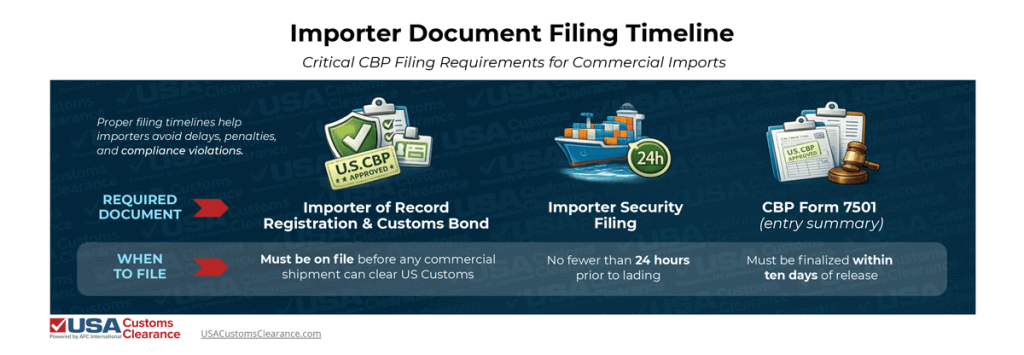
The penalties for failure to have these documents on file or accurately submitted vary. For instance, an incorrect or absent ISF can lead to fines of up to $5,000, and having no customs bond on file will, at the very least, hold your shipment up while you scramble to get a bond.
If you have your documents in order, the clearance and release process comes next.
While your shipment is in transit, CBP will use information from the ISF and 7501 forms to ascertain the risk status of cargo aboard the vessel. It’s during this time they’ll determine if any of your merchandise requires inspection once it reaches its port of destination.
There are a few reasons a customs hold or inspection can occur:
Some inspections can’t be anticipated, so it’s wise to always be prepared for the possibility. If you partner with a customs brokerage, the chances of inspection are lower since brokered shipments tend to send higher trust signals to CBP.
Our Licensed Customs Brokers [(855) 912-0406] can help upload your ISF. During a 45-minute consulitng session, they'll walk you through the steps and tell you what information you'll need.
The FDA uses Predictive Risk-based Evaluation for Dynamic Import Compliance Targeting (PREDICT) to prioritize inspections of regulated goods.
FDA regulated goods include:

If you attempt to import food that seems suspicious to the FDA, it may be held for inspection. Afterward, if further scrutiny is required, such merchandise could be detained and eventually refused entry into the US. You can track these holds through the Import Trade Auxiliary Communication System (ITACS) should they occur. The FDA may require you to submit additional documentation during inspection before they release your goods.
Another type of hold you might encounter if you import plants, or non-plant merchandise packaged in wood material, is a US Department of Agriculture (USDA) hold. The Animal and Plant Health Inspection Service (APHIS) is a program of USDA that specifically regulates wood packaging material. APHIS initiates holds to address pest and disease risks or to verify permit data.
If your shipment triggers a USDA hold, APHIS recommends contacting your customs broker as your first course of action. You can also double check your APHIS permit to ensure all information is accurate and sufficiently descriptive.
After CBP release, you’ll pay your estimated duties and other customs fees to CBP within 10 days through the Automated Commercial Environment (ACE) portal. Your customs broker can submit these payments on your behalf using Automated Broker Interface (ABI) software.
Qualifying importers can enroll in CBP’s Periodic Monthly Statement (PMS) program. This is a huge advantage for businesses looking to streamline their administrative processes. Usually, payments will be due as late as the 15th day of the month after your shipment’s arrival. If you shipped goods to multiple ports, you can even consolidate your entry statements into one statement.
Here’s the playbook you need to follow if your imports are held by customs:
If your shipment comes under scrutiny by CBP, it may be held, inspected, and even rejected based on the agency’s findings from a cargo examination. You’ll receive notification of this from your customs broker or directly from CBP should a hold or examination be triggered. Investigate the notification to determine the cause of your hold.
Speaking of customs brokers, you’re already ahead of the game if you’re partnering with a broker when a shipment is held. They can easily maintain open lines of communication with CBP during the process and provide you with regular status updates.
You may need to submit additional documentation proving your shipment’s country of origin, PGA compliance, or other information in order to get your shipment released. This is why it’s always a best practice to double check the information on your ISF and entry summaries, vet your supply chain, and conduct routine customs compliance audits: preparation is the best way to minimize the chance of your shipment being delayed or rejected at customs.
You or your customs broker should monitor the status of your hold after submission of new or updated information each day for more updates.
Ensuring your shipments are compliant with regulations established by CBP and PGAs is a difficult task, one that customs brokers do every day of the work week. The benefits of partnering with a Licensed Customs Broker from USA Customs Clearance far outweigh the costs, especially for new and inexperienced importers.
Give us a call at (855) 912-0406 or fill out a contact form online and take the guesswork out of clearing imported shipments.
FAQ
What must I file before importing?
You’ll need an ISF if your imports are arriving via ocean vessel and a CBP Form 7501, also known as the entry summary.
Can I still use the Type 86 for low-value imports?
No, the Type 86 is no longer valid because the de minimis rule has ended.
What are the cutoffs and penalties for filing import documents?
The ISF must be filed 24 hours before the ocean vessel transporting your freight is loaded. File your Entry Summary within 10 days of release. Incorrect or late filings can result in fines worth thousands of dollars.
How do I pay duties and can I streamline payments?
You can pay estimated duties and fees using ACE. You can also use the PMS to consolidate entries and streamline your payments.
What should I do if my shipment is held, inspected, or refused?
Stay in contact with your broker and CBP. You may be required to provide additional information for your import.
Legal disclaimer: All information provided is not to be taken as legal advice.
 Copy URL to Clipboard

Did you find this article helpful?
See more of our coverage on Google.
Add usacustomsclearance.com as a preferred source!
Add usacustomclearance.com as a preferred source!
See more of our coverage in Google's Top Stories.
Licensed customs support for importers across a wide range of U.S. entry needs. USA Customs Clearance provides Customs Bonds, Consulting, Customs Brokerage, Manifest Confidentiality, Importer of Record support, and Guides & Resources to help importers prepare for U.S. Customs and Border Protection (CBP) requirements and customs clearance with regulatory compliance, greater clarity, and confidence.
With licensed broker support, transparent service information, and secure checkout, we help importers take the right next step.

Add your first comment to this post