
IOR ENFORCEMENT IS NOW IN EFFECT | REVIEW MY IOR





Importers in the U.S. can expect to pay an HMF when shipping goods into the U.S. on a cargo vessel. CBP assesses the HMF to fund upkeep at U.S. ports, and it’s one of the customs fees businesses must incorporate into their import transactions when using ocean freight shipping. In this article we define the HMF, explain its purpose, and identify when importers will need to incorporate it into their landed cost calculations.
Harbor maintenance fee (HMF) is a U.S. customs fee equal to 0.125% of the value of qualifying commercial cargo moved by vessel through covered U.S. ports. U.S. Customs and Border Protection collects the fee, and importers usually include it in landed cost calculations.
The regulations establishing and governing the implementation of the HMF can be found in 19 CFR § 24.24, and the fee is collected to support port upgrades and routine maintenance.
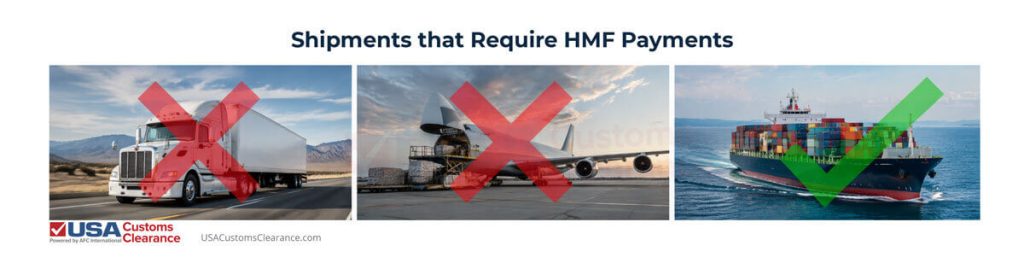
Since the fee is used for ocean ports, it does not apply to air freight or terrestrial shipments via truck and rail.
The HMF must be paid by the Importer of Record (IOR) or an authorized agent performing customs work on their behalf. A licensed customs broker is one such agent that can take care of this responsibility for an importer.
The HMF for 2026 is set at .125% of a commercial shipment’s valuation. It applies to the majority of commercial shipments coming into the United States by vessel with limited exceptions.
Commodities and situations in which the HMF would not apply include:
Unlike Merchandise Processing Fees (MPFs), there is no minimum or maximum HMF for imported shipments. Whether a shipment is worth $10,000 or $1,000,000, the HMF percentage is 0.125% ad valorem.
The main difference between HMFs and MPFs is that HMFs only apply to shipments that arrive via ocean freight, while MPFs apply to all imported commercial shipments that aren’t excluded by a trade act.
For instance, if two shipments of equal value arrived in the U.S., one via ocean freight and the other via truckload from Canada, both shipments would be subject to the MPF, but only the ocean shipment would be subject to the HMF.
The MPF is also subject to more fluctuation than the HMF. CBP increased the minimum and maximum thresholds for merchandise processing fees to $33.58 and $651.50 respectively in October 2025, while the HMF has held steady for years.
An importer can estimate a shipment’s HMF by multiplying its value by .00125. The resulting figure is the HMF for the imported goods.
For instance, an importer brings $100,000 worth of textiles imported from Vietnam into the Port of Los Angeles in California via a cargo vessel. While estimating their landed costs, they multiply $100,000 by .00125. This results in an HMF of $125.00.
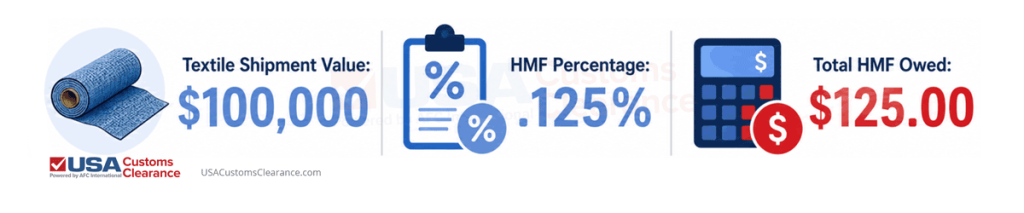
The importer adds the $125 to fees payable to CBP during customs clearance, in addition to duties, MPFs, and any other applicable customs fees.
For a second example, an importer needs to expedite $50,000 worth of imported machinery into the U.S. and books the shipment to arrive via air freight. The importer would multiply $50,000 x .00125 to estimate their HMF…if the shipment were coming in via ocean freight. Remember, this fee doesn’t apply to air shipments, so the HMF for this transaction would be $0.00.
One of the most common mistakes new importers make with the HMF is neglecting to factor the fee into their costs. While not nearly as costly as other customs fees like duties, failure to take all customs fees into account puts importers in the position of paying unexpected costs to CBP.
Other mistakes importers make when estimating the HMF include:
If you need help calculating customs fees or have other questions about customs clearance, our team of Licensed Customs Brokers can help. Call us at (855) 912-0406 or contact us online at your earliest convenience.
Title 19, Chapter I, Part 24, 24.24 Harbor Maintenance Fee, Code of Federal Regulations, 2026
 Copy URL to Clipboard
Did you find this article helpful?
See more of our coverage on Google.
Add usacustomsclearance.com as a preferred source!
Add usacustomclearance.com as a preferred source!
See more of our coverage in Google's Top Stories.
Licensed customs support for importers across a wide range of U.S. entry needs. USA Customs Clearance provides Customs Bonds, Consulting, Customs Brokerage, Manifest Confidentiality, Importer of Record support, and Guides & Resources to help importers prepare for U.S. Customs and Border Protection (CBP) requirements and customs clearance with regulatory compliance, greater clarity, and confidence.
With licensed broker support, transparent service information, and secure checkout, we help importers take the right next step.

Add your first comment to this post