

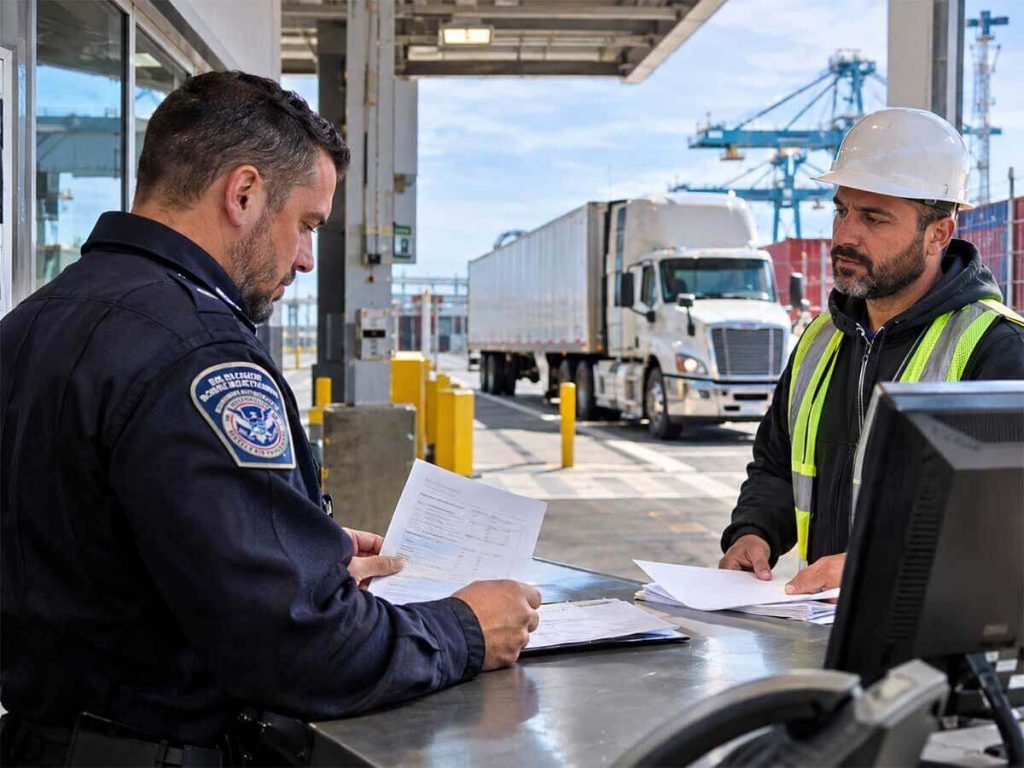

U.S. Customs and Border Protection (CBP) published an interim final rule (IFR) on November 6, 2026, titled ‘Heightened Requirements for Foreign Importers of Record’. It establishes new requirements for entities applying for Importer of Record (IOR) status, particularly for foreign IORs. The new rule requires foreign IORs to either obtain Customs Trade Partnership Against Terrorism (CTPAT) validation or designate a CTPAT-validated licensed customs broker to make entry. It also establishes new eligibility requirements for U.S. importers of record.
This rule is scheduled to go into effect on January 5, 2027, leaving importers with little time to prepare for CBP’s new IOR eligibility rules. While it specifically refers to foreign importers, Heightened Requirements for Foreign IORs also affects U.S. IOR qualifications.
What Changed Under CBP's New Importer of Record Rules?
CBP’s new IOR rule affects U.S. and foreign importers in different but notable ways:
- U.S. IOR: Establishes new eligibility requirements for individuals, companies, or entities that apply for and receive U.S. IOR status, such as citizenship, real property ownership, and U.S.-owned majority control.
- Foreign IOR: Must be CTPAT validated (not just certified) or work through a licensed U.S. customs broker who has CTPAT validation to enter or withdraw goods for consumption in the U.S.
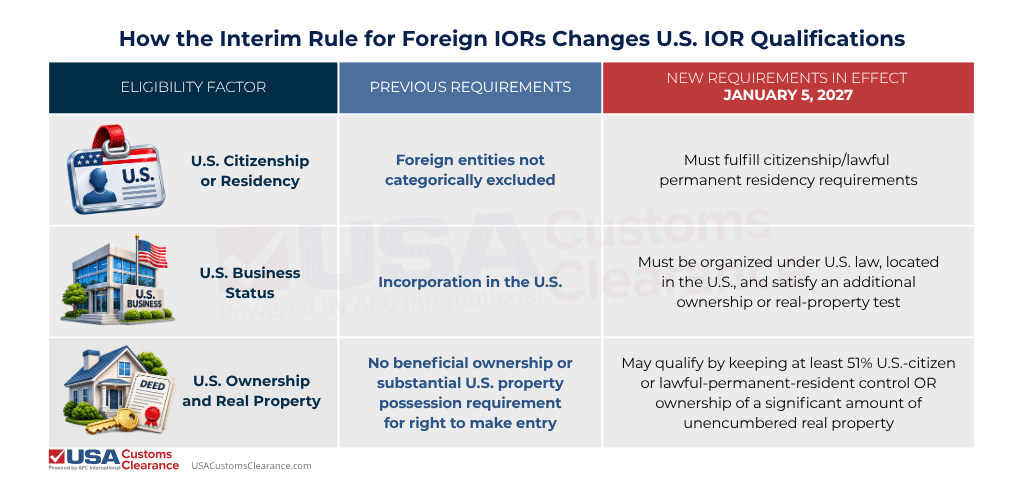
Here’s a graphic that explains how the interim rule changes foreign IOR requirements.
Even importers who have previously qualified as a U.S. IOR must ensure they meet these new qualification requirements or risk losing IOR status under the IFR.
Who Can Qualify as a U.S. Importer of Record?
Under 19 CFR § 110.2, an individual qualifies as a U.S. IOR if they are a U.S. citizen or lawful permanent resident. Business entities must satisfy three requirements to qualify as a U.S. IOR:
- U.S. location: The business must be located in the United States, including Puerto Rico.
- U.S. organization: The business must be organized under U.S. law.
- Ownership or real property: The business must maintain either at least 51% qualifying U.S. beneficial ownership with control or direct ownership of a significant amount of unencumbered real property in the United States.
Importers who do not meet the U.S. IOR qualifications are classified as foreign IORs under 19 CFR § 110.3.
The beneficial ownership and real property ownership provisions of U.S. IOR eligibility are new under this interim rule. IOR applicants should also be aware that the interim rule’s language implies that a rented office or workspace is insufficient to meet the real property rule.
What Are the New CTPAT Requirements for Foreign Importers of Record?
Under the interim rule, foreign IORs must be validated under CTPAT to make entry themselves or withdraw goods for consumption. Foreign IORs who don’t have this validation will need to work through a CTPAT-validated U.S. customs broker in order to have their imported goods released into the U.S. market.
Option 1: Obtain CTPAT Validation
Acquiring CTPAT validation begins by applying for CTPAT certification. This certification is an agreement between the foreign IOR and CBP to identify security gaps in the importer’s supply chain, put measures in place to correct them, and establish best practices to avoid bad actors in the international supply chain going forward.
Importantly, CTPAT validation for foreign importers is only available to nonresident Canadians. It can take over 12 months to gain CTPAT validation even for foreign IORs based in Canada, so foreign importers will most likely need to work through a licensed customs broker to clear U.S. customs starting on January 5.
Option 2: Work With a CTPAT-Validated Customs Broker
Foreign IORs who are not CTPAT-validated themselves have the option of partnering with a validated customs broker in the U.S. to clear goods at customs. Non-validated foreign IORs must confirm that their designated licensed customs broker holds CTPAT-validated status.
A CTPAT-validated broker may make an entry on behalf of a non-validated foreign IOR without necessarily assuming IOR responsibilities. However, the broker must act as the IOR when the foreign principal on the power of attorney is not the owner or purchaser of the merchandise.
The customs broker option does not necessarily require the broker to also act as IOR: the interim final rule contains specific provisions under which a foreign IOR retains their status without shifting those responsibilities to the customs broker. Therefore, foreign IORs don’t necessarily need their customs broker to act as a third-party IOR to use this option for customs clearance.
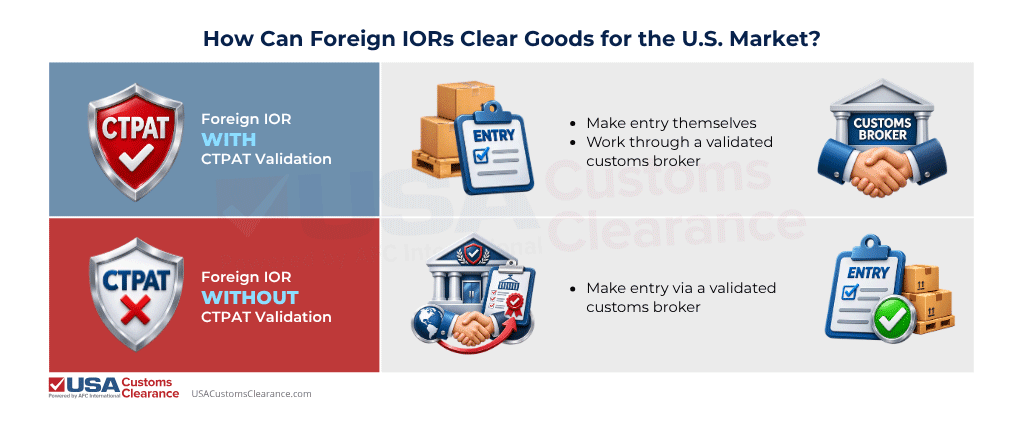
Not all foreign entities can qualify for CTPAT certification, and the timeline for validation can take well over a year.
New CBP Form 3461 and 7501 Filing Requirements
CBP’s interim rule for foreign importers includes the addition of three new data fields to Forms 3461 and 7501.
- U.S. Importer of Record: Select yes to assert that the importer is a qualified U.S. IOR or that the broker and principal on the required power of attorney (POA) form meet the criteria.
- Acting on behalf of: Select yes only if the broker lists themselves as the filer and IOR for purposes of filing an entry on behalf of the principal on the POA.
- Principal on Power of Attorney: Required when a non-CTPAT-validated broker acts as the IOR on behalf of a principal. The broker must report the principal’s IOR number linked to the principal’s IOR registration form (CBP Form 5106).
If these fields are not checked accurately, or if the documents supporting their claims are not verifiable by CBP and/or a customs broker, the affected shipments will likely be rejected under the IFR.
Why CBP May Reject Customs Entries Beginning January 5, 2027
When the IFR for foreign importers goes into effect, CBP may reject entries and entry summaries for the following reasons:
- A foreign IOR tries to file an entry when they are not validated by CTPAT or working through a CTPAT-validated customs broker.
- A customs broker that is not CTPAT-validated does not provide the required principal when acting as the IOR.
A rejected entry summary may be refiled once any erroneous information is corrected. However, if the shipment itself is rejected, importers will be faced with consequences from demurrage charges while the shipment is held to loss of cargo if the goods are rejected entirely.
To prevent rejections, it’s vital for importers to begin verifying their relevant documentation such as tax IDs, property ownership records, business structures, and personal identification. Correcting and updating those records before January 5 will mitigate the potential for delays and loss of cargo during customs clearance.
What Importers Should Do Before January 5, 2027
U.S. and foreign IORs alike should prepare for the January 5 effective date with a thorough documentation review, ideally with support from a licensed customs broker. This process should begin by identifying whether the individual or entity qualifies as a U.S. IOR or must file as a foreign IOR.
For U.S. IORs:
- Have sufficient documentation to prove U.S. IOR status under the IFR, such as personal identification, citizenship records, tax documents, deeds of real property ownership, and business structure proving a minimum of 51% U.S. beneficial ownership with control or direct ownership of a significant amount of unencumbered real property in the U.S.
- Be prepared to provide those records to CBP or your customs broker if and when requested.
For Foreign IORs
- If CTPAT-validated, make sure validation documents are ready for review by CBP or your customs broker.
- Foreign IORs who aren’t CTPAT validated must work through a licensed customs broker who has the necessary validation to make entry. Certification is not sufficient for your customs broker to make entry on your behalf.
- Confirm your customs broker’s validation status with CBP or their plan to file a compliance extension.
- Identify shipments arriving after the order goes into effect and develop a contingency plan for any potential ACE entry filing rejections or shipment holds.
Importers who don’t qualify for U.S. IOR status will have to rely on their customs brokers to clear shipments through customs once the IFR goes into effect.
How a Licensed Customs Broker Can Help With the New IOR Requirements
Licensed customs brokers with CTPAT validation can assist foreign IORs by using their CTPAT status to satisfy CBP’s requirements for clearance by non-validated foreign entities. For U.S. IORs, a customs broker can provide valuable assistance by reviewing identification and business documents to ensure they establish U.S. IOR eligibility if CBP requests verification.
To schedule a consultation with a licensed customs broker, call us at (855) 912-0406.

 Copy URL to Clipboard

Did you find this article helpful?
See more of our coverage on Google.
Add usacustomsclearance.com as a preferred source!

Add usacustomclearance.com as a preferred source!
See more of our coverage in Google's Top Stories.

Add your first comment to this post