
IOR ENFORCEMENT IS NOW IN EFFECT | REVIEW MY IOR


In This Article:


Import documentation mistakes are errors made on paperwork required for customs clearance. Most imports require some type of documentation that’s reviewed by Customs and Border Protection (CBP) before they’re allowed to enter the country. Partner Government Agencies (PGAs) that work with CBP may have paperwork requirements if an importer’s goods fall under their jurisdiction. Import documentation mistakes can complicate the customs clearance process by causing delays and costly fines and penalties.
Common mistakes made on import documentation include:
Understanding these mistakes and how they occur is the first step to learning how to avoid them.
Common mistakes made on commercial invoices include incomplete or inaccurate descriptions, quantities, and values of the merchandise. The appropriate 10-digit subheading from the Harmonized Tariff Schedule (HTS) of the United States is required on the document as well.
CBP requires complete and accurate commercial invoices with each customs entry before it releases the merchandise. Therefore, an incorrect commercial invoice can delay the clearance of your imports.
CBP and PGAs require import documents to have detailed product descriptions. This information helps them safely and legally process goods entering the country. Vague product descriptions can make it difficult to classify tariffs, inspect cargo, and confirm regulatory and security compliance.
While the exact information required can vary from document to document, a precise description that’s clear, concise, and in plain language should always be given. CBP says that superfluous information that’s not relevant to the commodity description should be left out.
Here’s a graphic that shows the difference between vague and detailed product descriptions.
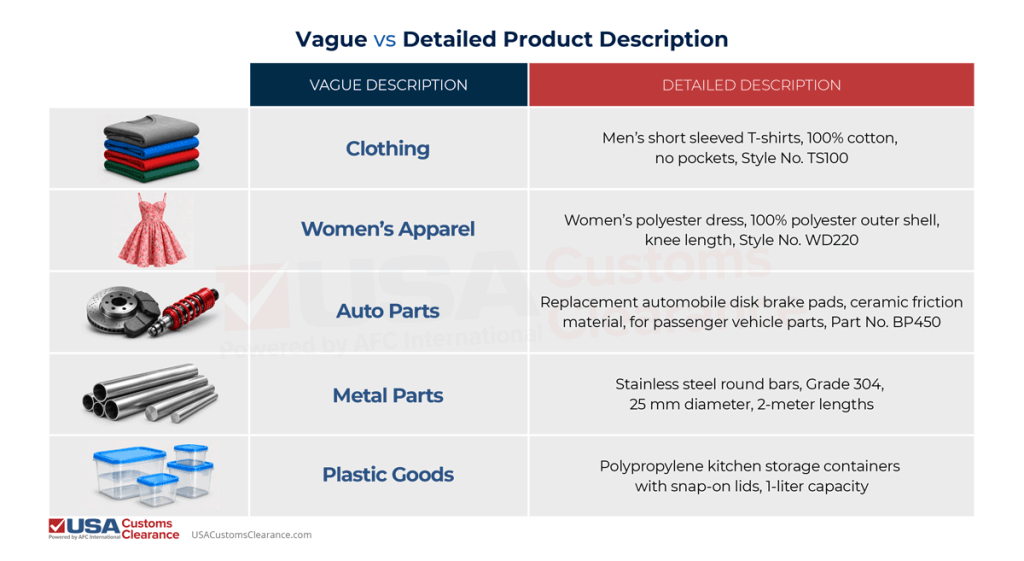
According to CBP, all superfluous information that’s not relevant to the commodity description should be left out.
HTS codes are 10-digit numbers used to classify goods and calculate customs duties. Using an incorrect HTS code can result in the wrong tariff being applied to imported goods. This can result in importers overpaying or underpaying tariffs. Neglecting to put HTS codes on required customs documents can lead to delays and costly fines.
Here’s an example of using the wrong HTS code:
An importer takes the 10-digit Schedule B number previously used to export a product and puts it on the U.S. import entry. While Schedule B numbers and HTS codes share the same first six digits for the same product, the final four digits can differ. The incorrect use of the Schedule B number and absence of an HTS code results in an incorrect tariff being applied to the imported goods.
The declared value is the value importers report to CBP for imported merchandise on entry documentation. Importers can accidentally overvalue or undervalue their goods on their import documents. The consequences for not reporting the correct value on customs paperwork can differ based on whether the error results from negligence, gross negligence, or fraud.
Here’s an example of providing an incorrect declared value:
An importer pays $100,000 for merchandise. They also pay the seller a $5,000 licensing fee as a condition of purchasing the merchandise. The importer only declares a value of $100,000. This value is incorrect because certain royalties and license fees related to the imported merchandise must be added when payment is a condition of the sale for export to the United States.
CBP cross checks documentation for accuracy. When information across documents is inconsistent, it can make it difficult for CBP to verify what was imported. Clearance delays and penalties are soon to follow when this occurs.
We’ve provided a table with examples of inconsistent information across import documents.
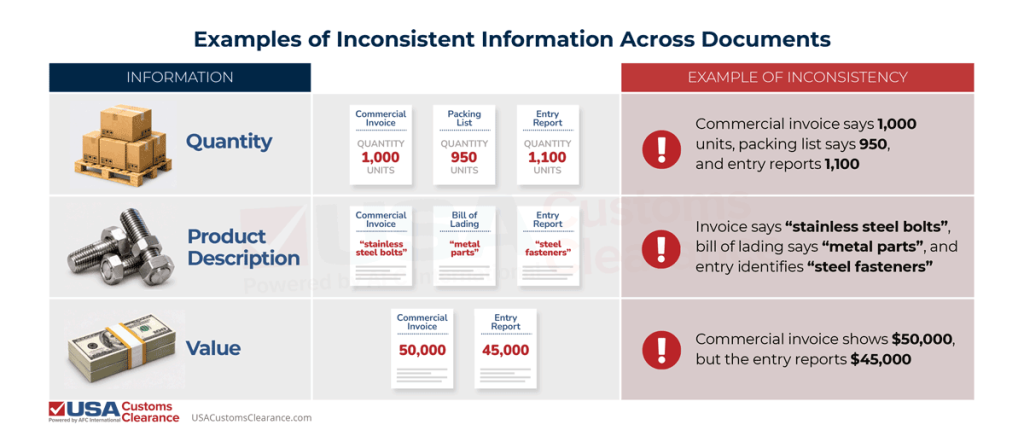
Having one accurate document is not enough if the others contain errors. All documentation must be complete, accurate, and consistent.
Not providing the appropriate documents for imports can cause the same problems as documents that are incomplete or inaccurate. This typically happens when importers don’t know the documentation requirements for their goods. In addition to common types of paperwork, permits, inspection records, and health or safety certificates might be required.
A certificate of origin is a document required by customs authorities when seeking preferential tariff treatment, when goods are subject to specific trade restrictions, or when customs authorities need to verify origin claims. A missing or incorrect certificate of origin can result in loss of preferential tariff treatment, potential penalties for unsupported or inaccurate claims, or delays in customs clearance.
Here’s an example of a certificate of origin that was incorrectly filled out:
An importer purchases merchandise from a Mexican distributor and assumes the goods qualify as Mexican-origin under the United States-Mexico-Canada Agreement (USMCA). However, the products were manufactured in China and merely warehoused and shipped from Mexico.
Unless subsequent production causes the merchandise to meet applicable USMCA rules of origin, certifying those goods as USMCA-originating would be incorrect.
Incoterms® are standardized international trade rules established by the International Chamber of Commerce (ICC). While not required by customs authorities, Incoterms® help buyers and sellers understand their responsibilities in an international transaction. However, confusion can arise if both parties don’t agree to the same term that works best for their transaction or if the term doesn’t correspond with the chosen method of international shipping.
Here’s an example of incorrectly using Incoterms®:
A buyer and seller use the FOB Incoterm® for containerized goods that the seller delivers to a port terminal before the goods are loaded onto a vessel. Because FOB transfers risk once the merchandise is on board the vessel, the FCA Incoterm® may be more appropriate when the seller’s responsibility ends after delivering the container to the carrier at the terminal.
Multiple import documents request detailed information about the importer, consignee, and supplier. Information about these entities that is typically requested includes legal/business name, address, phone number, and point of contact for compliance inquiries. Penalties for incorrect information about these entities can vary based on the document where the mistake occurs, but they can include legal, financial, and operational repercussions.
Here are some examples of incorrectly using importer, consignee, and supplier information:
In some examples, the information isn’t necessarily wrong. Instead, it’s attributed to the wrong entity.
Changes can occur before a shipment travels overseas. These changes can include increased product quantities, purchase-price increases or decreases, product substitutions, or revised freight arrangements. Any changes to the shipment should be reflected in the import documents before the goods arrive in the U.S. If information in the documents contradicts the shipment, it’ll lead to problems with CBP and PGAs.
Here’s a table showing some practical examples of shipment changes that warrant documentation updates.
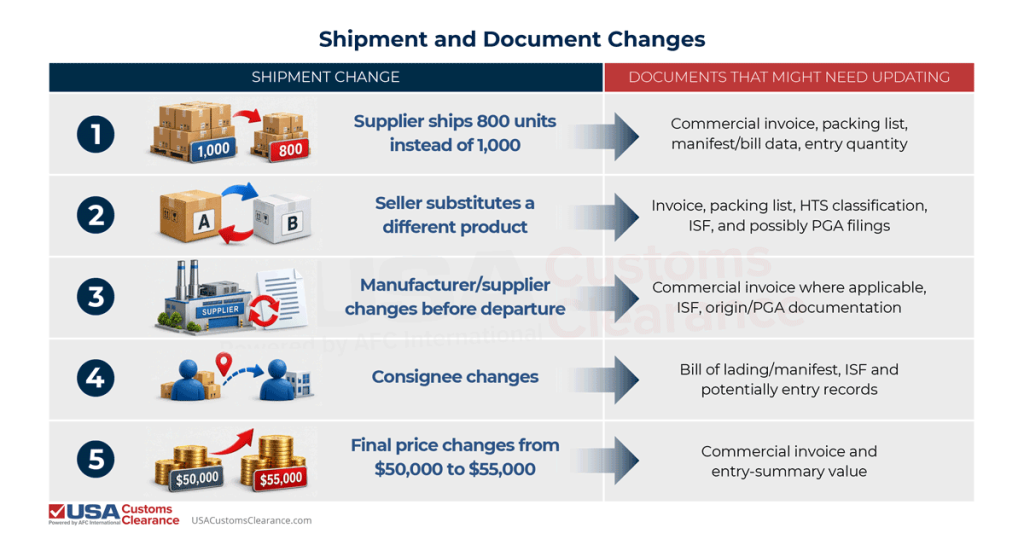
Having one accurate document is not enough if the others contain errors. All documentation must be complete, accurate, and consistent.
Goods regulated by PGAs often require additional documentation, which can include phytosanitary certificates, declarations, prior notices, product registrations, and HS-7 declarations.
Here’s a table showing some common mistakes made on a variety of PGA import documentation.
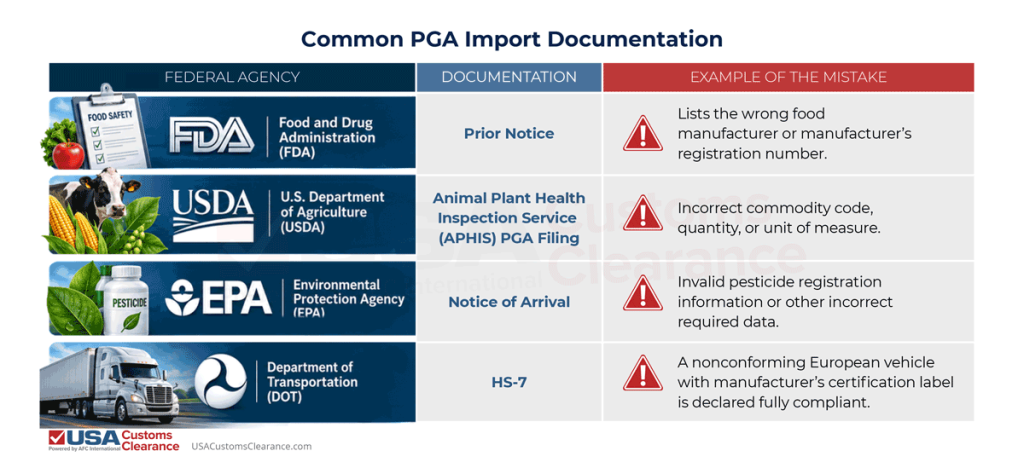
The required documents and what information they require vary based on the agency regulating the goods, which can make it easy for importers to make mistakes.
Mistakes in import documentation can result in repercussions like customs clearance delays, incorrect application of duties and taxes, shipment holds or inspections, penalties and compliance exposure, and additional logistics and storage costs.
Serious violations involving material information such as classification, value, origin, quantity, or importer identity can result in liquidated damages and civil penalties for importers that fail to exercise reasonable care.
Fortunately, import documentation mistakes are preventable. We’ve compiled simple practices that importers can implement to avoid mistakes on their customs paperwork.
These steps might lengthen the amount of time it takes to compile and fill out your import documentation.
Importers should ask for documentation support from a Customs Broker if they’re new to importing or don’t have a designated customs clearance specialist to help them. Documentation is only one challenge when it comes to bringing goods into the country. There are a variety of regulations and policies importers will have to follow.
Customs Brokers are licensed by CBP, which means they have all the information importers will need to clear their shipments successfully.
USA Customs Clearance has numerous import specialists that can assist you with your documentation. During a consulting session, you’ll be able to get clarity on your documentation and ensure that all the information you’ve recorded is correct. If you have more questions about how we can help with your customs paperwork, give us a call at (866) 849-4923 or reach out on our contact page.
 Copy URL to Clipboard
Did you find this article helpful?
See more of our coverage on Google.
Add usacustomsclearance.com as a preferred source!
Add usacustomclearance.com as a preferred source!
See more of our coverage in Google's Top Stories.
Licensed customs support for importers across a wide range of U.S. entry needs. USA Customs Clearance provides Customs Bonds, Consulting, Customs Brokerage, Manifest Confidentiality, Importer of Record support, and Guides & Resources to help importers prepare for U.S. Customs and Border Protection (CBP) requirements and customs clearance with regulatory compliance, greater clarity, and confidence.
With licensed broker support, transparent service information, and secure checkout, we help importers take the right next step.

We know the importing process and requirements can be confusing, but they don't have to be.
We're here to help.
When purchasing a product from our website, you can feel confident knowing our team can help if you accidentally select the wrong product. We'll guide you through the correct purchase and any applicable refund process.
Important Refund Policy Information
Eligible refunds are subject to a $50 processing fee, which will be deducted from your original purchase amount. Please allow up to 90 days for refunds to be processed, as refunds are handled quarterly by our Accounting Department.
Refunds are available only if you have not yet:
Additional Refund Terms
You have 90 days from the date of purchase to submit your bond application. After 90 days, bond fees are forfeited and are nonrefundable.
All eBook sales are final and nonrefundable.
Add your first comment to this post