
IOR ENFORCEMENT IS NOW IN EFFECT | REVIEW MY IOR


In This Article:


Importing aluminum into the U.S. requires correct Harmonized Tariff Schedule (HTS) classification, review of Section 232 and other tariff exposure, compliance with AIM licensing when applicable, complete shipping documents, and accurate customs filing. This guide explains each step, common mistakes, and how to reduce clearance delays.
To clear aluminum through U.S. customs, classify the product under the correct HTS code, review Section 232 and other duty exposure, secure a customs bond if required, prepare the invoice and shipping documents, submit ISF for ocean freight, and file the entry with accurate tariff and origin data.
Use the following checklist to successfully clear your shipment of aluminum.
Assuming you’ve factored in all applicable duties and your goods aren’t prohibited due to non-tariff barriers, following these steps will typically result in a smooth customs clearance process.
There are multiple tariffs that apply to imported aluminum, starting with the duty rates found in the HTS.
The ranges for those duties include:
Imported aluminum and many of its derived goods are also subject to Section 232 tariffs of 10% to 50%. These tariffs apply even if the general rate of duty is listed as free.
For example, a 50% tariff applies to unwrought aluminum. If an importer brought in $10,000 worth of unwrought aluminum coils (HTS code 7601.10.3000) with no associated rate of duty in chapter 76 of the HTS, the 50% Section 232 tariff would still apply. Therefore, assuming the Section 232 rate isn’t modified by a trade agreement, the shipment would incur duties of $5,000 (50% of $10,000).
For a second example, an importer brings in $10,000 worth of machinery which consists of more than 15% foreign aluminum by weight. The Section 232 tariff rate would be 25%, so in addition to the duty rate for the machinery itself, the importer would owe $2,500 in Section 232 duties.
Products which contain 15% or less of foreign metals are not subject to Section 232 tariffs.
Importers need to be aware of tariffs that specifically apply to Chinese goods and AD/CVDs, which primarily affect suppliers and manufacturers in China.
One of these tariffs is enacted under Section 301 of the Trade Act of 1974, and applies to the earlier example of unwrought aluminum coils. In addition to the 50% Section 232 tariff, that same commodity sourced from China is subject to a 100% Section 301 tariff. This leads to customs fees in excess of the aluminum’s value, which makes importing most aluminum products from China less than ideal for U.S. importers.
AD/CVDs can apply to a product based on its country of origin or the producer/manufacturer of said product. There are over 270 AD/CVD orders against suppliers in China according to data from the International Trade Administration (ITA), so importers who plan to source aluminum from the world’s factories must do their due diligence in making sure the import is profitable after they’ve paid all the required customs fees.
One document required for aluminum imports that isn’t required for most import transactions is a license from the ITA. Importers can get this license from the Aluminum Import License (AIM) system on ITA’s website.
Additionally, CBP requires the same documents for aluminum imports as they do for other commodities. Some of these must be submitted during customs clearance, and others contain information importers need to fill out their customs forms.
They include:
Importers will also need a customs bond for any imported shipment valued at $2,500 or more. Businesses that plan to import frequently should get a continuous customs bond, while single entry bonds may be appropriate for sporadic shipments throughout a 12-month period.
Aluminum products are varied, but most are described in chapter 76 of the HTS.
Common product types include:
The following table contains information about aluminum imports in 2025, including the value of imported aluminum on a per-Harmonized System (HS) code basis.
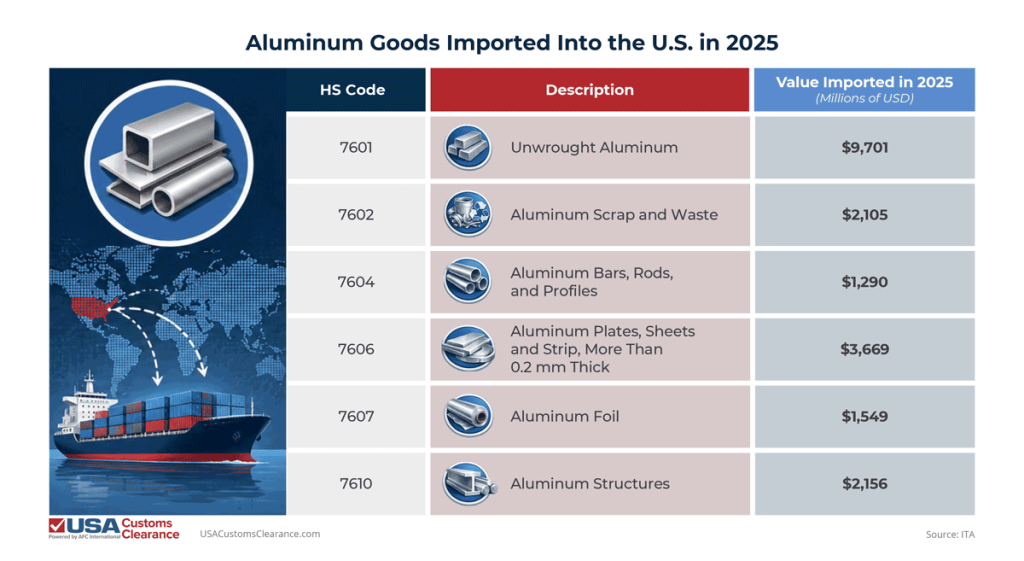
As the data shows, different types of aluminum are imported to the U.S. for various purposes.
Historically, the U.S. has imported most of its aluminum from Canada. In 2024, Canada accounted for 3.2 million metric tons of aluminum exported to the U.S. While increased tariffs and less hospitable trade relations have impacted the U.S./Canada trade relationship, Canada continued to be a top supplier of aluminum to the U.S. in 2025.
The table below shows the top three supplying countries for each aluminum HS code I’ve addressed earlier in the article.
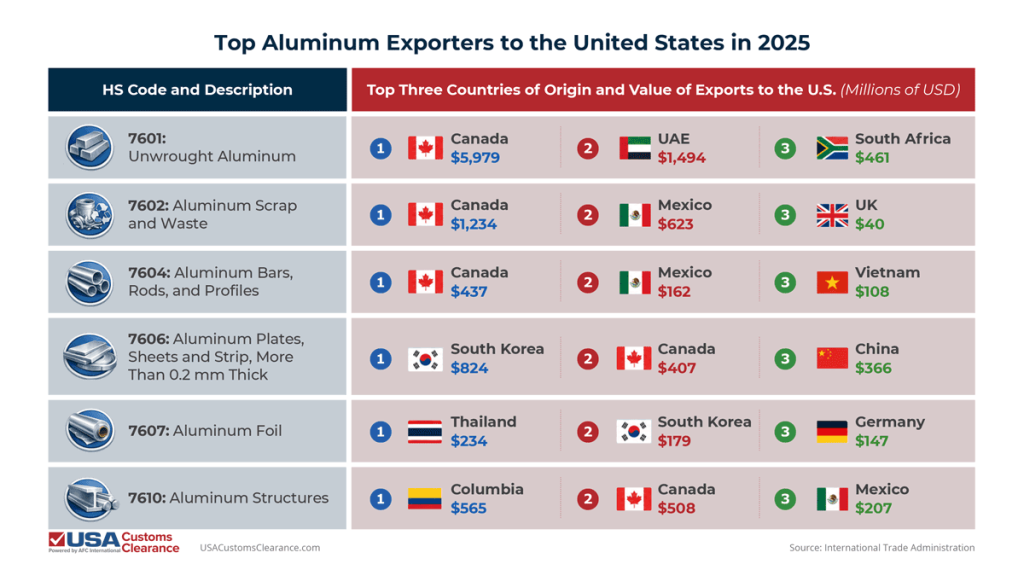
China, while a popular source for finished consumer goods, is less popular as an aluminum supplier due to high Section 301 tariffs and difficult-to-anticipate AD/CVDs.
Importers, especially inexperienced ones, often make mistakes classifying products with the HTS. Using the HTS requires understanding the General Rules of Interpretation, a set of regulations that must be followed to ensure accurate tariff classification.
Manufacturers may provide an HTS code for their exported goods, but it’s the responsibility of the importer to use the correct code and pay the corresponding duties. For this reason, many importers work with customs consultants with extensive knowledge of the HTS to avoid potential classification errors.
CBP also looks for consistency between documents involved in shipping, transactions, and the customs clearance process. If there are discrepancies between the BOL, packing list, commercial invoice, ISF, and entry summary, CBP may find the shipment suspicious and hold it for inspection.
Holds may be initiated for the following reasons:
If you are unsure about classification, tariff stacking, or document consistency, a licensed customs broker can review the shipment before filing.
Importing aluminum successfully depends on correct classification, complete documentation, and a full review of tariff exposure before filing. If your shipment involves China sourcing, derived products, or uncertain tariff treatment, a pre-entry review can reduce risk before the goods arrive.
Do I need a customs bond to import aluminum?
A customs bond is required for commercial shipments of aluminum that meet or exceed a valuation of $2,500.
Are aluminum imports subject to Section 232 tariffs?
Yes, aluminum is subject to Section 232 tariffs of up to 50% ad valorem.
How can a customs broker help with aluminum imports?
Licensed Customs Brokers are experienced with CBP paperwork and can ensure speedy, accurate submission of documents while also providing advice about sourcing products and avoiding AD/CVDs.
Importer Security Filing (ISF) - When To Submit To CBP, U.S. Customs and Border Protection, 2025
Section 301 of the Trade Act of 1974, Congress, 2026
U.S. Steel Industry Import Licensing, International Trade Administration
Trade Stats Express - U.S. Trade by Partners, International Trade Administration, 2025
The Top of U.S. Steel and Aluminum Imports, Reuters, 2025
 Copy URL to Clipboard
Did you find this article helpful?
See more of our coverage on Google.
Add usacustomsclearance.com as a preferred source!
Add usacustomclearance.com as a preferred source!
See more of our coverage in Google's Top Stories.
Licensed customs support for importers across a wide range of U.S. entry needs. USA Customs Clearance provides Customs Bonds, Consulting, Customs Brokerage, Manifest Confidentiality, Importer of Record support, and Guides & Resources to help importers prepare for U.S. Customs and Border Protection (CBP) requirements and customs clearance with regulatory compliance, greater clarity, and confidence.
With licensed broker support, transparent service information, and secure checkout, we help importers take the right next step.

We know the importing process and requirements can be confusing, but they don't have to be.
We're here to help.
When purchasing a product from our website, you can feel confident knowing our team can help if you accidentally select the wrong product. We'll guide you through the correct purchase and any applicable refund process.
Important Refund Policy Information
Eligible refunds are subject to a $50 processing fee, which will be deducted from your original purchase amount. Please allow up to 90 days for refunds to be processed, as refunds are handled quarterly by our Accounting Department.
Refunds are available only if you have not yet:
Additional Refund Terms
You have 90 days from the date of purchase to submit your bond application. After 90 days, bond fees are forfeited and are nonrefundable.
All eBook sales are final and nonrefundable.
Add your first comment to this post