
IOR ENFORCEMENT IS NOW IN EFFECT | REVIEW MY IOR



In This Article:


A post-entry customs correction is a process importers use to fix errors in a customs filing after entry submission. The right correction method depends on whether the error is on the importer’s side, whether Customs and Border Protection (CBP) made the decision, and whether the entry has been liquidated. In this guide, you’ll learn what a post summary correction, protest, and prior disclosure are, when to use each one, and how to stay compliant with CBP regulations.
CBP is a federal agency that oversees shipped goods being imported into the United States. Each shipment requires an entry summary, or CBP Form 7501, to assess the shipment’s tariff classification, duties, and country of origin.
When mistakes are made on CBP Form 7501 or during the importing process, importers can fix many of them with a CBP post entry customs correction. A post-entry correction is a filing or process used to correct customs information after entry submission.
There are three main post-entry correction paths:
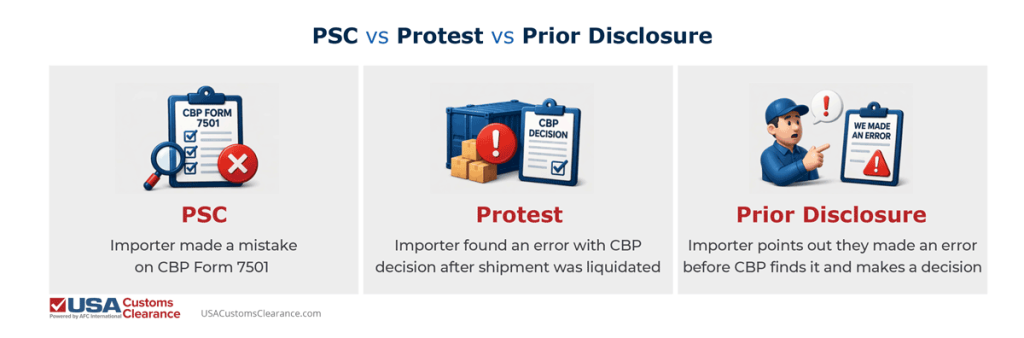
While not every error is able to be corrected with a post entry, many commercial importers are able to use these processes to comply with federal regulations and clear shipments through customs.
Let’s take a closer look at each in the following sections.
A post summary correction (PSC) is a document that’s used to correct information on an entry summary, or CBP Form 7501.
The most common mistakes made on an entry summary are:
Eligible PSCs must be filed within 300 days of entry and before liquidation. PSCs must also meet CBP criteria, such as having a paid entry summary that is not under CBP review.
A protest is a legal filing used to challenge a CBP decision after liquidation. When importers believe CBP has made a mistake, such as incorrect product classification or duties.
Protests are filed after an entry has been liquidated, which is CBP’s final computation of the total duties, tariffs, and fees owed on imported goods to complete an entry.
Importers must file CBP Form 19 to protest within 180 days after the date of liquidation to challenge CBP’s decision. According to 19 CFR (Code of Federal Regulations) § 174.21, CBP will review protests within two years from the date it was filed.
A prior disclosure is a voluntary report of an importer’s entry that contains potential compliance violations. Errors that lead to noncompliance can include:
A prior disclosure informs CBP of potential violations before CBP identifies them or opens an investigation.
A PSC should be used when you need to amend entry data for your imports, such as value, classification, or claims for duty exemption. However, the PSC is only valid if your goods haven’t been liquidated and aren’t under CBP review.
You’ll have 300 days from the date of entry and up to 15 days of the scheduled liquidation to make your changes.
You should file a protest when you want to challenge a CBP decision after your entry has been liquidated. CBP decisions that you can challenge include duty amount assessed, HTS classification, and country of origin. Protests should be filed within 180 days after your entry has been liquidated.
You should use prior disclosure to report potential customs violations to CBP. It can be used to identify compliance errors like misclassification, undervaluation or incorrect customs value, and incorrect country of origin. The prior disclosure must be submitted before CBP finds the violations or before they start an investigation.
Not sure which post entry customs correction submission you should make? We’ve created a simple decision flow chart to guide you.
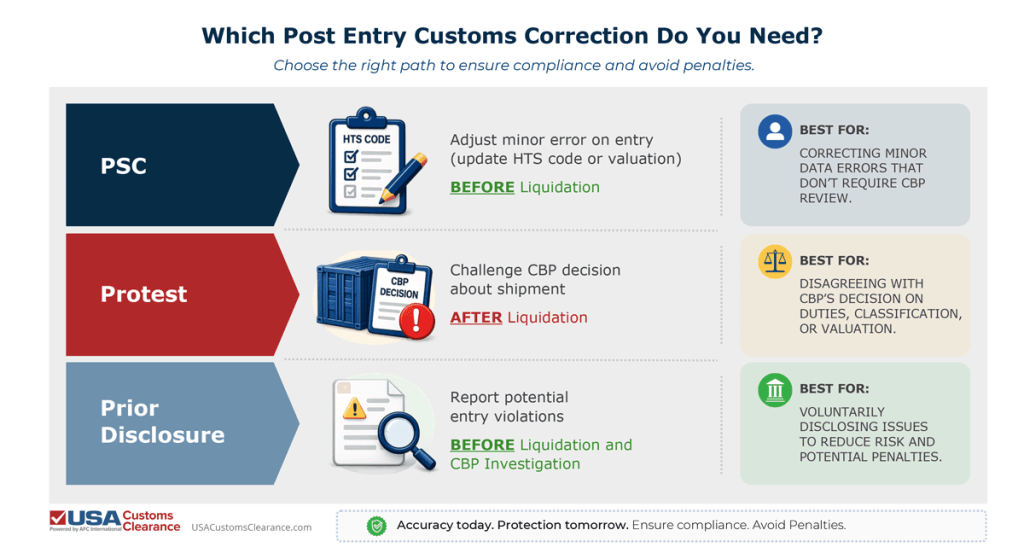
If you’re uncertain about the next steps to submit your correction, the best step is to consult a Licensed Customs Broker to prepare and submit the required documentation on your behalf to streamline your application and clear customs without hassle.
Each post-entry correction type requires specific documents. We’ve listed the documents and data to present when you file to simplify the process.
Importers can use ACE to submit and track the progress of applications for PSC, protest, or prior disclosure.
Importers wanting to avoid CBP rejecting their submission should steer clear of making these common mistakes:
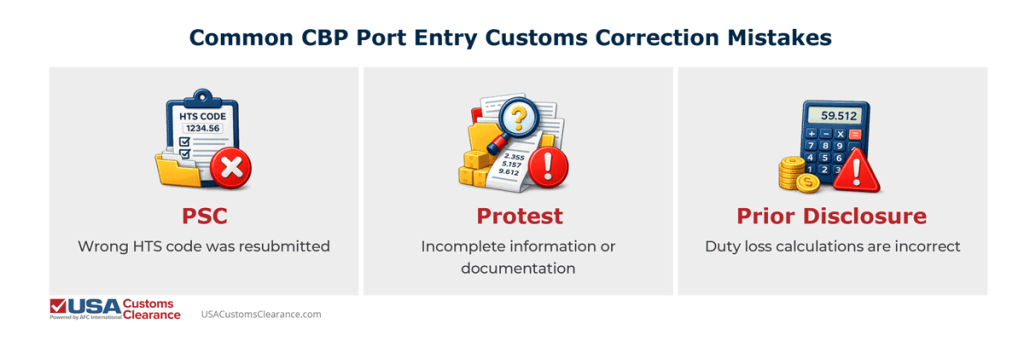
When PSCs, protests, or prior disclosures don’t solve the problem, there’s a fourth option: CBP Reconciliation Program.
CBP Reconciliation is an ACE portal process for importers to voluntarily flag entry information to correct before liquidation. This process alerts CBP that the importer has provided acceptable information, but will update their entry with precise information, such as the specific shipment value or HTS code, to comply with CBP and smoothly liquidate the reconciliation.
Need help choosing the right correction path? USA Customs Clearance can review your entry, confirm deadlines, and prepare the right filing. We offer a variety of services that will help you in your importing endeavors. Speak to a Licensed Customs Broker today, risk-free, by calling (855)-912-0406. You can also send your questions to our team through our contact page.
What is a CBP post summary correction (PSC)?
A CBP post summary correction (PSC) is a filing used to correct eligible errors on an entry summary before liquidation. Importers commonly use a PSC to amend issues such as HTS classification, value, duty-related claims, or other entry-summary data. PSCs must be filed before liquidation and cannot be used to change certain fields, such as the importer of record or entry number.
What CBP decisions can I protest about my entry?
Importers can protest certain CBP decisions after liquidation, including drawback claim denials, tariff classification decisions, and final appraisals of merchandise value. Decisions that are not yet final generally cannot be protested because CBP has not completed its determination.
What should be included in my prior disclosure letter?
A prior disclosure letter should clearly identify the violation and provide the corrected information. Depending on the issue, it may include the affected entry number, port of entry, merchandise description, HTS classification, value details, and any duty impact or drawback information. An incomplete prior disclosure can weaken the filing and increase compliance risk.
Legal disclaimer: All information provided is not to be taken as legal advice.
Sources:
U.S. Customs and Border Protection, Home Page, 2026
CBP Form 7501: Entry Summary, U.S. Customs and Border Protection, 2026
CBP Form 19, U.S. Customs and Border Protection, 2024
Code of Federal Regulations, Title 19, Chapter 1, Party 174, Subpart C, 2026
 Copy URL to Clipboard
Did you find this article helpful?
See more of our coverage on Google.
Add usacustomsclearance.com as a preferred source!
Add usacustomclearance.com as a preferred source!
See more of our coverage in Google's Top Stories.
Licensed customs support for importers across a wide range of U.S. entry needs. USA Customs Clearance provides Customs Bonds, Consulting, Customs Brokerage, Manifest Confidentiality, Importer of Record support, and Guides & Resources to help importers prepare for U.S. Customs and Border Protection (CBP) requirements and customs clearance with regulatory compliance, greater clarity, and confidence.
With licensed broker support, transparent service information, and secure checkout, we help importers take the right next step.

We know the importing process and requirements can be confusing, but they don't have to be.
We're here to help.
When purchasing a product from our website, you can feel confident knowing our team can help if you accidentally select the wrong product. We'll guide you through the correct purchase and any applicable refund process.
Important Refund Policy Information
Eligible refunds are subject to a $50 processing fee, which will be deducted from your original purchase amount. Please allow up to 90 days for refunds to be processed, as refunds are handled quarterly by our Accounting Department.
Refunds are available only if you have not yet:
Additional Refund Terms
You have 90 days from the date of purchase to submit your bond application. After 90 days, bond fees are forfeited and are nonrefundable.
All eBook sales are final and nonrefundable.
Add your first comment to this post