
IMPORT TARIFFS - LATEST NEWS & UPDATES



Did you find this article helpful?
See more of our coverage on Google.
Add usacustomsclearance.com as a preferred source!

Since early 2025, duty and tariff calculations in the United States have grown in complexity due to the implementation of several new tariffs on foreign trade partners. On some commodities, these tariffs overlap and create an instance of tariff stacking, which is the application of multiple tariffs to a single type of commodity.
Key Takeaways
In this article, I’ll explain how tariff stacking works, provide a common tariff stacking scenario importers face, and discuss legal methods to mitigate this issue.

Our 45 Minute Licensed Expert Consulting Will Personally Guide You.
Tariff stacking refers to multiple tariffs simultaneously being applied to a single commodity. When several of these levies are stacked together, they are often referred to as a cumulative tariff.
In early 2025, the executive branch of the United States federal government began levying multiple types of tariffs specific to factors like country of origin, commodity classification, and calculations based on trade deficits with other countries.
To gain a more complete understanding of how customs charges can stack, let’s look at some of the different types of import taxes countries use.
Many of these rates can be reduced or eliminated by free trade agreements such as the United States-Mexico-Canada Agreement (USMCA).
Now that we’ve defined these different types of tariffs, let’s look at some examples of how they might stack on top of each other.
Related: A Comprehensive Guide to Section 232 Tariffs
To illustrate how multiple tariffs can stack on a single commodity, let’s look at auto parts sourced from China. Between IEEPA, sectoral ,and commodity-specific tariffs, commercial importers in the US have seen triple digit effective tariff rates on numerous Chinese goods.
In this scenario, you’ll see a common and relatively uncomplicated instance of tariff stacking: Section 232 auto part tariffs and those assessed on China via IEEPA. Keep in mind these duty and tariff calculations are each based on the original shipment value.
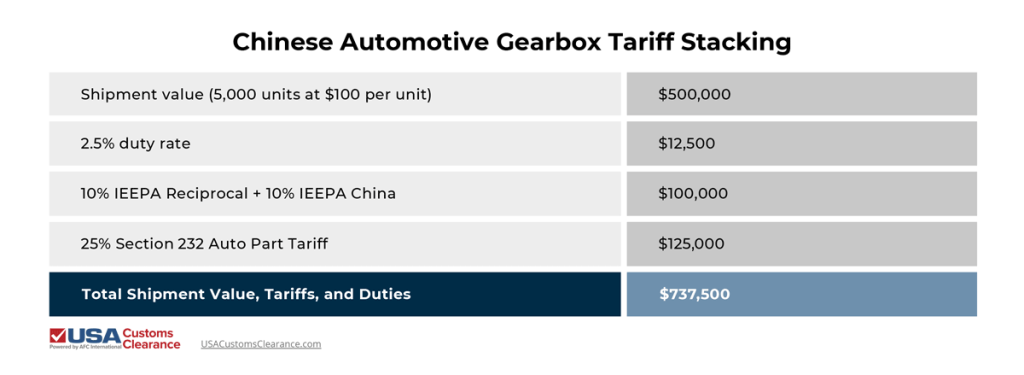
This amounts to an increase of 47.5% over initial costs. Keep in mind that these rates can change quickly during times of high tension in international trade. As always, the burden of tariff and duty calculation is on the importer, and you’ll need to thoroughly research your intended purchase from a commodity and even supplier level to ensure your calculations are accurate.
Partnering with a licensed customs broker can eliminate a great deal of this headache.
Related: Importing Auto Parts Into the U.S.
Tariff stacking can be difficult to avoid. However, it can be mitigated by sourcing your products from countries with whom the USA shares an FTA or other trade agreement.
Free trade partners with the US receive preferential rates of duty, and sometimes no duty at all. Some trade deals agreed upon in 2025 didn’t completely eliminate tariffs, but did reduce their effective rates.
So, if you have a choice of sourcing goods from a trade partner that has negotiated an agreement with the United States and a country subject to high, unmodified import tax rates, you’ll pay less overall in import taxes from the former.
The best way to make sure you don’t pay more in import fees than necessary is to have a licensed customs broker handle the clearance process on your behalf.
The brokers and customs experts at USA Customs Clearance have over a century of combined experience helping import businesses cut through the red tape of the clearance process. Additionally, they can put their knowledge to work by helping you mitigate tariff costs on imported goods.
Don’t let tariff turmoil tear down your business. Call us at (855) 912-0406 or submit a contact form online today!

Did you find this article helpful?
See more of our coverage on Google.
Add usacustomsclearance.com as a preferred source!
Add usacustomclearance.com as a preferred source!
See more of our coverage in Google's Top Stories.
Licensed customs support for importers across a wide range of U.S. entry needs. USA Customs Clearance provides Customs Bonds, Consulting, Customs Brokerage, Manifest Confidentiality, Importer of Record support, and Guides & Resources to help importers prepare for U.S. Customs and Border Protection (CBP) requirements and customs clearance with regulatory compliance, greater clarity, and confidence.
With licensed broker support, transparent service information, and secure checkout, we help importers take the right next step.

Add your first comment to this post