
IOR ENFORCEMENT IS NOW IN EFFECT | REVIEW MY IOR




Tariff stacking is a trade policy scenario where multiple, separate import duties or tariffs are applied to the same product, and this guide is for importers, ecommerce sellers, and businesses who need to understand which tariffs can stack, which goods are most affected, how to estimate total duty exposure, and what data importers should review before entry.
CBP tariff stacking is the application of more than one duty or tariff to the same imported product when multiple trade measures apply at entry. When several of these levies are stacked together, they are often referred to as a cumulative tariff.
The main duty programs that can contribute to stacked tariff exposure include the following:
Many of these rates can be reduced or eliminated by free trade agreements (FTA) such as the United States-Mexico-Canada Agreement (USMCA).
Now that we’ve defined these different types of tariffs, let’s look at some examples of how they might stack on top of each other.
Tariffs can stack on the same entry when separate duty programs apply independently to the same product. Common examples include ordinary customs duties plus Section 301, Section 232, Section 201, or AD/CVD, depending on the product, origin, and legal treatment.
To illustrate how multiple tariffs can stack on a single commodity, let’s look at auto parts sourced from China. Between sectoral and commodity-specific tariffs, commercial importers in the U.S. have paid higher tariff rates on numerous Chinese goods.
In this scenario, we’ve illustrated how tariffs are calculated on imported auto parts with Section 232 tariffs, and duties. Keep in mind these duty and tariff calculations are each based on the original shipment value.
This simplified example shows how a base duty and one additional tariff can increase landed cost. Actual entry treatment may include other measures depending on the product, origin, and current tariff programs.
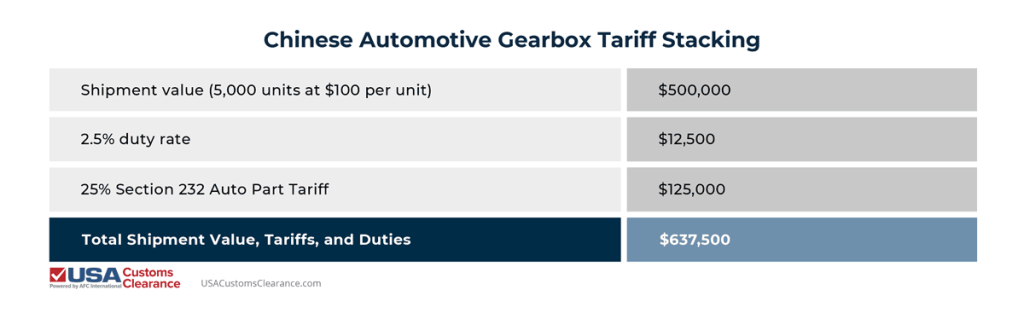
Keep in mind that these rates can change quickly during times of high tension in international trade.
Importers are responsible for tariff calculations, but a licensed customs broker can help verify classification, origin, and duty treatment before entry.
Goods are more likely to face stacked duties when they fall within product-specific tariff programs, contain tariff-sensitive materials such as steel or aluminum, or originate in countries subject to additional trade remedies.
To diagnose your duty bill and accurately calculate your tariffs to avoid CBP noncompliance and penalties, you’ll need to review these five data points:
Having this information at the ready will help you calculate stacked tariffs more easily.
Entry summary fields are elements found on CBP Form 7501 to import goods into the United States. This is a CBP-required document that collects data on imported goods to calculate duties and tariffs for importers to pay.
Entry summary fields that affect stacked tariffs include the HTSUS number, country of origin, customs value, and reported quantity in HTSUS units. CBP uses these fields on Form 7501 to determine which duty programs apply and how much duty the importer owes.
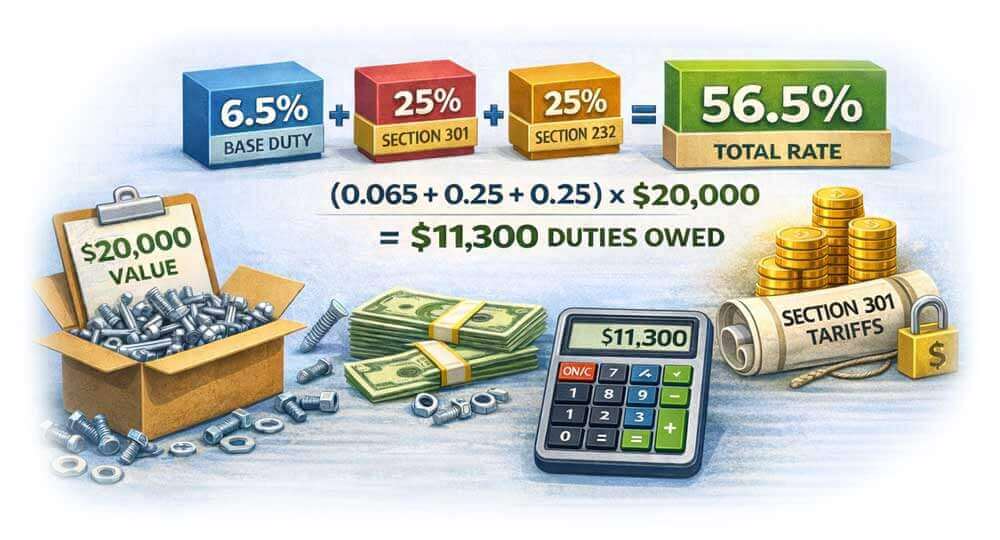
To calculate stacked tariffs, identify every applicable duty program, confirm each rate, and apply those rates to the customs value as required. The total duty bill depends on the product’s HTS classification, country of origin, and any additional trade remedies.
The example we’ve provided shows how base duty, Section 301, and Section 232 measures can increase total duty exposure.
Let’s say imported steel fasteners have a value of $20,000. The product is subject to a base duty of 6.5%, with an additional Section 301 and 232 tariffs that are both 25%.
When the base duty rate and the two tariffs are added together, the total rate is 56.5%. When you multiply the 0.565 by $20,000, the product is $11,300 worth of duties owed.
Importers can reduce their cumulative tariff risk by sourcing from lower-tariff countries, taking advantage of FTA, and by providing the correct HTS code and Certificate of Origin (COO).
Different nations are subject to different tariff rates. You can diversify your supply chain to find a country that has a lower rate, but that can still provide you with the products you need.
Tariff stacking can be difficult to avoid. However, it can be mitigated by sourcing your products from countries with whom the U.S. has an FTA. An FTA is a treaty between two or more countries that reduces or eliminates barriers to trade like tariffs, quotas, and duties on goods and services.
Free trade partners with the U.S. receive preferential rates of duty, and sometimes no duty at all. Some trade deals, like the USMCA, don’t completely eliminate tariffs, but reduce their effective rates.
Imported goods classified with the wrong HTS code or COO can impact duties and tariffs. If importers make an error with either entry summary field, they can correct it prior to liquidation with a post summary correction (PSC).
Minimize Your Tariff Costs With USA Customs Clearance
Don’t let tariff stacking turmoil tear down your business. USA Customs Clearance is ready to help you with tariff complexity. Call us at (855) 912-0406 or book a consultation with our Licensed Customs Brokers today!
Sources:
Section 232 Tariffs on Steel and Aluminum Frequently Asked Questions, CBP, 2025
Unstacking Certain Tariffs Chart, CBP, 2026
CBP Form 7501: Entry Summary, CBP, 2026
Antidumping and Countervailing Duties (AD/CVD) Frequently Asked Questions, CBP, 2025
Free Trade Agreements, Office of the United States Trade Representative, 2026
 Copy URL to Clipboard
Did you find this article helpful?
See more of our coverage on Google.
Add usacustomsclearance.com as a preferred source!
Add usacustomclearance.com as a preferred source!
See more of our coverage in Google's Top Stories.
Licensed customs support for importers across a wide range of U.S. entry needs. USA Customs Clearance provides Customs Bonds, Consulting, Customs Brokerage, Manifest Confidentiality, Importer of Record support, and Guides & Resources to help importers prepare for U.S. Customs and Border Protection (CBP) requirements and customs clearance with regulatory compliance, greater clarity, and confidence.
With licensed broker support, transparent service information, and secure checkout, we help importers take the right next step.

We know the importing process and requirements can be confusing, but they don't have to be.
We're here to help.
When purchasing a product from our website, you can feel confident knowing our team can help if you accidentally select the wrong product. We'll guide you through the correct purchase and any applicable refund process.
Important Refund Policy Information
Eligible refunds are subject to a $50 processing fee, which will be deducted from your original purchase amount. Please allow up to 90 days for refunds to be processed, as refunds are handled quarterly by our Accounting Department.
Refunds are available only if you have not yet:
Additional Refund Terms
You have 90 days from the date of purchase to submit your bond application. After 90 days, bond fees are forfeited and are nonrefundable.
All eBook sales are final and nonrefundable.
Add your first comment to this post