
IOR ENFORCEMENT IS NOW IN EFFECT | REVIEW MY IOR




Importing avocados is an agricultural import process that requires careful customs clearance, produce inspection, and plant-health compliance before shipments enter the United States. Most avocados that come to the U.S. are sourced from Mexico, though additional supply comes from Peru, Colombia, Chile, and the Dominican Republic.
Avocados are regulated by the U.S. Department of Agriculture (USDA) and Customs and Border Protection (CBP). The USDA’s Fruit and Vegetable Division is the federal body that enforces grade and maturity standards for covered avocado shipments, while CBP is the federal agency that examines imported goods at entry and enforces customs compliance.
Any shipment of avocados greater than 55 pounds must be inspected and certified for both grade and maturity by the USDA. Grade certification is a quality-control classification that confirms whether the fruit meets minimum U.S. import standards.
USDA grade standards classify avocado shipments into three quality grades. Avocados imported to the U.S. must be at least Grade 2.
To qualify, the avocados must be:
The USDA allows limited defects within a shipment. To qualify, no more than 10% of avocados in a shipment can fail to meet these requirements. No more than 5% are allowed to be seriously damaged by anthracnose, and no more than 1% are affected by decay.
Maturity standards are import criteria used to determine whether avocados are developed enough to enter U.S. commerce.
Most avocado varieties must meet one of two maturity measures before they can be imported into the U.S.:
Hass, Fuerte, Zutano, and Edranol varieties of avocado are exempt from maturity import requirements.
The U.S. requires phytosanitary certificates for avocado shipments imported from certain countries to clear customs. A phytosanitary certificate is an official plant-health document issued by the exporting country to confirm that a shipment meets pest and disease requirements.
Countries from which a phytosanitary certificate is required when importing avocados include:
If a required phytosanitary certificate is missing, incomplete, or inaccurate, the shipment may be refused entry, exported, or destroyed. Importers may also face civil or criminal penalties for noncompliance.
Packaging requirements govern how avocado shipments must be packed, marked, and transported for import. In general, avocados must be packed in clean boxes or crates that protect the fruit and support traceability during shipment.
The packaging must also be labeled with key identification details, including:
Avocados are typically transported in a sealed refrigerated container or truck to preserve product quality during transit.
An avocado import exemption is a limited exception from standard grade and certification rules for qualifying low-volume or special-use shipments. Avocado imports that are 55 pounds or less may be exempt from grade and certification requirements.
Shipments imported for consumption by exempt outlets will need to enter the country with an Importer’s Exempt Commodity Form (SC-6).
Exempted outlets include:
Commercial processing when the physical or chemical composition of your avocados are altered using one of the following methods:
Slicing, dicing, or peeling avocados doesn’t count as commercial processing.
The vast majority of avocados imported into the U.S. are grown in Mexico. About 85% of the avocados grown in Mexico come from the states of Michoacán and Jalisco. These are also the only two states permitted to export avocados to the U.S.
South America is another large exporter of avocados to the United States. Peru, Chile and Colombia are among the leading non-Mexican suppliers to the U.S. market. The Dominican Republic is also a top exporter of avocados, exporting $91.3 million globally.
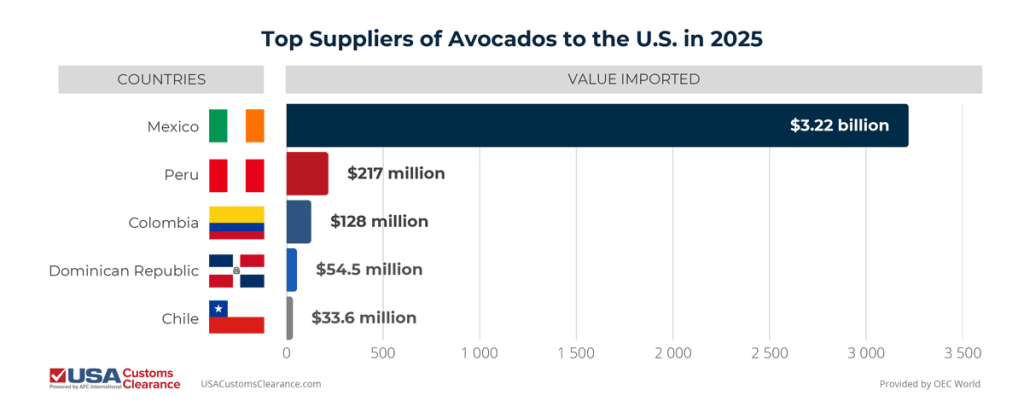
Mexico is by far the largest source of avocados imported into the United States, with Peru, Colombia, the Dominican Republic, and Chile supplying much smaller volumes. While the U.S. depends heavily on Mexican supply, there are other nations that you can source the fruit from.
According to the U.S. International Trade Commission (USITC), the import duty of avocados shipped to the U.S. is approximately 10.6 to 11.2 cents per kilogram, depending on the Harmonized Tariff Schedule (HTS) classification.
A free trade agreement (FTA) is a trade framework that can reduce or eliminate import duty on qualifying goods. The U.S. has FTAs in place with multiple avocado-exporting countries. This includes the U.S.’s top five suppliers of avocado imports.
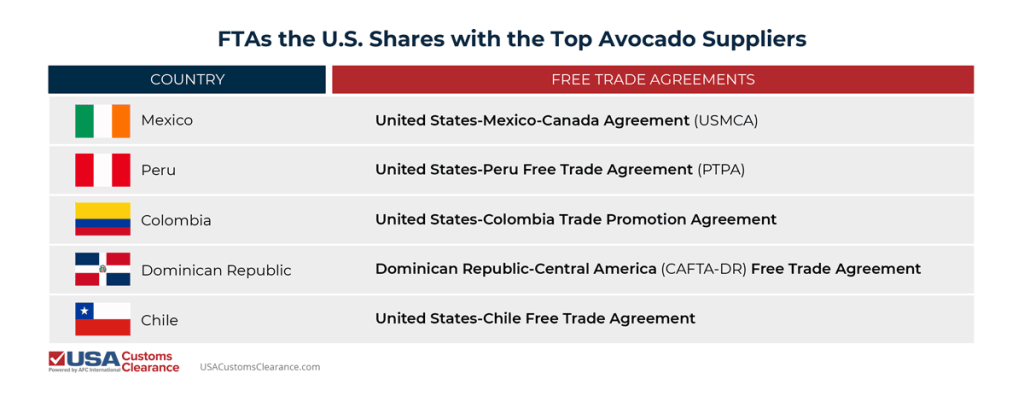
In practice, the total landed cost of avocado imports depends on the supplier, country of origin, shipment size, freight conditions, customs fees, and whether the goods qualify for duty-free treatment under an FTA.
Avocados aren’t banned in the U.S., but they can be suspended temporarily when inspection or safety issues arise.
For example, the importation of avocados from Mexico was temporarily suspended on February 11th, 2022. That ban was lifted a week later on February 18.
The ban was imposed due to a threat made against a USDA inspector. The agency released a statement upon the ban being lifted, stating that they had worked with Mexican authorities to install new safety measures for U.S. inspectors.
In June 2024, the U.S. temporarily suspended avocado and mango inspections in Michoacán. This came after two USDA employees were assaulted and temporarily detained during local protests. Inspections later resumed after additional security measures were arranged.
South American countries such as Chile, Colombia and Peru are in the top five avocado trade partners with the U.S., as is the Dominican Republic. Additionally, the U.S. has existing trade agreements with these partners allowing for duty-free status of avocado imports.
A licensed customs broker is a federally licensed trade professional who helps importers classify goods, file entry documents, and comply with customs requirements. Working with a customs broker is especially helpful for new importers and for shipments regulated by partner government agencies (PGA) such as the USDA.
Customs brokers can ensure that your shipment of avocados meets all applicable regulations. That means making sure that your avocados are packaged and labeled correctly, are accompanied by any necessary documentation, such as a phytosanitary certificate, and that they meet requirements for both grade and maturity.
Additionally, they can work to ensure that you’re using the correct HTS classification and that you pay the appropriate import duty no matter which country you import from.
For first-time importers, professional customs support can reduce filing errors, shipment delays, and compliance risk. USA Customs Clearance offers importer support services for businesses that need help with customs entry, documentation, and agency coordination. Contact USA Customs Clearance at (866) 730-2601 to discuss your shipment and next steps.
Sources:
Florida Avocado Grades and Standards, Agricultural Marketing Services, U.S. Department of Agriculture
Anthracnose, The University of California Statewide IPM Program, 2016
Title 7/Subtitle B/Chapter IX/Part 944-Fruits; Import Regulations, Code of Federal Regulations, 2026
SC6 Importers Exempt Commodity, Agricultural Marketing Service, U.S. Department of Agriculture
Avocado Annual, Foreign Agricultural Service, U.S. Department of Agriculture, 2026
Avocados (Fresh/Dried) in United States, OEC World, 2025
Caswell, Julie, U.S. Temporarily Bans Avocados From Mexico, Citing Threat, The New York Times, 2022
 Copy URL to Clipboard
Did you find this article helpful?
See more of our coverage on Google.
Add usacustomsclearance.com as a preferred source!
Add usacustomclearance.com as a preferred source!
See more of our coverage in Google's Top Stories.
Licensed customs support for importers across a wide range of U.S. entry needs. USA Customs Clearance provides Customs Bonds, Consulting, Customs Brokerage, Manifest Confidentiality, Importer of Record support, and Guides & Resources to help importers prepare for U.S. Customs and Border Protection (CBP) requirements and customs clearance with regulatory compliance, greater clarity, and confidence.
With licensed broker support, transparent service information, and secure checkout, we help importers take the right next step.

We know the importing process and requirements can be confusing, but they don't have to be.
We're here to help.
When purchasing a product from our website, you can feel confident knowing our team can help if you accidentally select the wrong product. We'll guide you through the correct purchase and any applicable refund process.
Important Refund Policy Information
Eligible refunds are subject to a $50 processing fee, which will be deducted from your original purchase amount. Please allow up to 90 days for refunds to be processed, as refunds are handled quarterly by our Accounting Department.
Refunds are available only if you have not yet:
Additional Refund Terms
You have 90 days from the date of purchase to submit your bond application. After 90 days, bond fees are forfeited and are nonrefundable.
All eBook sales are final and nonrefundable.
Add your first comment to this post