
IOR ENFORCEMENT BEGINS SEPTEMBER 18 | REVIEW MY IOR NOW




Air quality sensors are instruments that detect pollutants, gases, particulates, humidity, temperature, or pressure in the air. Importing air quality sensors into the U.S. requires importers to use the correct HTS classification, standard CBP entry documents, and any product-specific compliance records required by the agencies that regulate the device type.
The main specs needed to classify an air quality sensor are what it measures, how it detects it, whether it is a complete device or a component, and whether it performs one function or multiple functions.
Air sensors can be split into the following four types based on how they function:
To accurately classify an air quality sensor for import into the U.S., you’ll need information from the manufacturer regarding how it was made and what it was made from.
The General Rules of Interpretation (GRI) require importers to gather information about the essential characteristics, usage, and manufacturing processes of a commodity for accurate tariff classification.
For air quality sensors, knowing what the sensor measures has an impact on its classification in chapter 90 of the HTS.
Importers need to know if the sensor measures:
Chapter 90 focuses on what instruments measure as part of its classification process, so this information is crucial to get correct, as mistakes can lead to classification errors and fines/holds from CBP.
Importers usually misclassify air quality sensors when they do not know the detection method, the exact measurement target, whether the item is a part or finished unit, or whether the device combines multiple monitoring functions.
Failure to have the following information easily causes classification errors:
The information listed above should be available on technical documents and informational literature about the air sensor from its manufacturer or vendor.
Standard CBP entry documents for imported air quality sensors include:
These are the basic documents that CBP will require. However, there might be other types of paperwork that will be required. For example, a compliance certification might be needed depending on the type of air quality sensors being imported.
Certificates of origin are needed if an importer wants to apply for preferential tariff treatment. This document identifies where air quality sensors were manufactured. Most free trade agreements (FTA) require this kind of paperwork to determine eligibility for preferential treatment.
CBP also requires businesses to provide an ISF. This document will need to be submitted at least 24 hours before the goods depart for a U.S. port. Finally, BOLs or airway bills will also need to accompany every imported shipment.
The Environmental Protection Agency (EPA) has numerous documents required for air pollution detectors, such as:
Businesses and entrepreneurs may need to provide test reports from accredited laboratories that demonstrate compliance with relevant standards and regulations for air quality sensors. These reports can verify the accuracy and reliability of the sensors' measurements. They will also need certifications and declarations from the sensor’s manufacturer.
The purpose of this type of documentation is to verify that air quality sensors meet the following standards:
Another document sometimes requested for regulated sensor products is the user manual, which provides instructions for the business or entity that will use the device.
Manuals can provide guidance for:
Finally, importers of pollutant sensors will need to provide compliance statements. This type of documentation indicates air quality devices meet applicable regulations and standards set by the EPA or other relevant authorities.
Factors that can influence the prices of importing air pollution detectors include:
Different types of sensors in air quality detection devices can influence costs. Advanced technologies will be more expensive than basic models. To show how import costs can vary by device type, the table below groups sensors into broad price ranges.
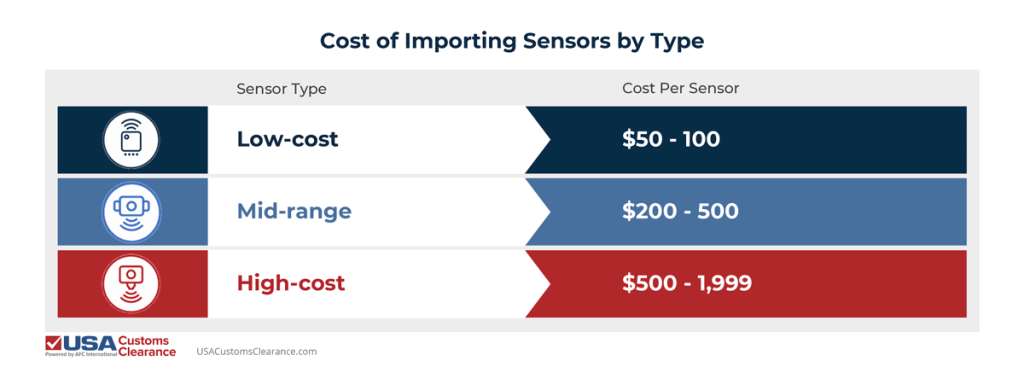
These numbers were taken from a variety of different air pollution detector prices, both residential and commercial models from brands like Room Alert and Sper Scientific.
Low cost sensors are usually used for personal operation, while mid-range varieties are utilized for commercial and industrial use.
High-end air pollution detectors are typically utilized for government purposes. The specifications and features of AQI equipment can affect the price as well.
Design features of air pollution detectors that can raise the cost of importing include:
Purchasing AQI equipment in larger quantities or volumes can often result in volume discounts from suppliers or manufacturers. Additionally, importing larger quantities often helps reduce the per-unit cost of the equipment due to bulk discounts.
Importers will also encounter customs fees and duties when importing air quality sensors. For instance, an importer bringing hygrometers into the country will pay a duty of 1.4% and a 10% Section 122 tariff on their shipment.
If the hygrometers are valued at $20 a piece and the importer orders 1,000 units, the valuation of the shipment is $20,000. Assuming the shipment arrived by ocean freight, the importer needs to be aware of four customs fees:
For a shipment valued at $20,000, the results would be:
This gives us a total of $22,374.28 in valuation and customs fees. Importers should also add shipping costs to this result for an accurate landed cost calculation.
The steps of customs clearance for ocean shipments generally follow this pattern:
Customs holds occur when CBP suspects there is an issue with an imported shipment, such as missing/inconsistent documentation or a deliberate attempt to import prohibited goods.
Scrupulous importers can minimize their exposure to holds and cargo inspections by following CBP’s standards of reasonable care for importers, making sure information matches between the commercial invoice, ISF, and entry summary, and maintaining transaction records for a minimum of five years from the date of importation.
If you are unsure how your sensor should be classified, gather the spec sheet, product description, and intended use before purchase. That gives your broker enough information to verify the HTS code, estimate duties, and spot likely CBP or PGA issues before shipment. Give us a call at (855) 912-0406 or fill out a contact form online for further assistance.
Sources:
2026 HTS Revision 11, Harmonized Tariff Schedule, 2026
Air Sensor Toolbox, United States Environmental Protection Agency, 2026
Imposing a Temporary Import Surcharge to Address Fundamental International Payments Problems, White House, 2026
 Copy URL to Clipboard
Did you find this article helpful?
See more of our coverage on Google.
Add usacustomsclearance.com as a preferred source!
Add usacustomclearance.com as a preferred source!
See more of our coverage in Google's Top Stories.

Add your first comment to this post