IMPORT TARIFFS - LATEST NEWS & UPDATES

US Customs Prohibited Items List for Commercial Importers

An image depicting a man holding a prohibited sign (red circle with diagonal red slash) next to a stack of miniature shipping containers, reinforcing the article's topic about the us customs prohibited items list
Author Photo
Written by Joe Weaver
Reviewer Photo
Reviewed by Licensed Customs Broker Mimi Arnold

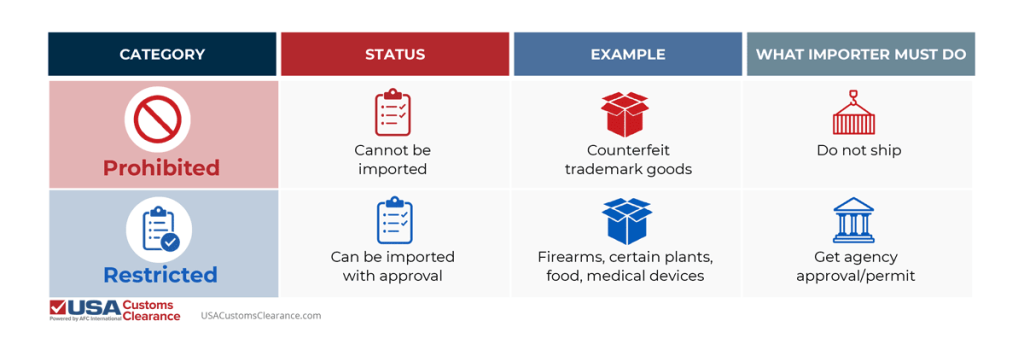
Certain items either can’t be imported into the US or are so tightly regulated as to be effectively banned to most commercial importers. Whether this is due to inherent dangers of the merchandise in question or enforcement of sanctions and trade regulations, trying to bring these US customs prohibited items into the country could end up costing you time, money, and your reputation as an importer. 

Key Takeaways

  • Goods that are prohibited from being imported into the US include products containing dog and cat hair, cultural artifacts from certain countries, and counterfeit merchandise that infringes on copyrights.
  • No goods from Cuba or Iran may be imported into the US, with rare exceptions for certain personal goods and informational media.
  • Importing certain goods, particularly those that potentially pose a danger to public health, requires authorization, permission, or licensure from associated partner government agencies (PGAs). 
  • US Customs and Border Protection (CBP) enforces import prohibitions and regulations on behalf of PGAs like the Food and Drug Administration (FDA) and the Department of Alcohol, Tobacco, and Firearms (ATF).

We’ve created this list as an easy reference tool for commercial importers. If you have in-depth questions about specific HTS codes, our team of licensed customs brokers can provide expert guidance.

Ask AI Assistant your question

45 Minute Licensed Expert Consulting Will Personally Guide You
USA CUSTOMS CLEARANCE
Overcome Your Customs Clearance Obstacles


We work with you every step of the way to ensure a smooth and stress-free customs experience. 

Request a Consultation >

CBP Prohibited Items

CBP specifically names 25 specific items or categories of items under its prohibited and restricted items list. They range from biological materials to archaeological artifacts and even something as simple as soil.

While CBP does list the general descriptions of these goods and enforces their associated regulations during customs clearance, prohibitions and restrictions on these goods are actually created by a number of partner government agencies (PGAs). Each agency regulates a particular class of goods, some which are obvious by the agency’s name and others that might surprise you. 

Items that can be considered effectively prohibited from importation into the United States for commercial purposes include:

  • Products containing fur from cats or dogs
  • Drug paraphernalia (except for legitimate medical conditions)
  • African bush meat and associated products
  • Defense and military articles (unless registered as a military supplier)
  • Certain threatened and endangered plants such as true rosewood
  • Certain endangered animals and products made from same
  • Articles made in violation of federally registered trademarks and those with copyrights protected by the Berne Convention for the Protection of Literary and Artistic Works 

While there are almost always some limited exceptions, the permissions necessary to bring such items into the country are rarely available for commercial importers. 

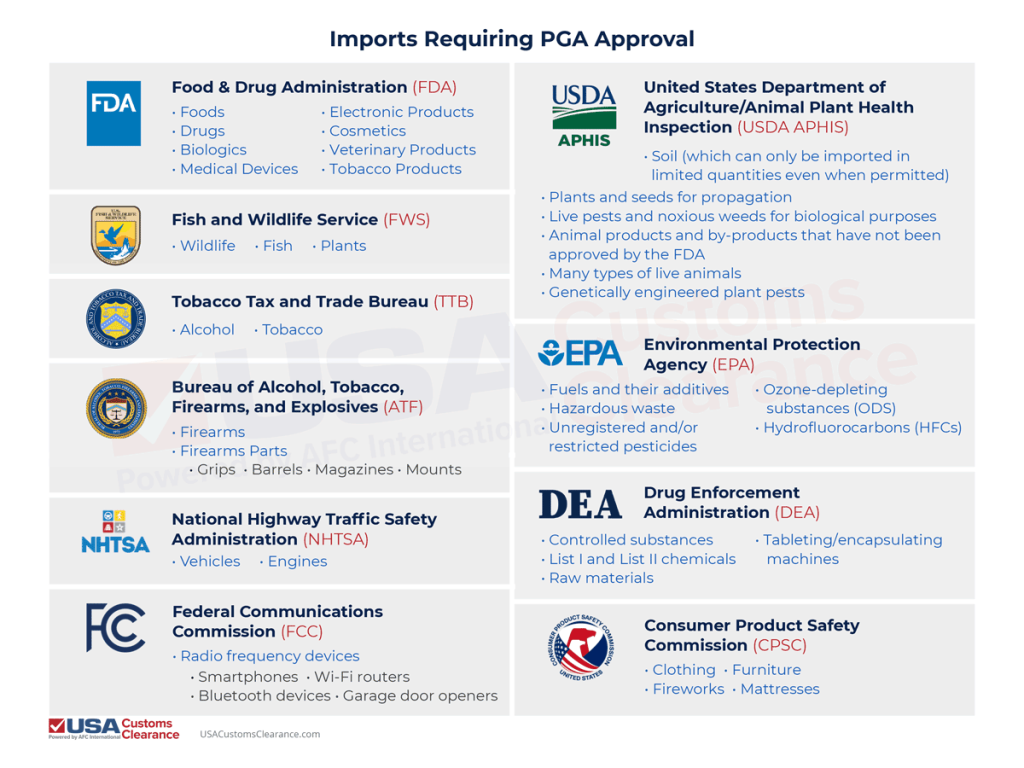
Other items aren’t quite so heavily restricted, but still require the importer to have a license or permit from a PGA. In the following list, you’ll be able to see what kind of import regulatory authority each PGA has with regards to the goods they oversee. For additional clarity, I’ve also included PGAs that don’t issue such permits, but have some involvement in commercial importing.

Food and Drug Administration (FDA)

The FDA uses a risk-based assessment program, meaning commercial importers should import from facilities that have been registered with and/or reviewed by the administration. Importing from unregistered sources can lead to your shipment being refused. 

You probably won’t need a license or permit from the FDA to import approved items under their regulation, which includes most food for humans, pharmaceuticals, and medical devices. The administration does require the filing of a prior notice for shipments of imported food.

Related: The Complete Guide to FDA Customs Clearance

Department of Agriculture (USDA)

Some of the USDA’s most import-specific work relates to its Animal and Plant Health Inspection Service (APHIS). They prohibit the importation of certain goods unless the importer applies for and receives a related permit. 

Animal and plant-related products requiring special permits or licensure under APHIS import requirements include:

  • Soil (which can only be imported in limited quantities even when permitted)
  • Plants and seeds for propagation
  • Live pests and noxious weeds for biological purposes
  • Animal products and by-products that have not been approved by the FDA
  • Many types of live animals
  • Genetically engineered plant pests

This department also enforces rules of importation based on the Convention on International Trade in Endangered Species of Wild Fauna and Flora (CITES). Plants, animals, and derivatives thereof listed in CITES Appendix I are not generally permitted for commercial import purposes. 

Fish and Wildlife Service (FWS)

A bald eagle soaring above a lake, reinforcing this section's topic about the Fish and Wildlife Service.

If you plan to import a species of wildlife, its parts, or products thereof and it can be legally traded, you’ll most likely need a permit from the FWS. The CITES list in the previous section is a good place to start looking once you’ve determined the scientific name of the species in which you’re interested. Species listed in the second and third appendices are less strictly regulated than those in appendix I.

You can also check the Endangered and Threatened Species List while determining if your wild animal import requires a permit.

Bureau of Alcohol, Tobacco, and Firearms (ATF)

If you want to import any defense articles besides sporting shotguns, you’ll need a permit from the ATF per the Arms Export Control Act. This isn’t limited to fully assembled firearms, but also many components, among which the bureau specifically lists the following:

  • Grips
  • Barrels
  • Magazines
  • Mounts

This list is not comprehensive. For example, we’ve seen a rifle stock from Australia get rejected at US customs due to the importer being unlicensed by the ATF. 

Commercial importers of tobacco and alcohol actually require permission from a different agency.

Alcohol Tobacco and Trade Bureau (TTB)

Importers who want to bring packaged spirits, beer, or wine into the US need to apply for a Federal Basic Importer’s Permit. To be approved, you must have a staffed business office located in the US, or make arrangements with a stateside importer. 

Assuming you receive this permit, you’ll then need a Certificate of Label Approval (COLA) for each of the alcohol products you intend to distribute. 

As for tobacco products and processed tobacco, the TTB requires prospective importers to go through an approval process. Importing tobacco products that were previously exported is generally prohibited.

Federal Trade Commission (FTC)

The FTC does not prohibit or strictly regulate a particular class of goods, and therefore doesn’t issue permits or licenses. Rather, they set labeling rules for a wide variety of goods, such as what qualifies as being “Made in the USA”. As such, goods you import will likely need to adhere to FTC labeling regulations, but you won’t need a permit from the commission to import them.

Department of Commerce (DOC)

The DOC is primarily focused on licensure and permission when it comes to exports and reexports of goods with potential military applications. They can impose additional duties on imports based on AD/CVD orders, but they do not grant licenses or permits for the importation of goods to the US.

An image of the Herbert C. Hoover building, where the offices of the Department of Commerce are located.

Environmental Protection Agency (EPA)

In its mission to protect the environment, the EPA regulates importation of harsh chemicals and emissions producing devices, including internal combustion engines. The latter category means they have a hand in determining what vehicles and engines are allowed on roads in the US. Along with the NHTSA, they set the standards to which such vehicles must be modified in order to be approved for use in the states. 

Vehicles that don’t meet EPA and FMVSS standards can only be imported by independent commercial importers registered with the NHTSA, who are authorized to modify such vehicles to be compliant. FMVSS-compliant vehicles that don’t meet EPA guidelines can be imported if the importer has a special hardship exemption such as repair or display use.

The EPA also requires certification from chemical importers that their goods comply with the Toxic Substances Control Act (TSCA) or that they are not subject to regulation via the act. 

In order to import certain EPA-regulated goods, you’ll need to be registered with the agency on a more general level than simply an importer. Besides the aforementioned vehicles, engines, and chemicals, these more specifically include:

  • Fuels and their additives
  • Hazardous waste
  • Unregistered and/or restricted pesticides
  • Ozone-depleting substances (ODS)
  • Hydrofluorocarbons (HFCs)

Many of these chemicals also have yearly import allowances and quotas.

Related: How to Import Vehicles to the USA in 6 Simple Steps

Drug Enforcement Administration (DEA)

A scientist in a laboratory examining a specimen with a microscope.

The DEA issues licenses for the importation of controlled substances and certain narcotics for domestic and scientific research purposes. If you’re not already registered with the DEA, you won’t qualify for this license.

National Highway Traffic Safety Administration (NHTSA)

This agency is responsible for setting safety regulations for passenger vehicles. They determine which vehicles are eligible for importation in partnership with the EPA, whose concern has more to do with engine emissions.

If you wish to import a non-conforming vehicle, it will most likely require extensive modification in order to be driven legally in the US. Different rules exist for vehicles intended strictly for race or display, but generally speaking, trying to import a non-conforming vehicle and make it legal for driving on public US roads is prohibitively expensive. This includes passenger cars, pickup trucks, and motorcycles.

Federal Aviation Administration (FAA)

While the FAA is responsible for regulating safety standards for aircraft and their associated parts, they do not provide any licenses or permits a commercial importer would require.

Department of Energy (DOE)

Importing natural gas from foreign sources is prohibited without prior authorization from the DOE. The department also has a hand in regulating imports related to nuclear energy, but import permits for such items are handled by the Nuclear Regulatory Commission.

Nuclear Regulatory Commission (NRC)

It should come as no surprise that not just anyone can import nuclear material. Specifically, the commission has licensing authority over the following:

  • Nuclear production facilities
  • Special nuclear material
  • Source and byproduct material

Importing these items without authorization from the commission is prohibited.

Directorate of Defense Trade Controls (DDTC)

The Directorate’s International Traffic in Arms Regulations (ITAR) govern international trade in defense articles, and are mostly focused on export regulations. However, if you plan to temporarily import such articles, you will need to be registered and licensed with the DDTC.

Federal Communications Commission (FCC)

The FCC authorizes and approves goods such as cell phones, radio communications hardware, and other digital devices for sale and use in the US. These goods cannot be imported for commercial purposes if they have not been authorized by the FCC. However, as long as they have, you require no further permission to import such goods.

A collage of electronic communications devices including cell phones, a smart watch, and a laptop, reinforcing the section's topic about the Federal Communications Commission

Consumer Product Safety Commission (CPSC)

This commission prevents the importation of consumer goods that don’t meet certain safety standards. Regulations such as acceptable concentrations of lead in paint are set by the CPSC and enforced at port by their Office of Import Surveillance. As long as your imports comply with any relevant CPSC regulations, no other authorization is required. The commission does not issue permits or licenses required by commercial importers.

Office of Foreign Assets Control (OFAC)

The only time you’d need any kind of authorization from OFAC as an importer is if you plan to transact business with a country, region, individual, or entity that is under US sanctions. It is generally prohibited to import anything from a country under comprehensive sanctions, and there are a handful of them worth mentioning.

Countries Under US Trade Sanctions Programs

The following countries and regions are considered to be under comprehensive OFAC sanctions. This means you would need OFAC authorization to execute any transaction with individuals or entities present in:

  • Russia
  • North Korea
  • Iran
  • Cuba
  • The Luhansk, Crimea, and Donetsk regions of Ukraine

Several other countries, such as Afghanistan and Iraq, are under less comprehensive sanctions. Importers should always do their due diligence when researching new suppliers to see if they show up on OFAC’s Specially Designated Nationals and Blocked Persons (SDN) list. Even if the country isn’t under comprehensive sanctions, many of its prominent business entities could be.

Keep Your US Imports Compliant with USA Customs Clearance

It’s not always easy to determine if goods you plan to import can make it legally into the US. Between prohibited items, restricted countries, and permit requirements, having a licensed customs broker on your side is the best way to prevent issues before they can occur. Call us today at (855) 912-0406 or fill out a contact form online to find out how we can improve your importing experience.

Share This Article
copy-link-to-clipboard Copy URL to Clipboard
[DISPLAY_ULTIMATE_SOCIAL_ICONS]

Add usacustomclearance.com as a preferred source!
See more of our coverage in Google's Top Stories.

Add usacustomclearance.com as a preferred source!
See more of our coverage in Google's Top Stories.

Leave a Reply

Add your first comment to this post

USA Customs Clearance
315 NE 14th St #4122
Ocala, FL 34470
(855) 912-0406
Copyright © 2025 AFC International LLC. All Rights Reserved.
magnifiercross