
IOR ENFORCEMENT IS NOW IN EFFECT | REVIEW MY IOR




If you’re familiar with all the different fees that seem to pop up between importing and reselling merchandise, you’re already halfway to knowing how to calculate the landed cost (LC) of imported goods. What you might not know is how many of these fees are estimations, and how a customs broker can help you get a clearer idea of how to calculate landed cost before a US Customs and Border Protection (CBP) audit finds your mistakes for you.
As an importer, you can think of landed costs as the total money spent on:
Landed costs do not include final mile expenses or general overhead. A fully comprehensive valuation such as this is more accurately called a total fulfillment cost.
Let’s take a closer look at each of the most common factors that go into landed costs.
US importers should incorporate the following into their landed cost calculations.
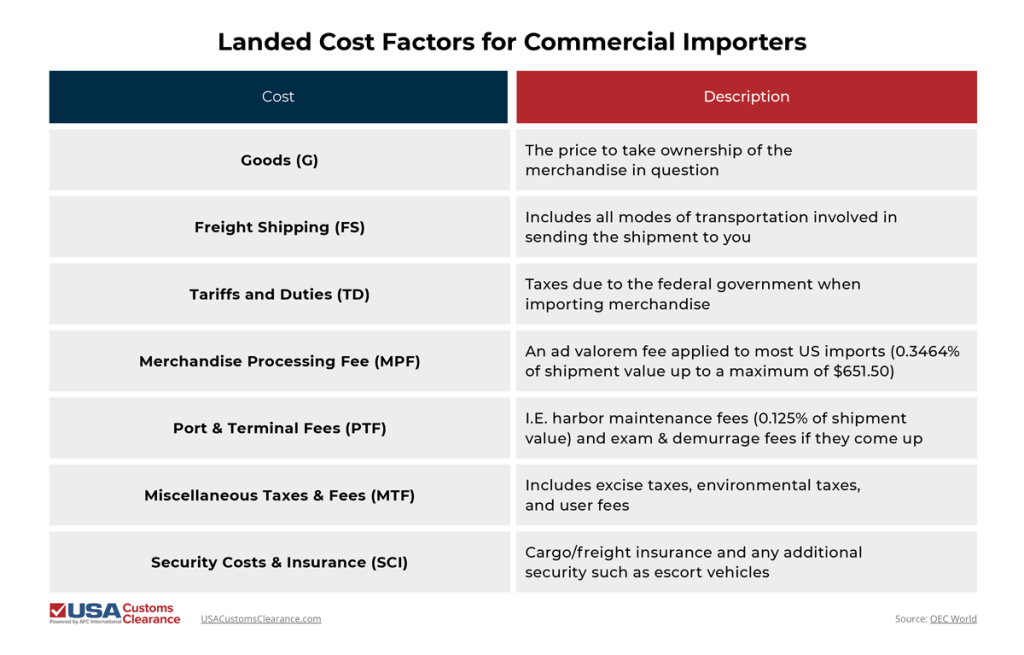
With this information, we can put together a simple landed cost calculation formula.
Related: A Guide to U.S. Import Taxes: Duties, Tariffs, and Other Fees
Our formula for calculating landed cost ends up as follows: G+ FS + TD + MPF + PTF + MTF + SCI = LC.
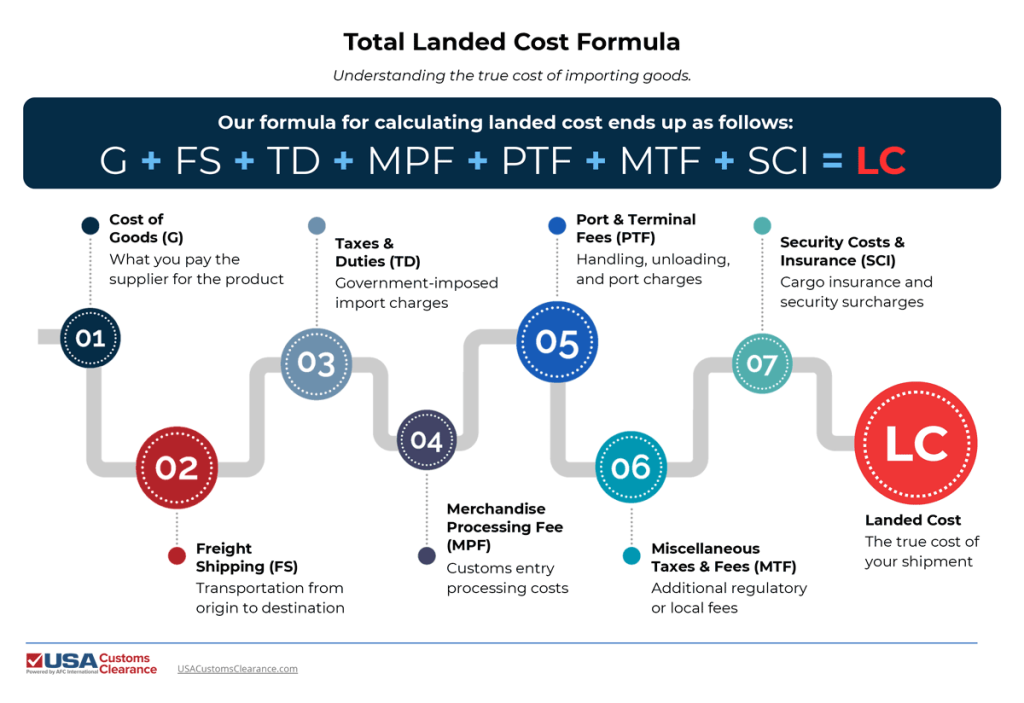
Many of these elements are also required on CBP Form 7501, aka the entry summary, so you should have them readily available for any given shipment upon accurate completion of that form. What’s not always as obvious is who’s responsible for paying landed costs in the first place.
International Incoterms® are used to determine the division of responsibilities in a given import transaction. This includes which party is responsible for paying the different fees and prices associated with landed costs. The result is that the responsibility for landed costs is often split between buyer and seller.
Take the Cost, Insurance and Freight (CIF) Incoterm for example. CIF puts the responsibilities for insuring and transporting an importer’s purchase on the seller until the shipment is loaded to a vessel destined for the buyer’s destination. Risk then transfers to the buyer, who takes over these responsibilities at this point.
It’s important to note that a shipment’s Incoterm doesn’t raise or lower the overall costs associated with the transaction. It simply assigns different levels of responsibility to each of the parties involved.
Related: The Best Incoterms For Importers: Winning in International Trade
The factors that go into a landed cost calculation will vary somewhat from one business to another. To illustrate some common examples, let’s look at a small retailer with just a few employees and a medium-size wholesaler who deals directly with retail establishments.
A small boutique in California orders clothing and fashion accessories from suppliers in Mexico. The boutique is located within 100 miles of the US/Mexico border, and they store excess inventory in a small warehouse on site.
An average restocking shipment of garments and accessories costs the business $5,000, which they have delivered via full truckload shipping for $1200 per delivery. For the purposes of this exercise, the shipment incurs a 5% ad valorem tariff and the buyer purchases full coverage cargo insurance for $500.
Since this shipment won’t go by sea, we don’t have to worry about harbor maintenance fees, just a $7.35 commercial truck arrival fee. This gives us the following calculation:

This is a fairly simple example. Now let’s complicate things.
Farther up the coast, an importer of bulk metal routinely brings in orders from overseas. Their average order is 100,000 kg (100 metric tons) The metal is priced at $5,000 per metric ton which gives us a value of $500,000. It incurs a duty rate of 1.5%, resulting in $7,500 worth of duties due to US Customs and Border Protection (CBP).
The metals are shipped via five full container loads (FCLs) at approximately $4,200 per container for a total of $21,000 in ocean freight shipping. Drayage service from the port to the importer’s warehouse comes out to another $400 per container, or $2,000 total. This gives us a total freight shipping cost of $23,000.
Additionally, we easily hit the maximum MPF of $651.50 and a $625 harbor maintenance fee (HMF). The shipment is spread across five containers insured at a rate of $1,000 a piece. On top of all of these costs, the containers are flagged for inspection at the importer’s expense once they arrive in port due to suspicion of excess radiation levels.
Inspection costs add another $1,200 and the process takes three days, which adds a $720 demurrage charge. This tacks another $1,920 to our port fees for a total of $2,545 when combined with the HMF.
With all of these charges, our calculation becomes:

Part of this landed cost could have been avoided by working through a customs broker trusted by CBP. This reduces the chances of certain inspections and exams, especially compared to newer importers who are prone to making costly errors on documents such as the entry form.
While some elements of landed cost are easy to determine up front, estimating import taxes and fees isn’t always straightforward. Mistakes can cost you time, money, and reputation, so partnering with a customs broker often ends up being a wise investment in your business.
Call our team of licensed brokers at (855) 912-0406 or fill out a contact form online: we’re standing by to take the guesswork out of customs clearance.
 Copy URL to Clipboard
Did you find this article helpful?
See more of our coverage on Google.
Add usacustomsclearance.com as a preferred source!
Add usacustomclearance.com as a preferred source!
See more of our coverage in Google's Top Stories.
Get Customs, Tariffs, and Compliance Alerts at Your Fingertips
Sign up for VIP email alert access.
Licensed customs support for importers across a wide range of U.S. entry needs. USA Customs Clearance provides Customs Bonds, Consulting, Customs Brokerage, Manifest Confidentiality, Importer of Record support, and Guides & Resources to help importers prepare for U.S. Customs and Border Protection (CBP) requirements and customs clearance with regulatory compliance, greater clarity, and confidence.
With licensed broker support, transparent service information, and secure checkout, we help importers take the right next step.

We know the importing process and requirements can be confusing, but they don't have to be.
We're here to help.
When purchasing a product from our website, you can feel confident knowing our team can help if you accidentally select the wrong product. We'll guide you through the correct purchase and any applicable refund process.
Important Refund Policy Information
Eligible refunds are subject to a $50 processing fee, which will be deducted from your original purchase amount. Please allow up to 90 days for refunds to be processed, as refunds are handled quarterly by our Accounting Department.
Refunds are available only if you have not yet:
Additional Refund Terms
You have 90 days from the date of purchase to submit your bond application. After 90 days, bond fees are forfeited and are nonrefundable.
All eBook sales are final and nonrefundable.
Add your first comment to this post