
IOR ENFORCEMENT IS NOW IN EFFECT | REVIEW MY IOR





International shipping costs are the combined expenses associated with moving imported goods from a foreign supplier to their final destination in the United States. Importers who want to know how to reduce international shipping costs can review their shipping modes, tariff strategies, and domestic partnerships to identify areas where costs can be cut without losing efficiency and efficacy.
The best practices importers can use to reduce international shipping costs can be broken down to the following five steps.
Let’s take a closer look at each of these steps and how they help importers curtail unnecessary expenditures.
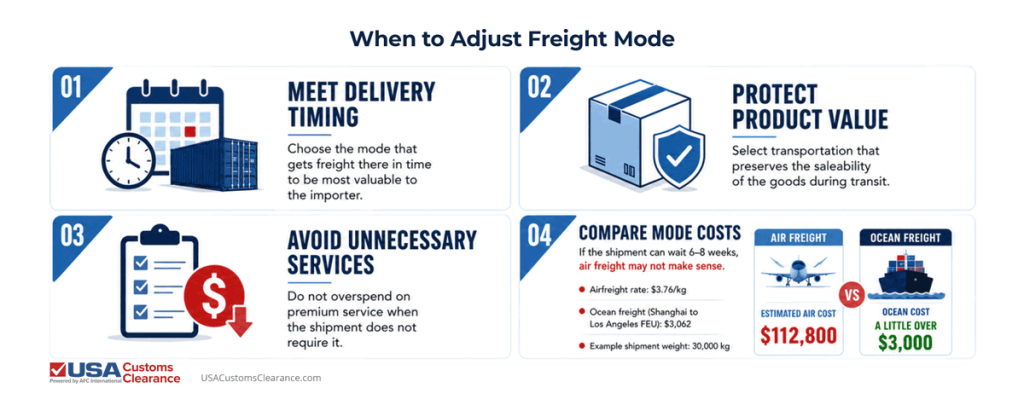
The optimal freight mode for an imported shipment satisfies the following requirements:
For instance, if an importer has six to eight weeks to wait for a shipment to arrive, it makes little sense to have that shipment brought in via air freight. As of May 2026, Air Cargo News reported spot airfreight rates at $3.76 per kg, while Drewry placed Shanghai-to-Los Angeles FEU pricing at $3,062 as of the same time period.
Assuming the shipment weighs 30,000 kg, that means a shipment that costs a little over $3,000 to ship via ocean freight would cost $112,800 on a cargo jet. This illustrates how planning shipments far ahead of time gives importers the opportunity to save money during freight transportation.
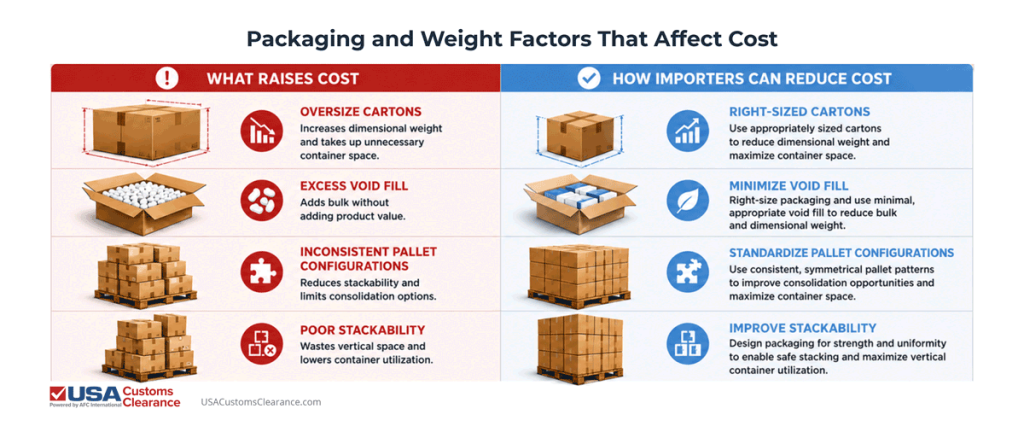
Packaging inefficiency can raise international shipping costs by increasing dimensional weight, reducing container utilization, and limiting consolidation opportunities.
Although suppliers package their cargo prior to shipment, importers still maintain substantial control over packaging standards through their purchase agreements and vendor instructions.
Importers should work with their suppliers to make sure goods are packaged efficiently. This maximizes container space, reduces weight, and gives the importer some control over one of the most costly aspects of international shipping.
Areas to evaluate include:
Importers should also inspect packaging when goods arrive in the United States to identify opportunities to improve packaging efficiency. Suppliers should be notified of repeated, consistent issues so they can improve their packaging processes.
Optimized packaging may not present a massive initial cost savings, but it can save importers considerable money over time. For instance, let’s say an importer brings goods into the country once a month for a year with sub-optimal packing and packaging, then contacts their supplier about the issue with suggestions for improvements.
If the supplier is able to reduce packaging, they can fit more goods into a container than they would have previously. This means the importer’s overall shipping cost per goods imported decreases if he utilizes the full container or splits it with another importer via Less Than Container-load (LCL) freight shipping.
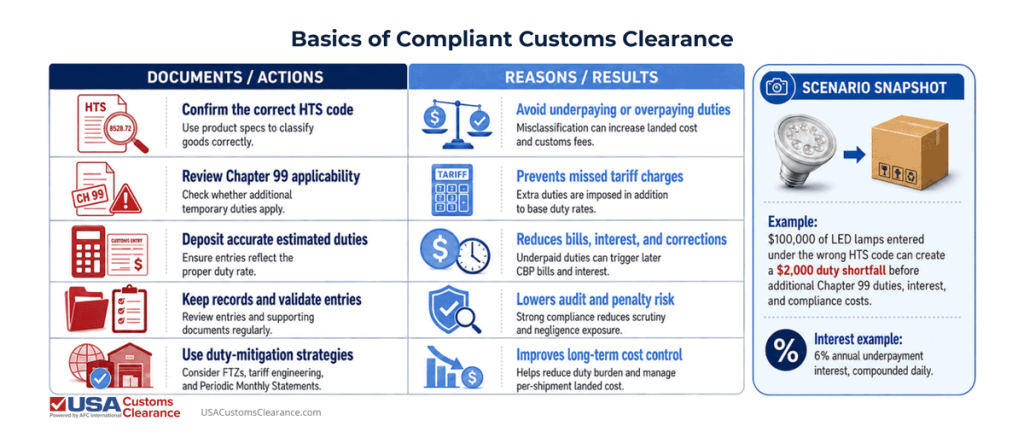
Customs classification is the process of using the United States Harmonized Tariff Schedule (HTS) to find an item’s associated HTS code, which is used to determine the duties an importer owes when bringing that item into the country.
Misclassifying goods under the wrong HTS code can lead to two types of additional costs for importers:
These scenarios illustrate how improper tariff classification can increase customs clearance fees and, by extension, the overall costs of international freight shipping.
Scenario 1: Underpaying Duties Due to Inaccurate Tariff Classification
A U.S. importer buys commercial LED lighting lamps from a manufacturer in China, which they resell to stateside warehouse operators and industrial facilities.
When preparing their entry documents, the importer mistakenly classifies the products under HTS code 8539.51.00, which applies to LED modules and carries a free general rate of duty. The correct code for the LED lamps is actually 8539.52.00, and carries a 2% rate of duty.
Assume the importer purchased $100,000 worth of misclassified LED lamps. That’s $2,000 in unpaid duties due to CBP.
Because the importer uses the incorrect HTS classification:
Chapter 99 states that applicable temporary duties are imposed “in addition to the duties, if any, otherwise imposed on the articles involved.” This means any temporary duties assessed under Section 301 or another tariff adjustment mechanism were likely overlooked or miscalculated as well.
Several months later, CBP reviews the importer’s entries during a focused assessment and determines the products were misclassified.
CBP issues a bill to the importer for unpaid duties, including those from Chapter 99 tariffs. The agency also assesses interest on the unpaid duty payments.
Under 19 CFR 24.3a, interest on underpaid duties accrues: “from the date the importer of record is required to deposit estimated duties, taxes, fees, and interest to the date of liquidation or reliquidation...”
The applicable interest rate is based on IRS quarterly underpayment rates found in Internal Revenue Code subsections 6621 and 6622.
The IRS Internal Revenue Bulletin for calendar quarter beginning April 1, 2026 establishes “6 percent for underpayments”. The bulletin also states that interest compounds daily under subsection 6622.
As a result, the importer not only owes the unpaid duties, but also:
While the misclassification was an honest mistake, the importer is still responsible for paying any penalties and underpaid duties.
Had the opposite scenario played out, the importer would have instead paid at least $2,000 in duties that were not owed. Either way, accurate tariff classification is an important element of any importer’s cost-reduction strategy.
Importers can also use the following methods to mitigate and reduce duties owed to CBP:
While duties aren’t strictly a cost associated with international shipping, they are intertwined with shipping expenses in landed cost calculations, and importers benefit from controlling these costs on a per-shipment basis.
Consolidating shipments involves placing goods from two or more vendors in the same shipment to reduce overall shipping costs.
This is a simple concept: if you need to pick up items at two destinations along the same route, it makes more sense to send one vehicle to pick up both items than two vehicles, since sending two vehicles would unnecessarily waste resources.
Scale that idea up and it’s easy to see how consolidation saves importers money. Frequent small shipments often create higher per-unit transportation costs due to:
For instance, if an importer pays Full Container Load (FCL) rates for three separate shipments over a two-month period at $3,000 per container load, that’s a total of $9,000 in shipping.
Now consider what would happen if the importer timed his inputs so that all three shipments could be shipped out and received together. The shipments are consolidated into a single container, and the importer’s shipping cost is reduced by $6,000 to just $3,000.
Patience and planning are two of an importer’s most effective tactics for reducing international shipping costs.
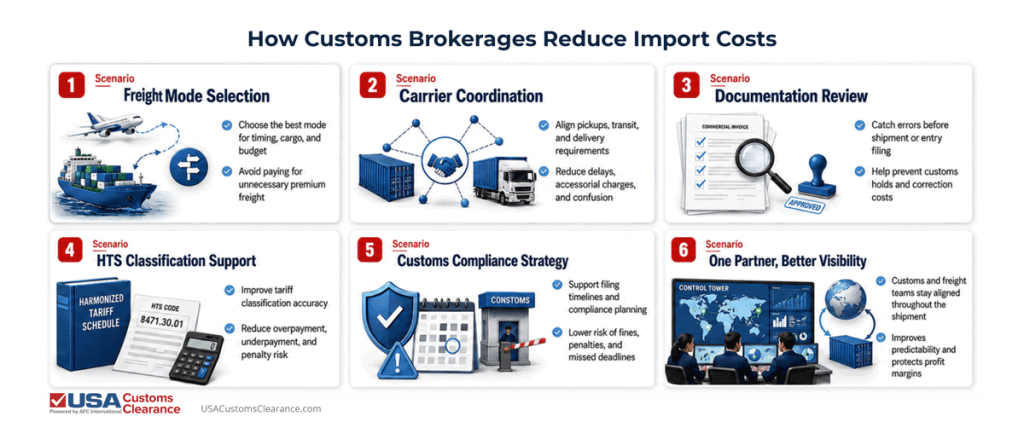
Importers who try to “go it alone” when they attempt to import goods quickly discover that having the right partners in customs clearance and international logistics is crucial to running a successful importing business. One of the most important partners an importer can work with is a Licensed Customs Broker, particularly one who works as part of a customs and freight brokerage service.
Partnering with customs brokerage and freight forwarding professionals under one roof is advantageous for importers because transportation planning and customs clearance strategy remain aligned throughout each shipment.
Experienced logistics professionals can assist with:
Professional oversight also helps reduce unexpected costs tied to:
Reducing compliance failures and transportation inefficiencies helps importers protect profit margins while improving supply chain predictability.
Each of these strategies, especially when used together, reduce total landed costs by preventing excess spending associated with unoptimized shipping practices and mistakes in customs documentation and clearance.
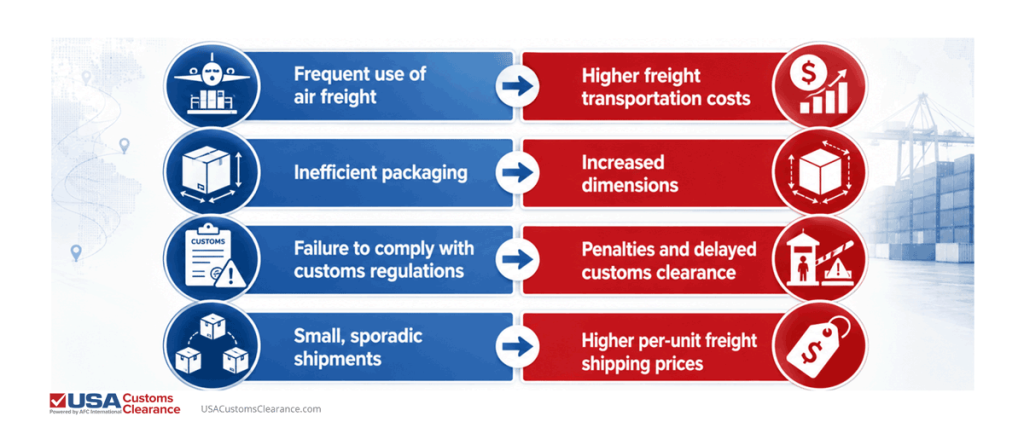
An importer with unoptimized processes might experience the following:
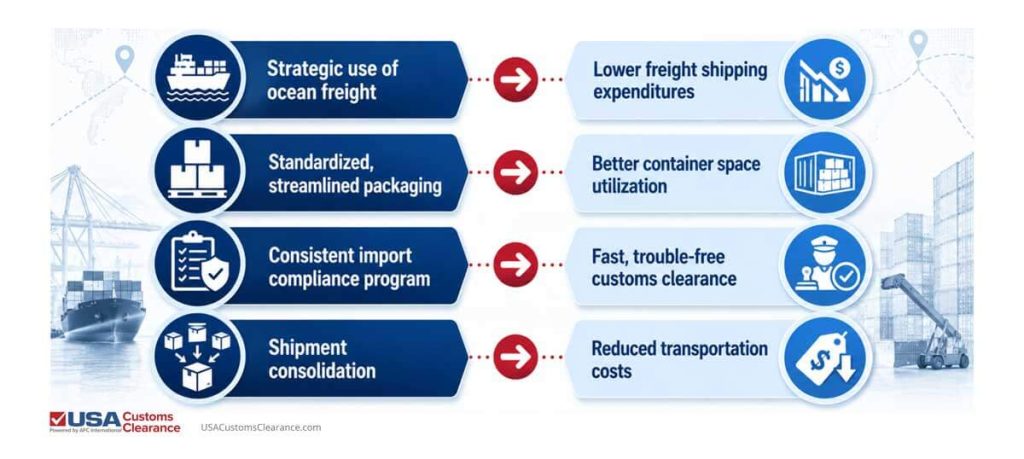
By comparison, an optimized importer is likely to get positive results:
There is no single, monolithic strategy importers can use to reduce international shipping costs. However, by optimizing at each stage in the transactional, shipping, and customs clearance processes, importers insulate themselves from penalties and overpayments that can cripple a small or medium-size business.
If you want help identifying where freight mode, customs classification, or import process issues may be increasing your landed costs, call (855) 912-0406 or visit our contact page to get in touch with a customs expert today.
What are the biggest factors affecting international shipping costs?
Fuel costs, lane volatility, capacity, and demand are the primary driving forces behind international shipping costs.
How can I lower customs duties legally?
Take advantage of trade acts, source your goods from countries that aren’t subject to AD/CVD and Section 301 duties, and include tariff engineering and tariff shifting in your import strategy, if applicable.
Is it cheaper to ship by air or ocean?
Ocean freight is less expensive since the vessels have the capacity for thousands of containers in contrast with the limited air freight space. However, ocean freight is also considerably slower than air freight.
Sources
Brett, Damian, Airfreight Rates Continue To Rise Despite Demand Weakness, Aircargo News, 2026
Supply Chain Advisors, Drewry
Harmonized Tariff Schedule, United States International Trade Commission
Penalties Program, U.S. Customs and Border Protection, 2025
Title 19, Chapter I, Part 23 23.3a CBP bills; interest assessment on bills; delinquency; notice to principal and surety, Code of Federal Regulations, 2026
Internal Revenue Bulletin: 2026-8, International Revenue Service, 2026
 Copy URL to Clipboard
Did you find this article helpful?
See more of our coverage on Google.
Add usacustomsclearance.com as a preferred source!
Add usacustomclearance.com as a preferred source!
See more of our coverage in Google's Top Stories.
Get Customs, Tariffs, and Compliance Alerts at Your Fingertips
Sign up for VIP email alert access.
Licensed customs support for importers across a wide range of U.S. entry needs. USA Customs Clearance provides Customs Bonds, Consulting, Customs Brokerage, Manifest Confidentiality, Importer of Record support, and Guides & Resources to help importers prepare for U.S. Customs and Border Protection (CBP) requirements and customs clearance with regulatory compliance, greater clarity, and confidence.
With licensed broker support, transparent service information, and secure checkout, we help importers take the right next step.

We know the importing process and requirements can be confusing, but they don't have to be.
We're here to help.
When purchasing a product from our website, you can feel confident knowing our team can help if you accidentally select the wrong product. We'll guide you through the correct purchase and any applicable refund process.
Important Refund Policy Information
Eligible refunds are subject to a $50 processing fee, which will be deducted from your original purchase amount. Please allow up to 90 days for refunds to be processed, as refunds are handled quarterly by our Accounting Department.
Refunds are available only if you have not yet:
Additional Refund Terms
You have 90 days from the date of purchase to submit your bond application. After 90 days, bond fees are forfeited and are nonrefundable.
All eBook sales are final and nonrefundable.
Add your first comment to this post