
IOR ENFORCEMENT IS NOW IN EFFECT | REVIEW MY IOR


In This Article:


To import silk into the United States, importers should first learn how to accurately classify silk goods in the U.S. Harmonized Tariff Schedule (HTS) to ensure they pay the correct duties and avoid delays and penalties from U.S. Customs and Border Protection (CBP). Several federal agencies may regulate a silk shipment depending on the product’s form and intended use. Relevant authorities can include the Federal Trade Commission (FTC), the U.S. Department of Agriculture (USDA), the Consumer Product Safety Commission (CPSC), and the Environmental Protection Agency (EPA).
Silk can be imported in raw, thread, and woven forms, and it is a constituent commodity used in the manufacture of textiles including clothing. The following list describes imported silk commodities according to their Harmonized System (HS) designations.
Raw silk and similar materials are classified in Chapter 50 of the HTS, while finished products containing silk are classified in chapters 51 through 63.
Importers and customs brokers use the General Rules of Interpretation (GRI) to classify silk and silk goods in the Harmonized System (HS). Specifically, silk importers will need to use the following information when classifying their goods:
Using this information, an importer applies the GRI to identify the appropriate four-digit HS heading and then continues through the subheadings to determine the full U.S. HTS classification.
Product form provides one of the clearest initial classification distinctions. For example, silk yarn on a spool is classified differently from a finished silk garment because the yarn has not yet become a finished article.
Generally speaking, no: silk imports are subject to the applicable column duty rate in the HTS for their imported goods, along with any additional tariffs applied via mechanisms such as Section 301 of the Trade Act of 1974 and anti dumping and countervailing duties (AD/CVDs).
In Chapter 50 of the HTS, silk commodity duty rates range from zero to 3.9% ad valorem under column 1, with preferential treatment available under trade agreements like the United States-Mexico-Canada Agreement (USMCA) and the Dominican Republic-Central America FTA (CAFTA-DR).
As of July 2026, additional Section 301 duties of 10% or 12.5% apply to covered products from numerous U.S. trading partners, subject to specified product exemptions and other adjustments. Importers must review the current Chapter 99 provisions for the product’s HTS classification and country of origin.
Labeling requirements for textiles (including those that contain silk) are established in part 303 of the Textile Fiber Products Identification Act.
The label must identify how much silk is present in the overall composition of a textile. For instance, a half silk/half cotton blend should contain “50 percent silk” and “50 percent cotton” on the label.
Labels must contain the accurate country of origin for the imported silk goods. Country of origin refers to the country in which the goods were made or harvested, so if goods are purchased by a wholesaler in Canada from a Chinese supplier and the Canadian business sells those goods to a U.S. buyer, the country of origin is still China, not Canada.
Labels must clearly identify the manufacturer or dealer of any silk textiles. A qualifying company may identify itself with its business name, a federally registered trademark, or an FTC-issued Registered Identification Number.
CBP enforces regulations on silk imports from four different partner government agencies:
The responsibilities these agencies fulfill vary depending on the type of silk being imported and which aspect of its importation they regulate.
The FTC primarily administers textile-labeling and deceptive-marketing requirements, while CBP enforces applicable import requirements at the border. Silk merchandise that fails mandatory labeling, marking, admissibility, or intellectual-property requirements may be detained, excluded, seized, or required to be corrected, depending on the violation.
USDA requirements may apply to silk-related commodities based on their form, processing, and claims. For example, live silkworms and certain biological materials can require USDA permits or inspection, while products marketed with regulated organic claims must satisfy the applicable certification and labeling requirements.
The CPSC is charged with enforcing labeling guidelines and ensuring that imported children’s sleepwear, bedding, and other textile goods are flame-resistant and can self-extinguish if ignited by a small flame such as that from a candle.
If an importer attempts to bring silk infantwear into the country that does not adhere to these applicable labeling and flammability requirements in the Code of Federal Regulations Title 16 § 1615.5, they may be subject to penalties such as delays, fines, and forfeiture of imported merchandise.
Agents of the EPA sometimes inspect silk imports to ensure they contain no toxic substances like pesticides. You should verify whether chemical treatments, coatings, dyes, or pesticidal claims trigger EPA reporting, certification, labeling, or admissibility requirements
Yes, it is legal to import silk and silk-derived products into the U.S. from China. China’s historical association with silk as a commodity means new importers often consider China before other trade partners.
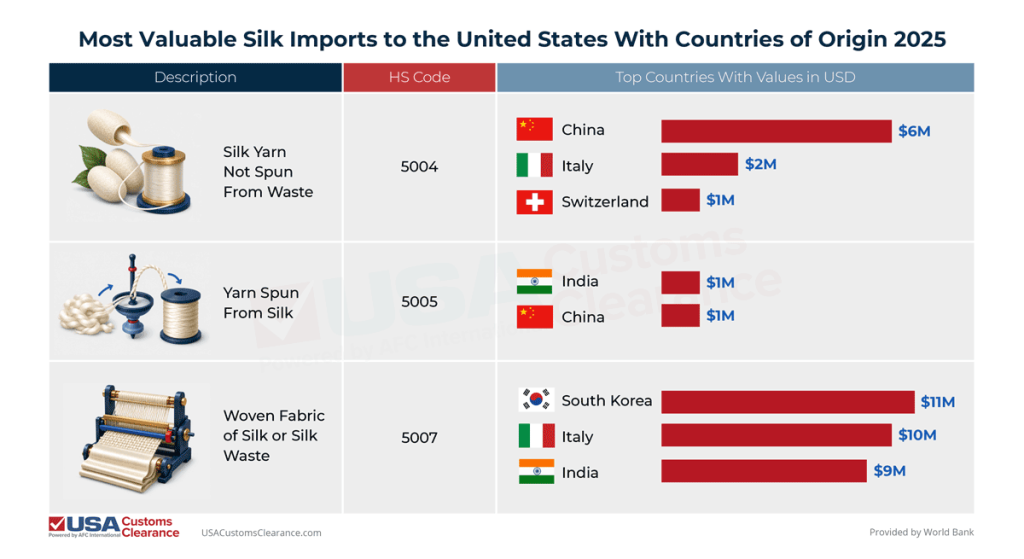
China ranked number one by USD value for supplying silk yarn not spun from waste to the U.S. in 2025. However, other countries rank higher in different types of silk commodities.
Besides China, other countries that supply silk to the U.S. include India, South Korea, and Italy. The table below displays commonly imported silk commodities from top U.S. trade partners in 2025.
Provided by World Bank
Other silk commodities with less import volume include silkwork cocoons for reeling, raw silk, and silk waste.
Silk importers, especially those who are inexperienced, commonly face these five problems:
Each item should state the problem and the preventive action in two or three sentences.
Importers can use this checklist to reduce the risk of clearance delays and CBP penalties:
Businesses that want to add an extra layer of verification to their dealings with CBP often partner with a customs broker. CBP-licensed customs brokers are uniquely qualified to assist importers with the complexities of U.S. customs.
If you’re interested in assistance from a licensed customs broker for your imported silk goods, call us at (855) 912-0406 or fill out a contact form online today.
Sources:
General Rules for the Interpretation of the Harmonized System
Title 16, Chapter I, Subchapter C, Part 303 - Rules and Regulations Under the Textile Fiber Products Identification Act, Code of Federal Regulations, 2026
Children’s Sleepwear, Consumer Product Safety Commission
Title 16, Chapter I, Subchapter D, Part 1615.5 Labeling Requirements, Code of Federal Regulations, 2026
 Copy URL to Clipboard
Did you find this article helpful?
See more of our coverage on Google.
Add usacustomsclearance.com as a preferred source!
Add usacustomclearance.com as a preferred source!
See more of our coverage in Google's Top Stories.
Licensed customs support for importers across a wide range of U.S. entry needs. USA Customs Clearance provides Customs Bonds, Consulting, Customs Brokerage, Manifest Confidentiality, Importer of Record support, and Guides & Resources to help importers prepare for U.S. Customs and Border Protection (CBP) requirements and customs clearance with regulatory compliance, greater clarity, and confidence.
With licensed broker support, transparent service information, and secure checkout, we help importers take the right next step.

Add your first comment to this post