
IOR ENFORCEMENT IS NOW IN EFFECT | REVIEW MY IOR


In This Article:


Customs documentation is the paperwork used to identify, classify, transport, and clear imported goods through U.S. Customs and Border Protection (CBP). It can include documents provided by suppliers or manufacturers, carried-issued shipping records, and import paperwork required by CBP or applicable Partner Government Agencies (PGAs) during customs clearance.
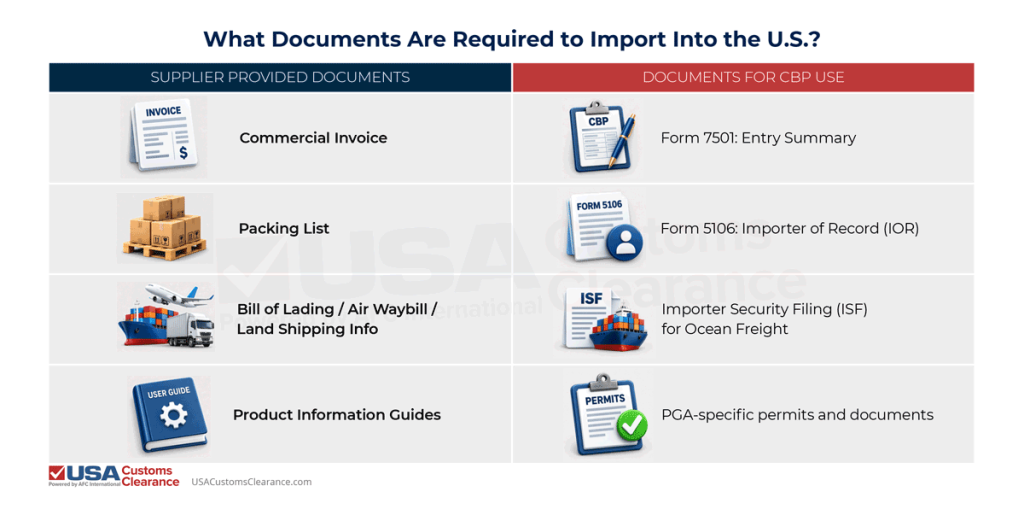
Documents required for importing into the U.S. generally fall into two categories: product-specific documentation from the manufacturer or supplier and documentation CBP requires importers to submit or maintain as part of the customs clearance process.
A non-exhaustive list of these documents includes the following:
Customs bonds are also required for the vast majority of commercial importing scenarios, but the document in this case represents a financial arrangement which I’ll explain in detail later on.
Each of the documents provided by suppliers during the purchasing and shipping process are used to inform submissions the importer or their customs broker will make to CBP during customs clearance.
This document contains multiple data points about the parties involved in a transaction, the merchandise itself, and its value.
Importers can source the following information from this invoice:
The merchandise descriptions, price, and value of the goods are particularly important when filling out the entry summary since that document requires customs valuation, HTS classification, and estimated duties to be provided.
The pro forma invoice has useful commercial applications, but it should not be used as a source of information for filling out import documents. Instead, importers should rely on the commercial invoice itself since it is a post-transactional document with less information that can change during the import process.
Packing lists essentially provide a list of goods inside the package(s) being shipped. Some of its information is redundant with the commercial invoice, but importers often benefit from having multiple documents stating the same information, as CBP often verifies customs documents against multiple sources to ensure goods are compliant with U.S. customs regulations.
Specifically, the list contains consignee and buyer information, details about the shipment itself, and product and packaging information.
Customs officials will verify a carton’s content against its packing list should that carton be marked for a customs inspection.
Depending on the mode of transportation chosen by the importer, the carrier will issue an ocean bill of lading (BoL), air waybill, or terrestrial shipping equivalent. Ocean freight is the most common method of commercial importing due to affordability, while air freight is valued for expedited delivery purposes.
The ocean BoL is used for imports traveling on a vessel. Importers will need to sign off on this document once their goods arrive. If the goods haven’t been officially sold when they reach the importer, the BoL becomes a blank endorsement and is considered negotiable.
Air waybills are for imports carried by plane. These BoLs are non-negotiable, which means the shipments can only be given to the person named on the document.
The International Air Transport Association (IATA) is responsible for making and distributing air waybills. There are two distinct kinds that can be used:
They’re essentially the same, except the neutral variant doesn’t have the carrier’s information pre-filled.
An inland BoL is used for shipments transported by rail, truck, or even inland waterway. It’s typically used before a shipment is transported outside the country via air or ocean. The inland BoL isn’t consigned to the importer, but rather to the international carrier.
These guides can include product catalogs, user guides, and any supplier-generated documents that reinforce information used on CBP-required documents.
For instance, classifying goods in the Harmonized Tariff Schedule (HTS) requires importers to know the product’s name, how it’s intended to be used, and its features to determine the correct HTS code. Information guides also contain country of origin information that supports accurate estimation of duties and preferential tariff treatment when applicable.
For commercial importers, the most common entry document is CBP Form 7501, aka the entry summary, which must accompany all imported commercial shipments coming into the U.S. Informal entries may follow different documentation procedures.
The Importer Security Filing (ISF) is also required when importing via ocean freight, and other PGA-specific documents may be required depending on the commodity and which agency has jurisdiction over it.
Before any import transactions, however, the importer must register their identity with CBP via Form 5106.
While not strictly an entry document, importers are required to submit information about themselves and their business structure to CBP using Form 5106 prior to importing any goods. Once successfully completed, submitted, and processed, the applicant will be registered as an Importer of Record (IOR) in the U.S. and will be able to transact imported goods.
The entry summary identifies merchandise entering into the U.S. for purposes including commercial use. During customs clearance, CBP may check this document against the supplier-provided documents mentioned above to verify:
This is arguably the most important document importers need to submit to CBP on a per-import transaction basis, as incorrect or incomplete information on Form 7501 can lead to delays, inspections, and cargo seizures at port.
Yes, importers need a customs bond to bring goods into the country in nearly any commercial transaction scenario. Triggers for customs bond requirement include:
Businesses that import four or more times a year will almost always benefit from having a continuous customs bond on file rather than filing a single entry bond for each individual shipment.
Importers mainly use certificates of origin (COOs) when applying for preferential tariff treatment under a Free Trade Agreement (FTA). A COO isn’t necessary for every imported shipment.
Most FTAs require importers to prove their goods originated in the country they’re importing from to be eligible for a reduced or eliminated duty rate.
This is not to be confused with documents that support country of origin claims, as CBP may request proof of origin during an audit even for shipments that didn’t receive preferential tariff treatment.
Importers might also need certifications or permits from the PGA or PGAs in charge of regulating specific goods and products.
Food importers, for instance, will need to submit Prior Notice of Imported Foods to the Food and Drug Administration (FDA) for commercial shipments in order to facilitate inspections and prove their goods are sourced from FDA-approved facilities. Depending on the food’s country of origin and the organism from which it is sourced, a certificate from the Animal and Plant Health and Inspection Service (APHIS) may also be required.
Similarly, importers of motorcycles will contend with regulations set by the Environmental Protection Agency (EPA) and will need to submit Form 3520-1 to prove the vehicle’s engine conforms to federal regulations.
This is also an example of regulation by two agencies, as the motorcycle must meet the National Highway Traffic Safety Administration’s (NHTSA) Federal Motor Vehicle and Safety Standards (FMVSS).
While PGAs may require additional documents, importers should keep in mind that there is no such thing as a general import license: IOR registration is the most basic requirement of a commercial importer, and any licenses or permits from there are PGA-specific.
Importers should supply their customs brokers with documents that support and confirm:
Our team of Licensed Customs Brokers is standing by to assist importers with every aspect of customs clearance from ISF filing to entry and release. Call us at (855) 912-0406 or fill out a contact form online today.
Entry Summary, Department of Homeland Security, U.S. Customs and Border Protection, 2026
Prior Notice of Imported Foods, U.S. Food and Drug Administration, 1/21/25
 Copy URL to Clipboard
Did you find this article helpful?
See more of our coverage on Google.
Add usacustomsclearance.com as a preferred source!
Add usacustomclearance.com as a preferred source!
See more of our coverage in Google's Top Stories.
Get Customs, Tariffs, and Compliance Alerts at Your Fingertips
Sign up for VIP email alert access.
Licensed customs support for importers across a wide range of U.S. entry needs. USA Customs Clearance provides Customs Bonds, Consulting, Customs Brokerage, Manifest Confidentiality, Importer of Record support, and Guides & Resources to help importers prepare for U.S. Customs and Border Protection (CBP) requirements and customs clearance with regulatory compliance, greater clarity, and confidence.
With licensed broker support, transparent service information, and secure checkout, we help importers take the right next step.

We know the importing process and requirements can be confusing, but they don't have to be.
We're here to help.
When purchasing a product from our website, you can feel confident knowing our team can help if you accidentally select the wrong product. We'll guide you through the correct purchase and any applicable refund process.
Important Refund Policy Information
Eligible refunds are subject to a $50 processing fee, which will be deducted from your original purchase amount. Please allow up to 90 days for refunds to be processed, as refunds are handled quarterly by our Accounting Department.
Refunds are available only if you have not yet:
Additional Refund Terms
You have 90 days from the date of purchase to submit your bond application. After 90 days, bond fees are forfeited and are nonrefundable.
All eBook sales are final and nonrefundable.
An auto was imported from Turkey to Florida. It was purchased by a friend and shipped cargo ship. The car I am told has my name, address, DL# assigned to it as me being owner. What is the process of getting legal registration and license plates, insurance?
I am told Title will be mailed to me. I fear I am getting scammed.
What govt entity do I contact about Title on car?
I want to understand this with examples.
Proper formats of these papers.
Explain this through short examples with proper working inside the formats.
Thanks
Would want to know more about international shipping, exports and imports documentation, etc.