
IMPORT TARIFFS - LATEST NEWS & UPDATES




Prior disclosure is a voluntary, written self-disclosure to U.S. Customs and Border Protection (CBP) where an importer (or other eligible party) notifies CBP of past import-related errors and explains what happened, which entries are affected, and how the revenue impact was calculated.
This starter kit is for importers, compliance managers, finance teams, and logistics teams who suspect an error or discovered one during an internal review and want to understand whether prior disclosure is an option—plus what a “strong” submission typically includes and how to avoid common mistakes.
Key takeaways:
Now let’s walk through what prior disclosure is, who can submit, and how to prepare a submission that’s easy for CBP to review.
Legal Disclaimer: This article is general information and not legal advice.

Our Expert Licensed Customs Brokers can help you build a reviewer-ready Prior Disclosure before U.S. Customs and Border Protection (CBP) finds it first. Confidential review - no obligation.
Testimonial from Jonathan W., Importer - Gained ACE Secure Data Portal access in 6 days after using our Importer of Record Registration service.
“It worked! Thanks to you and your team’s help - we finally got ACE Secure Data Portal access.”
What it is: Prior disclosure is a voluntary, written self-report to CBP in which an importer or other eligible party discloses a compliance error in their import transaction before CBP discovers it.
Errors can include incorrect:
Prior disclosures provide the scope of affected entries, supporting facts, and corrected information.
What it isn’t: Prior disclosure is not a way to avoid all accountability, and it’s not the same as other post-entry tools.
For example:
CBP wants accurate entry data and proper revenue collection. A well-prepared prior disclosure helps CBP understand the issue quickly and supports the integrity of the import process.
In practice, prior disclosures usually involve the IOR. However, more than one entity may take part in the submission, depending on how the transaction is structured.
Common eligible/participating entities may include:
Practical takeaway: Even when multiple parties are involved, CBP generally expects clarity on who is responsible, who is submitting, and who can produce the underlying records.
You should submit a prior disclosure if you want to receive reduced penalties in connection with a violation. While this is the primary reason importers pursue a prior disclosure, there are other benefits they can enjoy.
This includes:
Essentially, prior disclosure can lead to a smooth supply chain in the future.
CBP reviewers want a prior disclosure that answers four basic questions quickly.
1) What happened?
Provide a clear explanation of the issue using plain language.
Information you need to provide includes:
2) Which entries are affected?
A strong disclosure defines scope in a way that is:
3) What is the revenue impact?
You’ll typically include:
4) What have you done to prevent recurrence?
CBP generally expects corrective action, such as:
Ensure your prior disclosure has a clean structure that makes it easy for CBP officials to identify the data elements they need to review. Finally, we’ve provided a checklist of the import documents and items you’ll need when submitting a prior disclosure.
This includes:
The information provided by these documents and items will help you submit an accurate and robust prior disclosure.
Headline: Check Prior Disclosure Eligibility
Supporting line: Not sure whether Prior Disclosure is the right tool? Our Expert Licensed Customs Brokers quickly assess timing risk, issue type, and the cleanest next stop.
Button text: ready for Consultation
Not sure whether Prior Disclosure is the right tool? Our Expert Licensed Customs Brokers quickly assess timing risk, issue type, and the cleanest next stop. Confidential review - no obligation.
Prior disclosures must be submitted at the right time and place for them to be accepted.
When:
Submit your prior disclosure when after you discover a violation and before CBP finds the same issues during a formal investigation. If you wait for CBP to discover the problem first, you’ll lose the ability to submit the document.
Where:
Submit your prior disclosure to the port of entry where the disclosed violation occurred. If you have violations at multiple ports, you’ll need to list each one in the disclosure.
Filing a prior disclosure can be a hassle. With so many steps to follow, it’s easy to make a mistake. That’s why we’ve provided the following graphic to make it easier for you to complete this process.
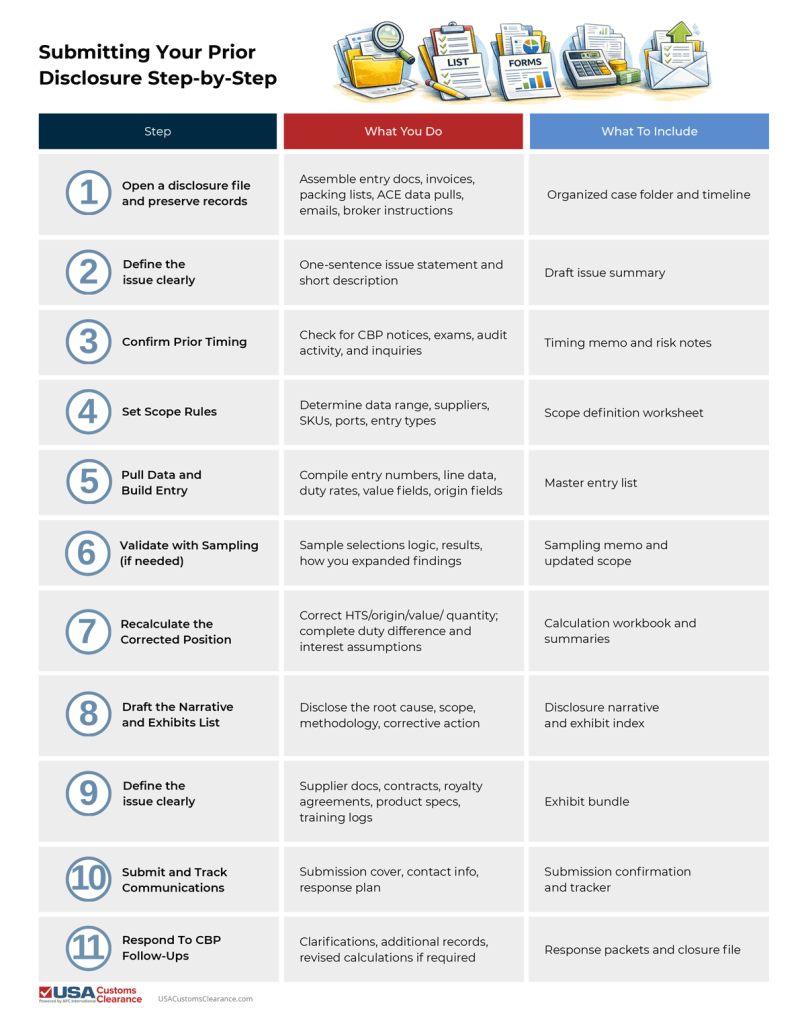
The fastest way to create delays is to submit a disclosure that is hard to understand or hard to verify.
Common mistakes include:
Take your time when filling out your prior disclosure and double check it for mistakes. Hiring a Licensed Customs Broker to look over it is another line of defense you can use to ensure your document is accurate before being submitted.
A prior disclosure is both a compliance project and a documentation project. USA Customs Clearance can support importers by helping you:
- Triage the issue type (classification, valuation, origin, quantity, preference program, documentation gaps)
- Define a defensible scope and create clean entry universes from broker/ACE data
- Reconstruct and validate calculations so the revenue impact is consistent and traceable
- Draft a reviewer-friendly narrative with an exhibit structure that’s easy to follow
- Strengthen internal controls (broker instructions, SOPs, supplier requirements, training, post-entry review cadence)
- Project-manage communications and follow-ups so nothing falls through the cracks
Here at USA Customs Clearance, we begin working on your prior disclosure right away. Give us a call at (855) 912-0406 or reach out to us on our contact page.
 Copy URL to Clipboard

Add usacustomsclearance.com as a preferred source!
See more of our coverage in Google's Top Stories.

Add usacustomclearance.com as a preferred source!
See more of our coverage in Google's Top Stories.
Add your first comment to this post