
IOR ENFORCEMENT IS NOW IN EFFECT | REVIEW MY IOR


In This Article:


An ATA Carnet is an international customs document that allows eligible goods to enter participating countries temporarily without payment of standard import duties and taxes. Businesses and travelers commonly use it for professional equipment, commercial samples, exhibitions, and trade fairs.
An ATA Carnet is a temporary-admission customs document often called a “passport for goods”. It allows eligible goods to cross participating borders without routine import duties and taxes, provided the goods are re-exported and properly validated by customs.
An ATA Carnet simplifies the import and export process between participating countries by allowing streamlined movement of goods used for commercial purposes. However, if you’re not able to present each of the goods listed on your carnet at every point of entry and exit, you may be charged 110 percent duty on those items.
ATA stands for a combination of the French and English words “Admission Temporaire/Temporary Admission.”
The system was established by the International ATA Convention in 1961. It was officially adopted in 1963 and is now jointly governed by the World Customs Organization (WCO) and the International Chamber of Commerce’s (ICC) World Chambers Federation.
The WCO is an intergovernmental body established in 1952 and based in Brussels, Belgium, while the ICC is the largest global business organization, representing millions of companies across 170 countries.
To get an ATA carnet, businesses must apply for one through the United States Council for International Business (USCIB) or from two other officially-appointed carnet service providers. An ATA carnet application may take up to two business days to process.
In the U.S., Roanoke Trade and the Corporation for International Business (also known as Boomerang Carnets) issue ATA Carnets on behalf of the USCIB. U.S. Customs and Border Protection (CBP) has designated the USCIB as the guarantor of the carnets, meaning the USCIB would be liable for payment in cases in which the terms of the carnet were violated.
A Temporary Importation Bond (TIB) is a U.S. customs entry procedure that allows qualifying goods to enter the United States temporarily without being treated as permanent imports. Like an ATA Carnet, a Temporary Importation Bond (TIB) allows qualifying commercial goods to enter a count temporarily.
However, unlike a carnet, a TIB is only good for one entry into a country and must be repurchased for every re-entry into that country, or for each entry into another country.
A TIB also requires the individual or business to file a CBP Form 3461 (Entry/Immediate Delivery) or CBP Form 7501 (Entry Summary), as well as to secure a customs bond from a surety or Licensed Customs Broker.
A carnet can be used as many times as necessary during the 12-month period that it’s valid and can be used in any country that accepts ATA carnets. Additionally, no other documents are required upon entry other than the carnet. Here’s a table that compares the differences between an ATA Carnet and TIB.
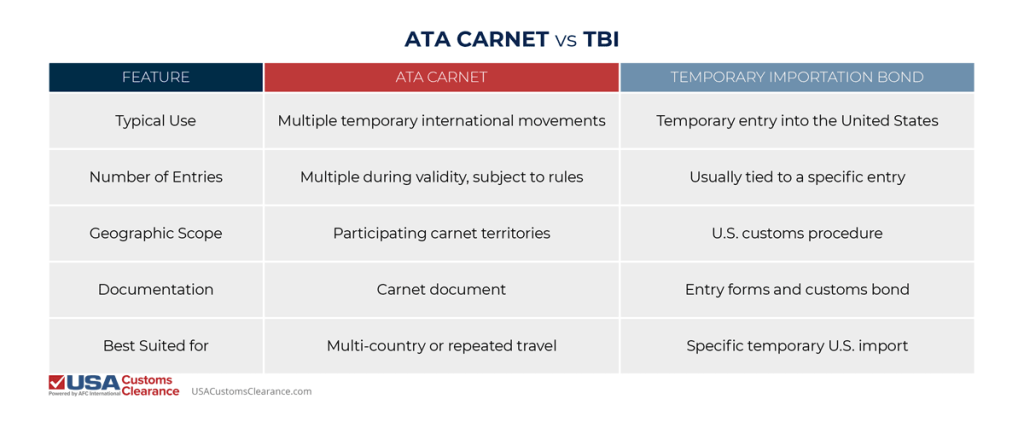
If you plan on temporarily importing your goods multiple times within a calendar year, or if you plan to use those goods for commercial purposes in multiple participating countries, an ATA Carnet can save you time and money compared with using a TIB.
An ATA Carnet provides a number of benefits for travelers needing to temporarily import and export items intended for commercial use.
The benefits of using an ATA Carnet include:
With a carnet, you’ll only have to pay one upfront fee for the year, in addition to a security deposit. Without the carnet, you would have to pay customs duties and taxes on every item you import, or purchase a separate TIB for each entry into a country. A carnet eliminates those costs, including value-added taxes (VAT).
Additionally, carnets simplify the import and export process by including all information needed in one document, eliminating the need to file multiple documents or go through additional procedures at each customs point.
All items covered by an ATA Carnet must be documented on the carnet’s ‘general list’ and fall under at least one of three accepted categories in order to be allowed tax-free entry into a country.
The three categories of goods that are eligible:
While goods that fall under one of these categories are typically accepted by most participating countries, there are some countries that differ on what they choose to accept under a carnet.
Some countries will allow additional goods to be covered, even if not listed under one of the categories. Other countries may choose not to accept certain goods, even if those goods fall under one of the three categories.
Prior to your travel, check with the customs agency in each country you plan to temporarily import goods into to verify whether or not your goods will be accepted.
Generally speaking, most items used for commercial purposes are covered, but some of the most common examples of goods covered by an ATA Carnet include:
These examples show that ATA Carnets primarily cover reusable goods that support temporary professional, commercial, or exhibition activities and will be re-exported after use.
Goods that an ATA Carnet does not cover include goods intended only for personal use, consumable items, disposable items, and goods intended for resale. All goods imported under the carnet must be accounted for at each entry and exit point or you risk the chance of being charged a duty equal to 110% of the applicable duties and taxes.
Once a carnet is issued, the general list can no longer be amended. That means that additional goods cannot be added, nor can you remove any goods from the list. However, carnet holders may add additional countries to the carnet if they were not listed at the time it was issued.
An ATA Carnet consists of four sections, each identified by a different color: green, yellow, white and blue.
The cover section of a carnet is green and contains information such as:
The yellow sheets are for exportation from and re-importation to the issuing country. White sheets are used for temporary importation to, and exportation from, the destination country. Blue sheets are used for transit through countries.
Each section contains both counterfoils and vouchers. Counterfoils remain in the carnet and are used to document the actions taken by CBP at every entry and exit point. Vouchers contain a list of the goods covered by the carnet and are kept by CBP. It’s worth noting that U.S. carnets do not include yellow vouchers.
The cost of a carnet depends on the total value of items listed on the general list. Carnet holders will be charged a base fee that will cover the first page of the general list and up to four sets of counterfoils and corresponding vouchers.
If your general list requires more than one page, you can purchase additional pages for $10 per page. Additional counterfoils and vouchers can also be purchased for $20 per set. The base cost of the carnet can be calculated using the graphic we've provided:
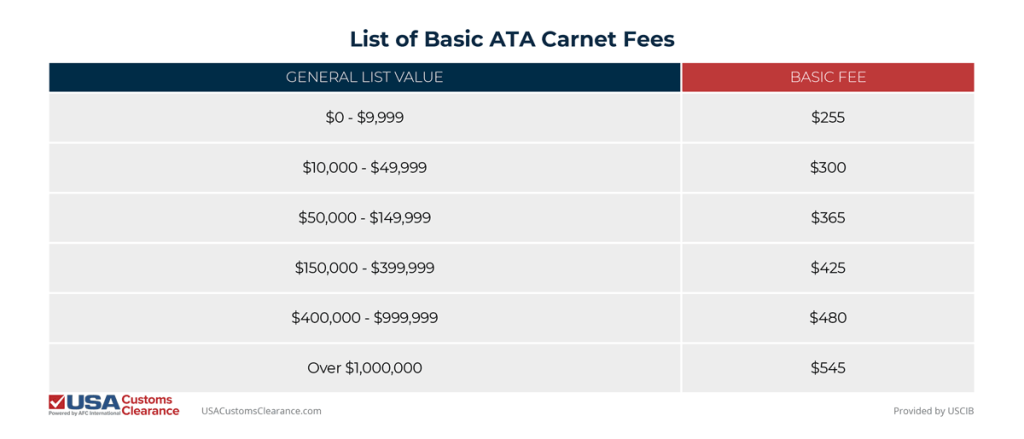
Provided by USCIB
The total cost of an ATA Carnet depends on the declared value of the goods, the number of document pages and voucher sets required, and the applicable security deposit.
An ATA Carnet security deposit is a financial guarantee that protects the guaranteeing association if the holder fails to comply with carnet requirements. The security may be provided in a form accepted by USCIB, such as cash or a surety bond.
The USCIB requires a security or bond amount of 40 percent of the total value of goods covered by the general list. Some countries, like India (55 percent) and Brazil (60 percent) require a higher security amount.
In the case of vehicles covered by an ATA Carnet, you may be required to pay 100 to 150 percent of the value for the security deposit. Security deposits are typically refunded four to six weeks after the carnet is closed.
An ATA Carnet is valid for one year from the date that it’s issued and allows the carnet holder to temporarily import goods into foreign countries as many times as necessary during that time, duty-free. Technically, carnets cannot be extended, however, it’s possible to file for a replacement carnet instead.
If you plan to purchase a replacement carnet, you must apply and be accepted prior to your original carnet expiring. Otherwise, you’ll need to export your goods before the original carnet expires and then apply for a new carnet. It’s also important to note that not all countries accept replacement carnets.
Additionally, there are a handful of countries that don’t allow the temporary export or import of items for the full 12 months, including Mexico, Singapore, Malaysia, Korea, and China.
The holder of a carnet can apply for an extension called a replacement carnet that can lengthen the 12-month limit of their original carnet. However, not all countries accept replacement carnets. The replacement carnet must also be requested before the original carnet expires. Approval is up to the discretion of foreign customs authorities.
ATA Carnets are accepted by more than 80 countries and territories worldwide. If you purchase a carnet, you will be able to temporarily import your items into, and export out of, any carnet countries as many times as needed for 12 months (unless otherwise stated). It should be noted that the 80 countries participating are subject to change.
You may need an ATA Carnet when you temporarily take commercial samples, professional equipment, or exhibition goods into one or more participating countries and intend to re-export the same goods. A carnet is especially useful for repeated trips or multi-country itineraries.
With a carnet, you’re only required to pay for the initial cost of the carnet and the security deposit. And you’re allowed unlimited entry to, and exit from, a network of 80 countries and territories for a full year.
At USA Customs Clearance, our Licensed Customs Brokers are here to assist importers during every step of the process, from determining what an ATA carnet is to how they can get one.
Sources:
CBP Form 7501, U.S. Customs and Border Protection, 2026
CBP Form 3461 - Entry/Immediate Delivery for ACE, U.S. Customs and Border Protection, 2025
Fees and Security Deposit, United States Council for International Business
ATA Carnet FAQs, United States Council for International Business
ATA Carnet, International Trade Administration
 Copy URL to Clipboard
Did you find this article helpful?
See more of our coverage on Google.
Add usacustomsclearance.com as a preferred source!
Add usacustomclearance.com as a preferred source!
See more of our coverage in Google's Top Stories.
Get Customs, Tariffs, and Compliance Alerts at Your Fingertips
Sign up for VIP email alert access.
Licensed customs support for importers across a wide range of U.S. entry needs. USA Customs Clearance provides Customs Bonds, Consulting, Customs Brokerage, Manifest Confidentiality, Importer of Record support, and Guides & Resources to help importers prepare for U.S. Customs and Border Protection (CBP) requirements and customs clearance with regulatory compliance, greater clarity, and confidence.
With licensed broker support, transparent service information, and secure checkout, we help importers take the right next step.

We know the importing process and requirements can be confusing, but they don't have to be.
We're here to help.
When purchasing a product from our website, you can feel confident knowing our team can help if you accidentally select the wrong product. We'll guide you through the correct purchase and any applicable refund process.
Important Refund Policy Information
Eligible refunds are subject to a $50 processing fee, which will be deducted from your original purchase amount. Please allow up to 90 days for refunds to be processed, as refunds are handled quarterly by our Accounting Department.
Refunds are available only if you have not yet:
Additional Refund Terms
You have 90 days from the date of purchase to submit your bond application. After 90 days, bond fees are forfeited and are nonrefundable.
All eBook sales are final and nonrefundable.
Add your first comment to this post