
IOR ENFORCEMENT IS NOW IN EFFECT | REVIEW MY IOR





Customs bonds are required for many formal entries, including commercial shipments valued at $2,500 or more, entries involving goods regulated by a Partner Government Agency (PGA), and some shipments subject to antidumping or countervailing duties. We’ll walk you through the complexities of customs bonds so you know when to buy one and which type to get.
A customs bond is a financial agreement between an importer, Customs and Border Protection (CBP), and a surety that ensures CBP will receive duties and other customs payments for imported shipments. The importer purchases the bond from the surety or brokerage to guarantee those payments will be made to CBP.
The individual who purchases the bond should also be registered with CBP as an Importer of Record (IOR). Regulations for when a customs bond is needed and how to apply for one are contained in 19 CFR Part 113.
Commercial shipments valued at $2,500 or more require a customs bond to be imported into the United States. While this is the most common trigger for bond requirements, it’s not the only one.
CBP also requires importers to have a customs bond on file in the following scenarios:
These scenarios, in our experience, are less common than new or inexperienced importers simply not realizing they need a customs bond in the first place.
The customs brokerage team at USA Customs Clearance has assisted hundreds of importers with clearing U.S. Customs, and first-time importers with formal entries stuck in customs make up a large percentage of our phone calls.
First-time commercial importers often need a customs bond, and many choose between a single-entry bond and a continuous bond based on shipment frequency and filing needs. I’ll address the different types of customs bonds available to importers later in the article.
Commercial importers tend to bring in multiple high-value shipments on a yearly basis, which makes a customs bond a requirement for adhering to CBP regulations. While Section 321 entries once gave resellers a way to import up to $800 worth of goods without owing duties, that program, also known as de minimis, was terminated by executive order in August 2025.
Therefore, businesses that plan to import multiple times throughout the year should have a customs bond on file before doing so.
The two types of customs bonds with which U.S. importers need to be most familiar are both classified as Activity Code 1 import bonds. These can be further separated into single entry and continuous customs bonds.
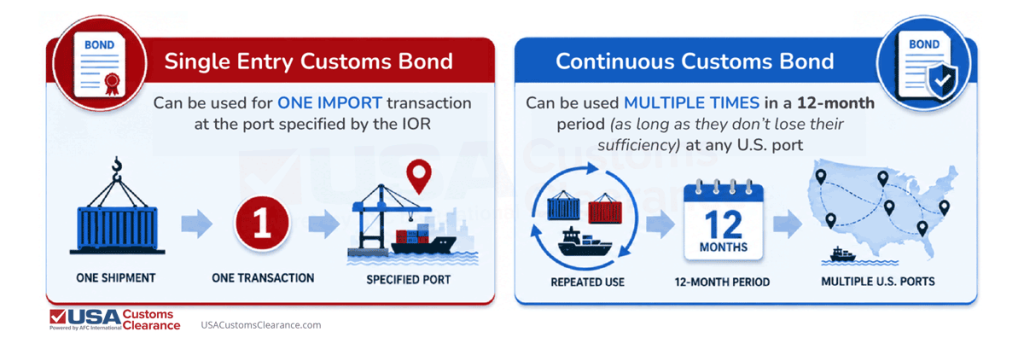
Both of these bonds satisfy CBP’s requirements for bonded shipments. Importers using ocean freight who decide to use a single entry bond will also need a separate bond to satisfy Importer Security Filing (ISF) requirements, though continuous bonds meet this requirement without the need of additional coverage.
Frequency of importing also plays a significant role in deciding between a single entry bond vs a continuous customs bond. There are other types of customs bonds, such as carrier bonds for bonded freight transportation. However, commercial importers will deal with continuous and single entry bonds more than these other types.
In terms of timing, importers should buy a customs bond before moving forward with the purchase and shipping of any goods that require a bond during customs clearance.
Going by CBP regulations, this means importers need to buy a bond when their shipment meets one or more of the following criteria:
Speaking of AD/CVD orders, there are 831 active orders with 74 open investigations as of 3/24/26. Approximately 32% of those orders apply to suppliers in China.
Oftentimes, importers who require a customs bond don’t realize they do, which leads to holds and delays at customs clearance.
One common mistake importers make when it comes to customs bonds is failing to have one on file before they need it.
For instance, let’s say a new importer purchases $5,000 worth of consumer electronics for later resale. Since the shipment’s value exceeds the $2,500 threshold, CBP will require a customs bond on file to clear the shipment.
If the importer fails to purchase a bond and file it with CBP before their shipment arrives, CBP will hold or reject the shipment upon arrival. While it’s possible to buy a bond while the goods are on hold, waiting until this stage in customs clearance will cause delays, frustrations, and possible demurrage charges as your container sits in port waiting to be released.
Importers also sometimes overlook the importance of bond sufficiency. A continuous customs bond must provide coverage equal to 10% of an importer’s estimated annual duties, taxes, and fees, subject to CBP minimum bond requirements.
The minimum coverage prescribed by CBP is $50,000, which is sufficient to cover 10% of up to $500,000 worth of customs fees in a given year.
The $50,000 minimum is not sufficient for an importer who projects $800,000 worth of duties and customs fees over a year. This importer will need a bond worth $80,000 (10% of $800,000) to avoid bond insufficiency.
An insufficient bond can trigger holds from CBP during a customs bond review, compelling the affected business to increase their customs bond coverage before they continue importing goods into the country.
Finally, even importers who are aware of the need for a customs bond if their shipment is valued at or above $2,500 often don’t realize less valuable shipments can require a bond due to PGA regulations and exposure to specific types of tariffs.
We once assisted a personal importer who ended up needing a customs bond because they had ordered a firearm stock valued at less than $1,000, but regulated by the Bureau of Alcohol, Tobacco, and Firearms (ATF). You can easily apply for a customs bond online today or give us a call at (855) 912-0406 to get started meeting CBP’s regulations for commercial importers.
Sources
When is a Customs Bond Required, U.S. Customs and Border Protection, 2026
Title 19, Chapter I, Part 113 - CBP Bonds, Code of Federal Regulations, 2026
ADCVD Proceedings, International Trade Administration
Import Firearms, Ammunition, and Defense Articles, Bureau of Alcohol, Tobacco, Firearms and Explosives, 2026
 Copy URL to Clipboard
Did you find this article helpful?
See more of our coverage on Google.
Add usacustomsclearance.com as a preferred source!
Add usacustomclearance.com as a preferred source!
See more of our coverage in Google's Top Stories.
Licensed customs support for importers across a wide range of U.S. entry needs. USA Customs Clearance provides Customs Bonds, Consulting, Customs Brokerage, Manifest Confidentiality, Importer of Record support, and Guides & Resources to help importers prepare for U.S. Customs and Border Protection (CBP) requirements and customs clearance with regulatory compliance, greater clarity, and confidence.
With licensed broker support, transparent service information, and secure checkout, we help importers take the right next step.

We know the importing process and requirements can be confusing, but they don't have to be.
We're here to help.
When purchasing a product from our website, you can feel confident knowing our team can help if you accidentally select the wrong product. We'll guide you through the correct purchase and any applicable refund process.
Important Refund Policy Information
Eligible refunds are subject to a $50 processing fee, which will be deducted from your original purchase amount. Please allow up to 90 days for refunds to be processed, as refunds are handled quarterly by our Accounting Department.
Refunds are available only if you have not yet:
Additional Refund Terms
You have 90 days from the date of purchase to submit your bond application. After 90 days, bond fees are forfeited and are nonrefundable.
All eBook sales are final and nonrefundable.
Add your first comment to this post