
IOR ENFORCEMENT IS NOW IN EFFECT | REVIEW MY IOR


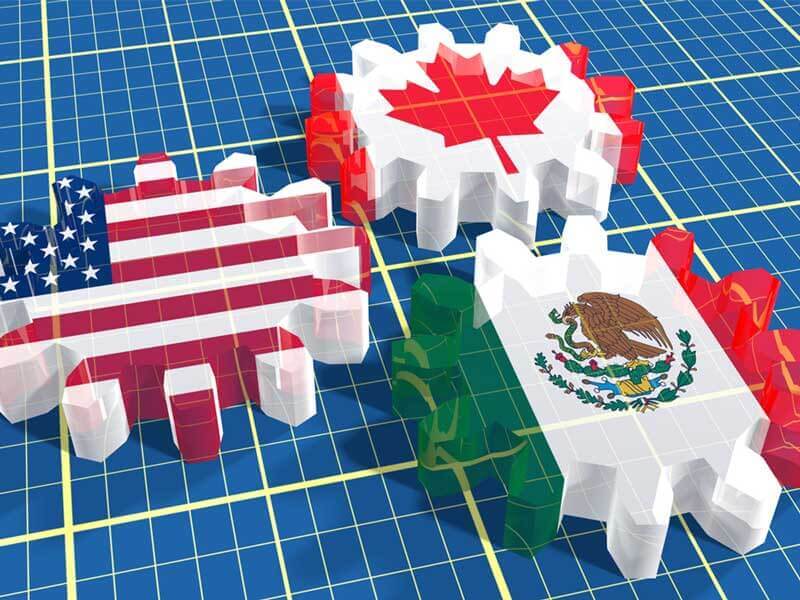


The United States-Canada-Mexico Agreement (USMCA) is a free trade agreement (FTA) between the U.S., Canada, and Mexico that establishes rules and regulations governing market access and preferential tariff treatment for goods traded between the three member countries.
Importers who wish to claim preferential duty treatment for their goods via the United States-Canada-Mexico Agreement must supply documentation to U.S. Customs and Border Protection (CBP) verifying the goods meet the USMCA’s rules of origin. This guide explains the eligibility basics, the documentation elements, and the recordkeeping practices that will help importers take advantage of USMCA.
Key Takeaways:
Understanding eligibility rules, documentation requirements, and verification procedures helps importers claim preferences confidently while maintaining import regulatory compliance.
The United States-Canada-Mexico Act (USMCA) is a trade act that offers businesses in the member countries opportunities for preferential duty treatment and improved market access when importing and exporting between Mexico, Canada, and the U.S.
For U.S. importers, the practical value of USMCA is straightforward: if a product qualifies as an originating good under the agreement, the importer may be able to reduce or eliminate ordinary customs duties on entry.
To receive USMCA preferential duty benefits, a product must meet the agreement’s rules of origin. These rules determine whether a good qualifies as an “originating good” eligible for preferential tariff treatment.
At a basic level, if a product is:
Then it fulfills the requirement of good eligibility per the act’s language. However, there are more nuances based on manufacturing processes that may qualify goods made with non-originating materials under USMCA as well.
In general, goods qualify for USMCA duty treatment if they:
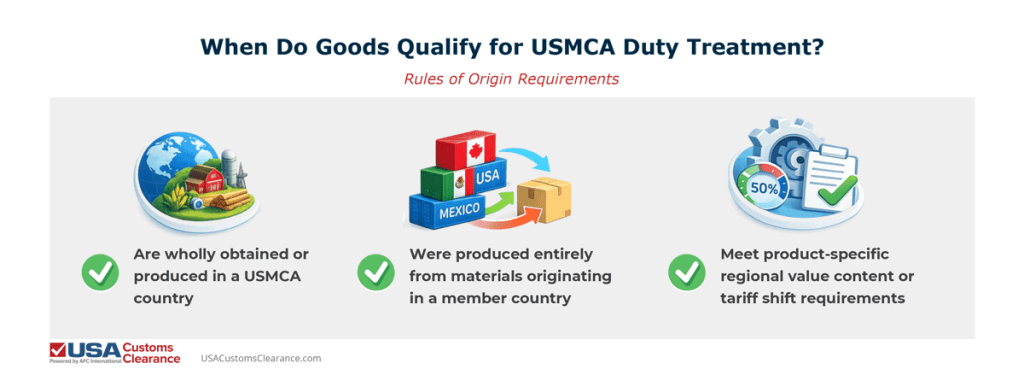
The agreement defines originating goods as products that satisfy the rules of origin established in the agreement’s origin chapters.
Let’s take a closer look at how goods qualify for reduced duties under the USMCA.
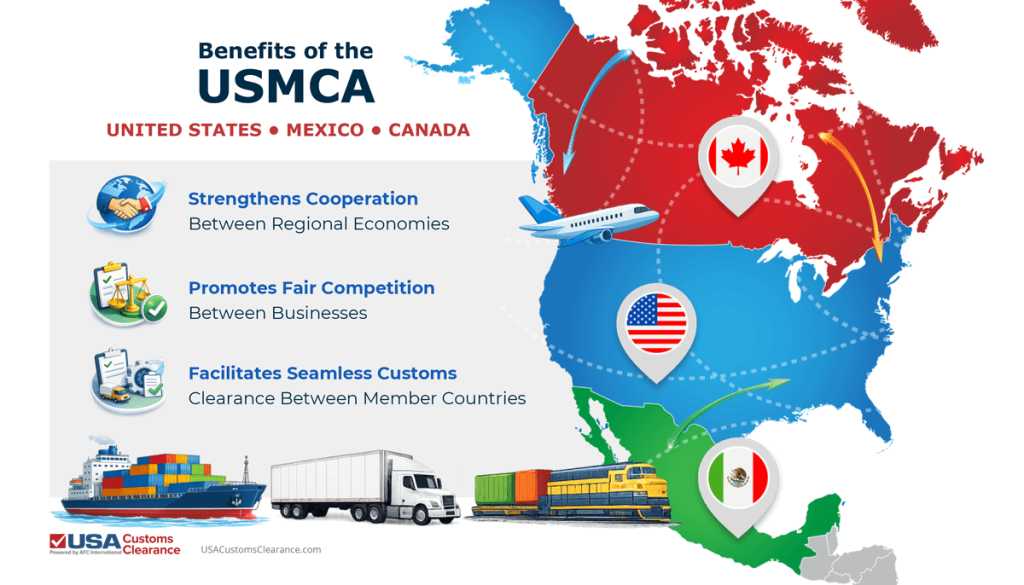
The key concept of United States-Canada-Mexico Act eligibility is that preferential treatment is reserved for goods genuinely produced within North America. Since the three countries are in proximity to one another and specialize in different areas of trade, it makes sense economically to empower importers within the U.S., Canada, and Mexico to trade between one another with ease:
Doing so offers benefits to businesses, shippers, and customers alike:
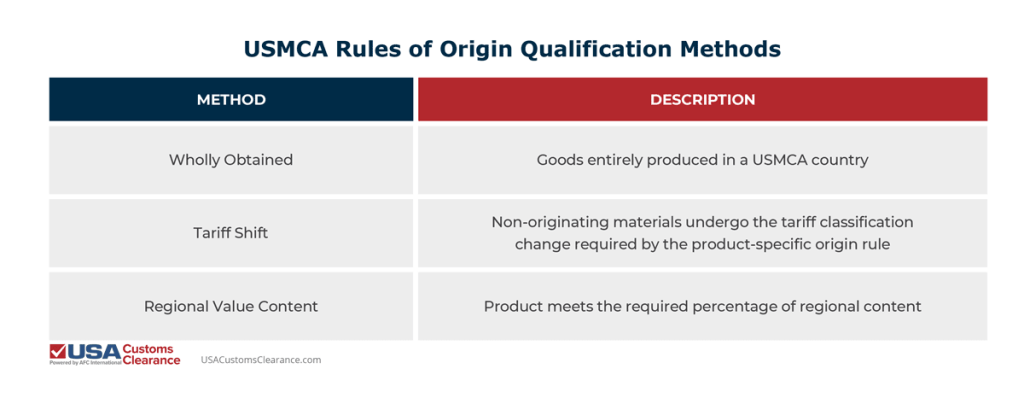
The USMCA rules of origin therefore analyze the following:
For instance, if a clothing manufacturer in Mexico imports raw materials from India to create a final product, the product may still qualify for preferential treatment under USMCA if regional value percentages are satisfied and/or a tariff shift occurred during the manufacturing process.
Importers often obtain the origin facts needed to support a USMCA claim from the producer, exporter, or supplier.
Importers often rely on their suppliers to provide product details that confirm origin status under the USMCA. These suppliers may provide documentation such as:
Because importers don’t usually control upstream production, ensuring supplier cooperation is a key aspect of maintaining accurate country of origin documents.
Depending on the transaction, the importer may base the claim on a certification completed by the importer, exporter, or producer, or on the importer's knowledge supported by underlying records.
There is no specific certificate of origin CBP requires to certify preferential status for goods imported under the United States-Canada-Mexico Act. However, the agency does prescribe data points that must be included in any documents used to claim preferential duty treatment under USMCA.
Data points CBP requires to justify goods as USMCA compliant include:
The HS classification in particular will go a long way toward helping you find the right HTS code for your merchandise.
Customs administrations in the United States, Canada, and Mexico are authorized to verify USMCA origin claims. These verifications can occur after importation during document review or a formal audit from the customs agency in question.
Preparing for potential verification is a key compliance step.
Supporting documents that may be requested during verification include:
These records help demonstrate that the product meets the applicable origin rule.
Importers claiming preferential treatment from an FTA must maintain records that substantiate their claim.
Best practices for importer recordkeeping include the following:
A country’s customs agency can take months or even years to request verification. Therefore, organized recordkeeping systems are essential. For instance, U.S. Customs and Border Protection requires importers to maintain records for up to five years after the date of importation.
Even experienced importers sometimes encounter compliance issues when claiming USMCA benefits. The most common problems include documentation gaps or misunderstanding origin rules.
Frequent failure points include:
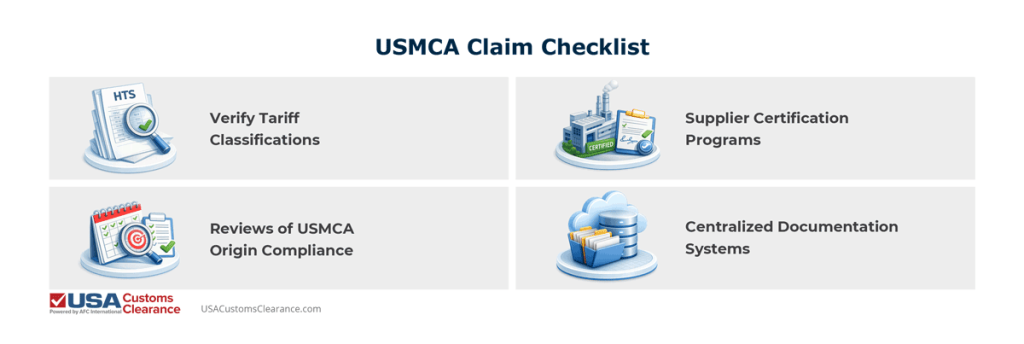
To avoid rejection of claimed preferential duty status under USMCA, use the following checklist:
Verifying your shipment’s compliance with USMCA origin rules is easy with assistance from a Licensed Customs Broker.
Claiming USMCA preferential treatment requires careful documentation, origin analysis, and coordination with suppliers and logistics partners. Licensed customs brokers work to ensure that your entries meet regulatory expectations. This helps you reduce import costs and fix problems.
What we do:
Typical Timeline: Once documentation is complete, we can prepare and submit entries electronically to CBP as part of the customs clearance process.
What We Need From You: Commercial invoice, packing list, product description, HS code, and supplier origin certification.
Call us at (855) 912-0406 to start using the USMCA the right way today.
Q: Did USMCA replace NAFTA?
A: Yes, NAFTA was replaced by the USMCA in 2020.
Q: Do all goods from Canada or Mexico qualify for preferential trade under USMCA?
A: No, only goods that meet the agreement's rules of origin qualify for preferential duty rates and market access.
Q: Does CBP require a specific USMCA certificate of origin format?
A: No, but they do require several common data elements, such as country of origin and manufacturing/sourcing processes.
 Copy URL to Clipboard
Did you find this article helpful?
See more of our coverage on Google.
Add usacustomsclearance.com as a preferred source!
Add usacustomclearance.com as a preferred source!
See more of our coverage in Google's Top Stories.
Licensed customs support for importers across a wide range of U.S. entry needs. USA Customs Clearance provides Customs Bonds, Consulting, Customs Brokerage, Manifest Confidentiality, Importer of Record support, and Guides & Resources to help importers prepare for U.S. Customs and Border Protection (CBP) requirements and customs clearance with regulatory compliance, greater clarity, and confidence.
With licensed broker support, transparent service information, and secure checkout, we help importers take the right next step.

We know the importing process and requirements can be confusing, but they don't have to be.
We're here to help.
When purchasing a product from our website, you can feel confident knowing our team can help if you accidentally select the wrong product. We'll guide you through the correct purchase and any applicable refund process.
Important Refund Policy Information
Eligible refunds are subject to a $50 processing fee, which will be deducted from your original purchase amount. Please allow up to 90 days for refunds to be processed, as refunds are handled quarterly by our Accounting Department.
Refunds are available only if you have not yet:
Additional Refund Terms
You have 90 days from the date of purchase to submit your bond application. After 90 days, bond fees are forfeited and are nonrefundable.
All eBook sales are final and nonrefundable.
Add your first comment to this post