
IOR ENFORCEMENT IS NOW IN EFFECT | REVIEW MY IOR


In This Article:


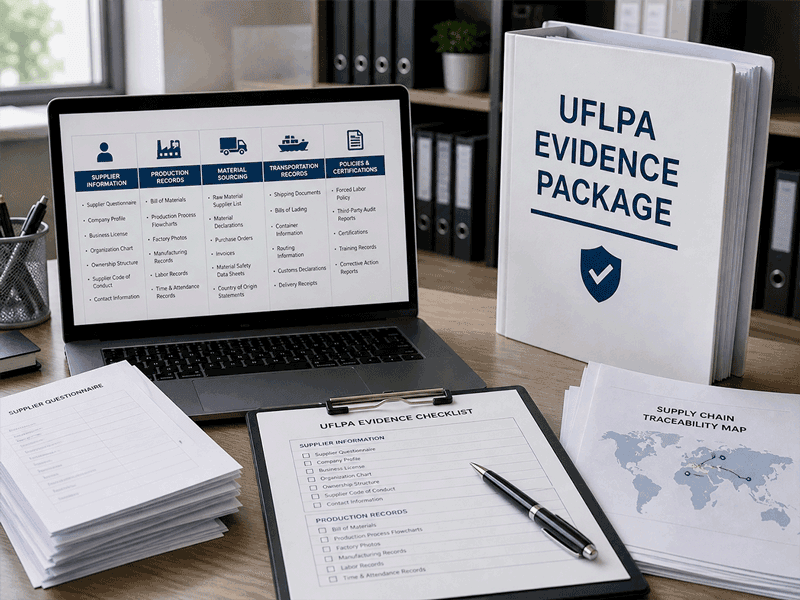
A UFLPA evidence package is a document set that helps an importer prove goods and inputs did not originate in the Xinjiang Uyghur Autonomous Region or from a listed forced-labor entity. Importers should collect supplier, production, and transportation records before CBP requests them.
The Uyghur Forced Labor Prevention Act (UFLPA), signed on December 23, 2021, blocks goods made wholly or partly with forced labor from entering the United States. For importers, that means CBP can detain shipments unless the importer can document a compliant supply chain.
The Department of Homeland Security (DHS) maintains a list of entities believed to be associated with forced labor practices in the XUAR. Importation of goods made with forced labor is banned under 19 U.S.C 1307.
Importers in the United States must do their due diligence to ensure their goods can’t be sourced back to the XUAR.
Importers risk UFLPA exposure when importing goods from the People’s Republic of China, as approximately 160 manufacturers and suppliers from the PRC have been identified on the DHS’s UFLPA entity list. Even if an importer sources goods from an area outside of China, it’s possible that the raw materials used in the manufacturing of those goods can be traced back to the XUAR.
Through the Forced Labor Enforcement Task Force, the DHS works to identify supply chains at high risk of exposure to forced labor practices that violate the UFLPA.
The following materials and commodities are among those at high risk of UFLPA exposure:
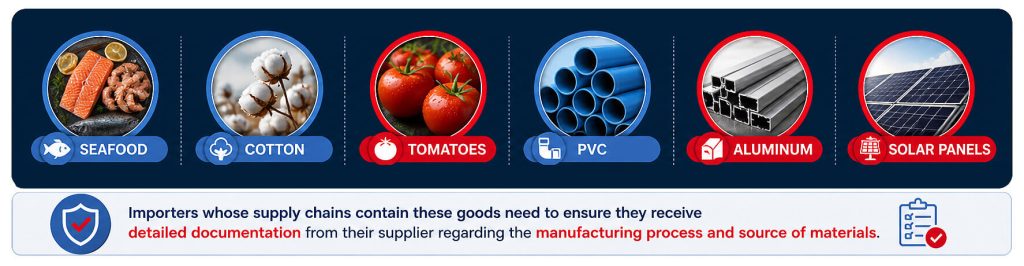
Importers whose supply chains contain these goods need to ensure they receive detailed documentation from their supplier regarding the manufacturing process and source of materials.
Weak supplier documentation fails to prove where a product, its components, and its raw materials originated. If records stop at the finished goods and do not trace upstream inputs, CBP can treat the shipment as high risk.
CBP requires extensive production records that include every step of the sourcing and manufacturing process. For instance, if CBP suspected a computer motherboard to violate the UFLPA, proving the board wasn’t manufactured in the XUAR wouldn’t be enough to disprove the accusation. Each constituent piece, and the raw materials used to manufacture them, would have to be disproven as well.
Weak supplier documentation does not adequately prove the origin of a product, its components, or its raw materials when an importer needs to rebut a UFLPA allegation.
A UFLPA evidence package should include supplier identity records, production records, and transportation records that trace the goods and their inputs through the supply chain.
To verify supplier identity and determine where each component came from in the supply chain, CBP requires the following documents, among others:
Strong supplier documentation supports the UFLPA rebuttal process.
Production records should trace each product back to its raw materials and identify where those materials were sourced.
Production contracts, work orders, flow charts displaying production steps, and batch numbers all contain information that can be used to verify the production stream for a given piece of merchandise. This is called manufacturing traceability, and it’s a core method of disputing a UFLPA claim against your shipment.
If any part or raw material in a product can be traced back to a supplier or manufacturer on the UFLPA entity list, it will be rejected by CBP at customs clearance.
Transportation records support UFLPA claim rebuttals since they can be used to disprove transshipment. A transshipment is the process of unloading cargo from one vessel onto another during its journey to the final destination. Transshipments can be illegal if they’re used to deceptively bypass tariffs, duties, and other trade restrictions by masking the true origin of the goods.
Keep the following transportation records handy for shipments that are likely to trigger a UFLPA claim:
These document sets are all effective when it becomes necessary to rebut a presumption of forced labor violations. Importers can use them as a checklist of ways to prove their goods weren’t sourced from the XUAR.
Importers who want to avoid the possibility of a UFLPA violation, and the subsequent seizures and fines that follow, need to thoroughly vet suppliers before making a purchase. These questions and requests can be used to determine whether an importer should be concerned about forced labor in a vendor’s supply chain.
Getting this information up front saves importers time when it comes to avoiding products manufactured with forced labor.
Since CBP requires importers to maintain records of import transactions for five years from the date of importation, following the best practice of compliant record keeping is key to preparing your UFLPA evidence package.
Importers should keep detailed shipping, production, and purchasing records of all transactions, and be prepared to produce them if CBP flags an imported good for violating UFLPA.
Importers with multi-tier supply chains or incomplete upstream records often need help validating traceability before CBP asks for proof. If you’re unsure whether your imported goods could have origins in the XUAR, a customs broker can help. Here at USA Customs Clearance, we have a team of Licensed Customs Brokers that are ready to help.
We also help importers manage customs clearance and related import services. Book a consultation with our licensed customs brokers at (855) 912-0406 or contact us online.
Does UFLPA apply if my goods are not shipped directly from China?
Yes. UFLPA risk can still apply if goods are manufactured outside China but contain inputs or raw materials that trace back to the XUAR or a listed entity.
What should importers do if a supplier refuses to provide traceability records?
Importers should treat missing traceability records as a serious compliance risk. If a supplier cannot identify upstream sources, production steps, or transportation history, the importer may not have enough documentation to respond to CBP.
Can a customs broker help before CBP requests proof?
Yes. A customs broker can help importers review supply-chain documentation, identify traceability gaps, and organize records before a shipment is flagged or detained.
Sources:
Uyghur Forced Labor Prevention Act, U.S. Customs and Border Protection, 2025
UFLPA Entity List, Homeland Security, 2025
19 U.S.C. 1307 - Convict-made goods; importation prohibited, GovInfo, 2012
 Copy URL to Clipboard
Did you find this article helpful?
See more of our coverage on Google.
Add usacustomsclearance.com as a preferred source!
Add usacustomclearance.com as a preferred source!
See more of our coverage in Google's Top Stories.
Licensed customs support for importers across a wide range of U.S. entry needs. USA Customs Clearance provides Customs Bonds, Consulting, Customs Brokerage, Manifest Confidentiality, Importer of Record support, and Guides & Resources to help importers prepare for U.S. Customs and Border Protection (CBP) requirements and customs clearance with regulatory compliance, greater clarity, and confidence.
With licensed broker support, transparent service information, and secure checkout, we help importers take the right next step.

Add your first comment to this post