
IOR ENFORCEMENT IS NOW IN EFFECT | REVIEW MY IOR


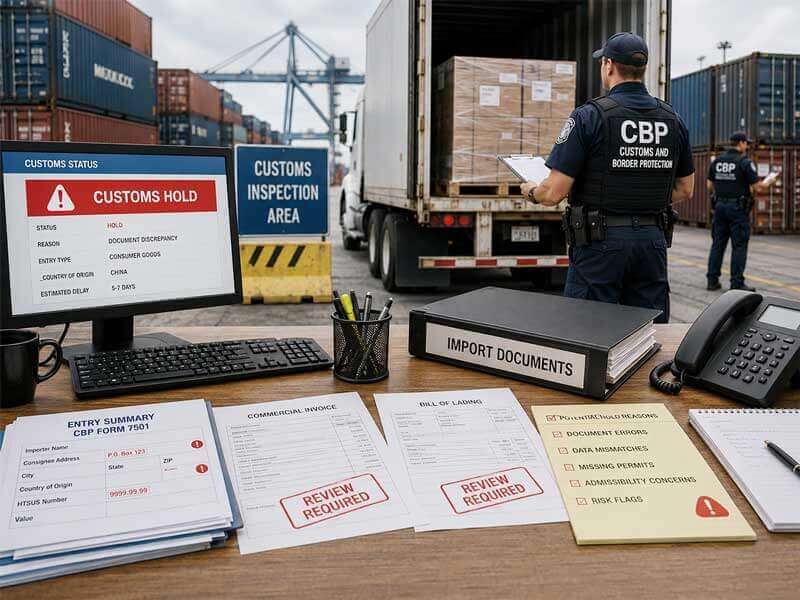


A customs hold or exam is a Customs and Border Protection (CBP) enforcement or review action that can delay cargo release when a shipment has missing documents, data mismatches, admissibility concerns, or risk flags. Some holds are resolved with corrected paperwork, while physical exams can add days of delay and significant inspection costs.
A customs hold is an action CBP undertakes when an imported shipment is missing documentation, uses erroneous information on otherwise correct documentation, or triggers a “red flag” with the agency due to factors like country of origin or a suspicious supplier.
Customs holds can sometimes be resolved without further examination of the cargo, though holds often precede customs inspections and exams.
CBP usually places shipments on hold because of document errors, missing permits, admissibility concerns, or targeting flags tied to the shipment’s contents, origin, or supplier.
Importers, especially those who don’t work with a customs broker, can easily make mistakes on important customs documents, such as CBP Form 7501, the entry summary. Common mistakes importers make on this form include:
The HTS is an expansive and highly detailed method of classifying imported goods, and importers without working knowledge of the General Rules of Interpretation are likely to make mistakes when searching for the correct HTS code.
Partner Government Agencies (PGAs) of CBP set regulations that govern the importation of goods that could be potentially hazardous or high risk. You may find once your merchandise arrives that an associated PGA requires extra paperwork or licensure from importers to consider the shipment compliant with their regulations.
You’ve probably heard of some of these agencies. The table below identifies PGAs with additional requirements that importers must follow should they bring regulated goods into the country.
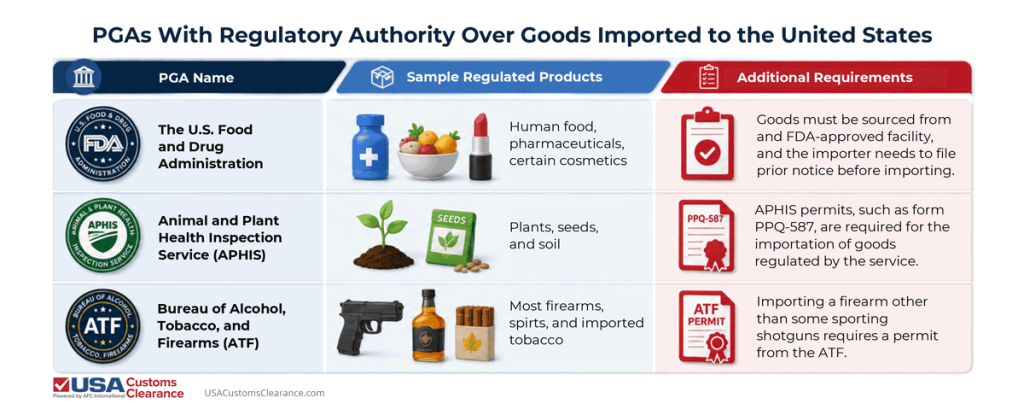
Importing these and other regulated goods without the proper permits or licensure will almost certainly trigger a hold or inspection. If you’re importing something for the first time, don’t complete the transaction until you’ve determined whether you’ll need special permissions from a PGA to bring your shipment into the U.S.
CBP maintains a list of prohibited items that are illegal to import into the United States. If they have reason to believe your shipment includes prohibited merchandise, they will flag the shipment to be held and inspected.
Examples of prohibited goods that cannot be brought into the country legally are:
Additionally, your shipment could be targeted based on where it or its constituent materials were sourced from. CBP enforces sanctions against entities suspected of using forced labor to manufacture goods.
For instance, the Uygur Forced Labor Prevention Act (UFLPA) forbids the importation of merchandise suspected to have been made in the Xinjiang Uygur Autonomous Region (XUAR) of China. Importers of solar panels need to be careful sourcing their goods, as photovoltaic cells from panels manufactured by trade partners in Asia often contain materials that can be tracked back to the XUAR.
If your hold cannot be resolved simply by providing corrected importing documents, it will likely lead to a customs exam.
There are three common physical customs exam types: X-ray, tail gate, and devanning exam. X-ray exams use non-intrusive imaging, tail gate exams involve opening the container for a limited visual check, and devanning exams require the cargo to be moved to a Customs Exam Site for unloading and detailed inspection.
A document review process compares customs documents, such as entry summaries and Importer Security Filings (ISFs) to shipping documents. This is done to ensure accuracy between the multiple documents importers must gather and submit to CBP when importing.
If CBP finds a discrepancy in your ISF or entry summary, you may be able to correct it by amending or re-submitting the erroneous document with accurate information. For instance, an entry summary can be amended via Post-Summary Correction (PSC) if its associated shipment has not been liquidated or is not within 15 days of liquidation.
An intensive cargo exam from CBP can be done in the following three ways:
These efforts are part of the Container Security Initiative (CSI), which also sees containers inspected before they’re even loaded onto their shipping vessels in many countries.
Importers bear the costs of any customs exams, as well as the cost of shipping containers in bond to inspection facilities when that situation occurs. This fact emphasizes the importance of double checking your paperwork prior to submission and ensuring that your goods aren’t prohibited for entry into the United States.
During a CBP pre-screening scan, the agency can identify high-risk containers and quickly scan them to determine if an inspection or customs hold is necessary. This level of cargo examination has practically no impact on the speed of international trade. It is also referred to as a non-intrusive inspection.
If your shipment is selected for inspection, you’re looking at days or weeks’ worth of delays, assuming CBP eventually clears the shipment at all. Factors like port congestion can compound this issue.
At the U.S.’s busiest port, the Port of Los Angeles, average dwell time for shipping containers ranged from 2.55 to 3.25 days throughout 2025. That’s already an approximately three-day delay just for standard container processing. Holds and exams compound this delay, leaving you without stock and with potentially angry customers.
A best practice for importers is to be prepared for a hold to occur rather than assuming it won’t. Being unprepared when CBP notifies you of a hold or exam will only stretch the timeline of resolving your issue out even more.
Preparing for the possibility of a customs hold or exam means having ready access to all of your customs and shipping documents. The following four documents will likely contain information CBP wants to verify or have corrected during the hold process:
CBP expects importers to retain customs documents for up to five years after the date of importation, so complying with this requirement is vital to being prepared for a customs hold or inspection.
Customs inspections don’t just cost you time: they can cost you hundreds or thousands of dollars as well. Customs holds can cost up to $2,500, while customs exams can cost you up to $5,000.
During an intensive cargo exam, CBP will move the container out of port to a warehouse or inspection facility where it will be opened and its goods thoroughly examined.
This is a worst-case scenario for any importer: in addition to the storage and inspection costs, you’ll also be on the hook for transportation to and from the inspection area. Since the goods have not been approved to enter the U.S. market yet, they’ll have to be transported under bond, which drives the cost up further.
For example, an importer sharing a container with others via less than container load (LCL) shipping triggered an inspection that ended up costing each of the three parties using the container over $600 a piece.
Assuming CBP eventually clears and releases your shipment, you’ll be responsible for having the container picked up and moved to your originally intended destination. This can lead to even higher costs if you have to go to the spot market to find a carrier instead of using pre-arranged freight shipping.
USA Customs Clearance helps importers respond to CBP holds, correct entry issues, and work through exam-related delays with licensed customs broker support. Our team of licensed customs brokers will analyze your importing situation and provide you with your next steps.
Don’t let a customs hold eat into your time and profits. Call us at (855) 912-0406 or reach out to us on our contact page to get started today!
Sources
“U.S. Customs and Border Protection Container Security Initiative Brief, 2025”
“U.S. Customs and Border Protection Prohibited and Restricted Items List, 2025”
“General Notes; General Rule of Interpretation; General Statistical Notes, United States International Trade Commission”
“U.S. Customs and Border Protection Cargo Control, 2026”
“Dwell Down for LA-Long Beach Container Trucks, Rail, Freight Waves, 2025”
“U.S. Customs and Border Protection CBP Form 7501: Entry Summary, 2026”
 Copy URL to Clipboard
Did you find this article helpful?
See more of our coverage on Google.
Add usacustomsclearance.com as a preferred source!
Add usacustomclearance.com as a preferred source!
See more of our coverage in Google's Top Stories.
Licensed customs support for importers across a wide range of U.S. entry needs. USA Customs Clearance provides Customs Bonds, Consulting, Customs Brokerage, Manifest Confidentiality, Importer of Record support, and Guides & Resources to help importers prepare for U.S. Customs and Border Protection (CBP) requirements and customs clearance with regulatory compliance, greater clarity, and confidence.
With licensed broker support, transparent service information, and secure checkout, we help importers take the right next step.

Add your first comment to this post