
IOR ENFORCEMENT IS NOW IN EFFECT | REVIEW MY IOR




Typically, the cost of a customs broker depends on the complexity of your import needs. Brokers often handle various parts of the import clearance process, and that process isn’t always consistent from one commodity to another. If you choose not to use a customs broker, it might still cost you in the form of fees or penalties that may have been avoided.
When you’re looking to hire a customs broker, you need to look at costs in two ways. Number one, you look at the amount the brokers are charging for their services.
You may find yourself shopping around, comparing rates and reviews as you would for any service. Perhaps you even come to the conclusion that the DIY approach is best. Before you commit to that, you need to examine what the cost of your potential mistakes may be.
In nearly every case, the penalty for mistakes in your documentation or import process will far outweigh what you would pay for a brokerage service. Not convinced of the value yet? Let’s examine this in more detail.
How much it costs to hire a customs broker will depend on what services they take on and how often they need to do them.
Frequent importers may have a continuing contract with brokers and be billed collectively for a variety of different services. Estimating these costs is difficult because it varies, not only from broker to broker, but from one commodity to another
Commodities for which importers should expect to pay additional fees include:
These products have specific entry needs that result in fees that must be paid to their respective regulatory agencies. However, they aren’t flat rates, so hiring a customs broker will help you avoid over or underpaying.
Those importers and exporters who only ship a few times a year are more likely to pay for services as individual tasks. First-time importers may also wish to schedule a private consultation with a customs broker to review necessary documentation and procedures. Private consultations can vary widely depending on the company.
Why the wide price range for the same services? Although customs brokers are licensed by CBP, brokerage firms are privately run businesses that are free to set their own prices.
Price differences could be the result of:
Choosing a customs brokerage service that fits your unique import needs is going to bring more value than if you just hire the cheapest service. International trade has too many unique needs that require professional expertise.
As mentioned, customs brokers charge clients based on specific services. For all the thousands of different kinds of products that pass through US customs, there are hundreds of different documents and certifications.
Some importer needs are incredibly specific, and the myriad services offered by brokers reflect this. However, there are some nearly universal services all importers will require.
These brokerage services are:
With very few exceptions, these services are required for all commodities clearing customs. Licensed customs brokers work on these more than any other profession, and can accurately process these forms much more quickly than shippers and importers.
Any merchandise imported into the U.S. by ocean vessel must be accompanied by an Importer Security Filing (ISF) prior to arrival.
ISF filing can be completed by the importer directly or by an assigned agent – a customs broker. It has to be filed at least 24 hours before the shipment is loaded onto its shipping vessel. Even goods entering a Foreign Trade Zone (FTZ) must have one filed.
There are ten data points that must be included by the importer with every filing:
The final two data points on this form – container stuffing location and consolidator – are provided by the carrier, from which the ISF’s common name “10+2 filing” derives.
Some of this information is very straight forward – buyers and sellers are simple enough, and even things such as country of origin shouldn’t be too difficult. Information on HTS codes, however, must be exact.
If CBP fails to receive an ISF filing or receives ones with mistakes, consequences include:
Although only one of these is a specific fine, the others could cost you just as much money. Delays can cause missed deadlines on promised deliveries, and some holds result in your goods being seized and destroyed.
In comparison, paying a broker a fraction of the potential money you might end up spending on fines seems well worth it.
If you plan on importing more than $2,500 worth of products, you need a customs bond. A customs bond is how CBP ensures that all necessary fees and import duties owed are paid.
There are two types of customs bonds brokers can arrange on behalf of their clients.
As a commercial importer, you will most likely need a continuous bond.
On this type of bond, the amount needs to be at least 10% of any duties or taxes you project to pay over a one-year period, with $50,000 being the minimum threshold. Customs brokers arrange for the purchase of bonds through a surety company. Importers pay a service charge that depends on both the broker and the amount required.
Which one you require depends on your import practices. What’s stopping an importer from simply getting a bond directly from the surety? In most cases, it’s the surety itself and their unwillingness to risk their business.
These are companies placing themselves on the line for what could be thousands in customs entry taxes. Most sureties will not work with anyone other than a licensed customs broker. In their experience, most importers simply don’t have the needed experience and are more likely to make mistakes that end up impacting the surety company.
Customs brokers make importing simpler by consolidating many of the required tasks. To accomplish this, they must often work with various government agencies.
Other than CBP, agencies that are frequently involved in the import process include:
In order for a customs broker to work with these organizations on behalf of an importer, they need to be granted power of attorney (POA). It won’t give the broker any control over the inner workings of your business. It simply allows them to legally sign off on certain documents.
Fees for a POA filing are rarely charged separately because it’s being used to complete other tasks. Anytime you use a customs broker to assist with customs clearance, there must be a POA signed and on file with CBP.
This is actually a requirement of 19 CFR 141.44 and is completed with Customs Form 5291 or another valid POA authorization.
An importer of record (IOR), whether a company or an individual, is the party CBP will hold responsible for complying with all import laws.
This is an important role that can have severe financial and legal consequences if mistakes are made. Because of that, the chosen IOR is often part of the negotiations between the involved parties. In many cases, Incoterms® are used to officially designate the buyer or seller with the job.
There are 11 different types of Incoterms used in international trade.
Depending on the contract terms, the responsible party must then complete an importer of record registration.
Customs Brokers can assist with this in two ways.
The majority of brokerage firms will complete your IOR registration without an issue. In this case, you are using their services to make sure that all the right information is present and that it’s being filed with the correct authorities.
Fewer brokerage firms are willing to act as the IOR in your business’ place. By taking on the responsibility of being the IOR, they also open themselves up to liability should anything go wrong. For many firms, it’s just not worth the financial risk.
U.S. Customs services cannot legally require you to use the services of a customs broker.
Any member nations of the World Customs Organization (WCO) follow similar rules. The US does have specific licensing for customs brokers, but has no control over a private citizen or company that wants to handle things on their own.
It’s important to understand that licensed or not, you won’t get any leeway from CBP for mistakes – an audit is possible with any shipment from anyone. They collect millions of dollars worth of penalty fees every year, as well as a few million more in seized shipments that didn’t follow procedures.
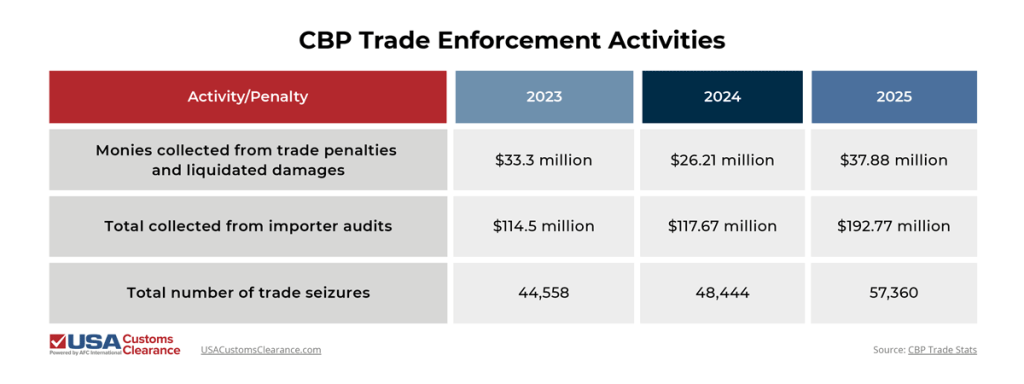
By not using a customs broker, you are much more likely to end up on a statistics table like the one here.
However, no matter how much research and care is taken, the biggest hurdle is securing a customs bond. As mentioned, most sureties that issue customs bonds will only do so through licensed customs brokers.
If you want to minimize the number of services you have a broker taking care of, it is possible to secure only a customs bond from a broker if that is your preference.
To hire or not to hire a customs broker? If you’re looking to expand your import/export business, knowing how much it costs to hire a customs broker is a worthwhile investment towards that future.
USA Customs Clearance and our team of licensed customs brokers are here to tackle the various import laws and document filings required for successful transactions. Call us today at (855) 912-0406 to find out how we can start helping your business today. Ready to schedule your 1-on-1 consultation? Click here to arrange for your personalized session.
 Copy URL to Clipboard
Did you find this article helpful?
See more of our coverage on Google.
Add usacustomsclearance.com as a preferred source!
Add usacustomclearance.com as a preferred source!
See more of our coverage in Google's Top Stories.
Get Customs, Tariffs, and Compliance Alerts at Your Fingertips
Sign up for VIP email alert access.
Licensed customs support for importers across a wide range of U.S. entry needs. USA Customs Clearance provides Customs Bonds, Consulting, Customs Brokerage, Manifest Confidentiality, Importer of Record support, and Guides & Resources to help importers prepare for U.S. Customs and Border Protection (CBP) requirements and customs clearance with regulatory compliance, greater clarity, and confidence.
With licensed broker support, transparent service information, and secure checkout, we help importers take the right next step.

We know the importing process and requirements can be confusing, but they don't have to be.
We're here to help.
When purchasing a product from our website, you can feel confident knowing our team can help if you accidentally select the wrong product. We'll guide you through the correct purchase and any applicable refund process.
Important Refund Policy Information
Eligible refunds are subject to a $50 processing fee, which will be deducted from your original purchase amount. Please allow up to 90 days for refunds to be processed, as refunds are handled quarterly by our Accounting Department.
Refunds are available only if you have not yet:
Additional Refund Terms
You have 90 days from the date of purchase to submit your bond application. After 90 days, bond fees are forfeited and are nonrefundable.
All eBook sales are final and nonrefundable.
Need a port clearance at L.A for a non profit relegious corporation. Shipment is arriving in 30-40 days at L.A. port of entry. The contents are dome will be installed on Sikh Temple at 7640 Haven Street ,Las Vegas. 89123.
We have all tax exempt paper work.