
IOR ENFORCEMENT IS NOW IN EFFECT | REVIEW MY IOR


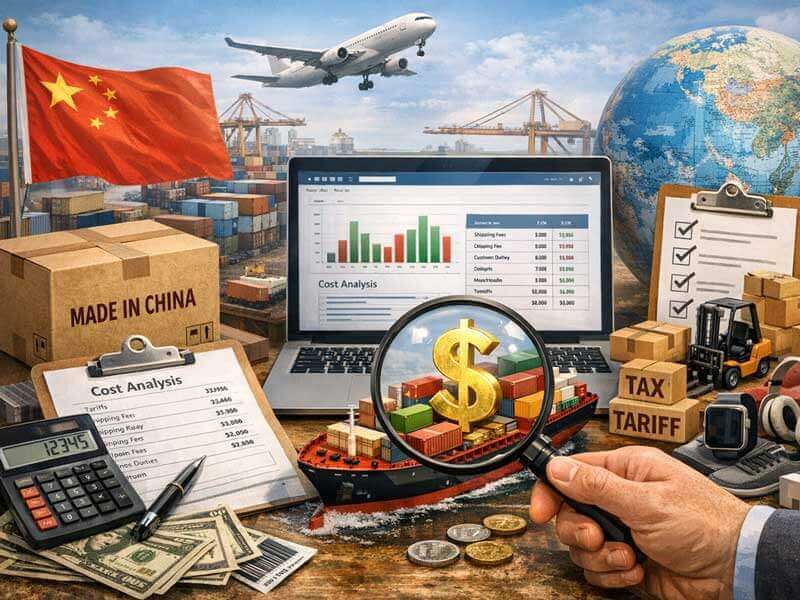


Profitable items to import from China are products that still leave room for margin after freight, duties, fees, storage, and returns. The best candidates are usually lightweight, non-fragile, consistently demanded items with manageable compliance requirements.
Importing goods from China has become more complicated than in the past due to the introduction of multiple tariffs with limited exclusions. Tariffs result in increased duties, and they aren’t applied uniformly across product categories.
You should confirm your base duty rate in the Harmonized Tariff Schedule (HTS). Check for additional duties that apply to your product’s country of origin.
For example, tariffs implemented under the International Emergency Economic Powers Act (IEEPA) have been challenged. In Learning Resources v. Trump, the Supreme Court ruled the IEEPA can’t be used to apply tariffs.
Many China-origin products are also subject to additional Section 301 duties. These tariffs can add up to 25% additional duties to your imported goods.
Section 301 China duties are product-specific and are organized by lists covering different HTS subheadings. You can verify whether your product is subject to Section 301 by confirming HTS classification and checking the China tariffs list alongside the HTS.
Section 232 of the Trade Expansion Act of 1962 authorizes the president to impose tariffs or quotas on imports deemed to threaten national security. Certain steel, aluminum, and copper products can face Section 232 duties (and related measures) that materially change the landed cost.
Duties make up one part of landed cost calculations for importers. Other costs you’ll need to include in landed cost are:
Here’s a simple landed cost formula:
(Unit Price x Quantity) + International Freight + Insurance + Duties/Tariffs + MPF + (HMF if ocean) + Inland U.S. Transport
Now, let’s go through a quick example.
If a $10 unit has $2.50 in duties/tariffs, $1.20 in freight and insurance, and $0.30 in fees, your landed cost before post-import selling costs is $14. This means your resale price must cover the $14 plus returns, storage, and marketing.

Knowing how to conduct a product fact-finding procedure will be beneficial to any importer regardless of the type of commodity they plan to import.
You should address the following questions before making a buying decision:
Importers must answer these questions because the response impacts the bottom line or even the privilege to sell the products in the first place.
U.S. Customs and Border Protection (CBP) enforces import requirements, classification rules, and entry documentation for goods entering the country.
CBP focuses on a few points where importers often fail:
Federal regulations take precedence, but you must also be aware of any state and local regulations that might affect your importing process. For instance, several states use California Air Resources Board (CARB) standards for vehicle emissions. These are stricter than federal regulations. Therefore, it’s possible to import a car or engine that satisfies federal regulations, but can’t be registered for street use in a CARB-compliant state.
Some other essential customs clearance rules and best practices to keep in mind are:
If CBP suspects that any part of your supply chain touches the Xinjiang region, they will detain your shipment. The Uyghur Forced Labor Prevention Act (UFLPA) bans imports from Xinjiang due to suspicion of forced labor in the area, and the onus is on importers to prove suspected shipments don’t violate the UFLPA. To anticipate this, importers, must build traceability into their supplier selection process.
You’re sourcing products here with the intention of reselling them for a profit. That means several things when trying to find these goods.
Those three things are worth looking into, but so is one last thing — requesting a product sample.
Even if you barely know a hairdryer from a hairbrush, it’s not hard to tell if an item is well-constructed, free of defects or blemishes, and would meet your potential customer’s needs.
Here’s a supplier vetting checklist:
Using this checklist will lead you to a reliable supplier that can provide quality products.
The best way to get the cheapest base price for most products, in any industry, regardless of the product, is to buy as much of it at one time as you can. However, it can also increase inventory risk. Use bulk buying after you validate demand and calculate your landed cost.
This is mutually beneficial for the wholesaler/manufacturer and the party purchasing it to resell. Manufacturers are known to give discounts if you purchase a certain quantity.
Consider the following scenario:
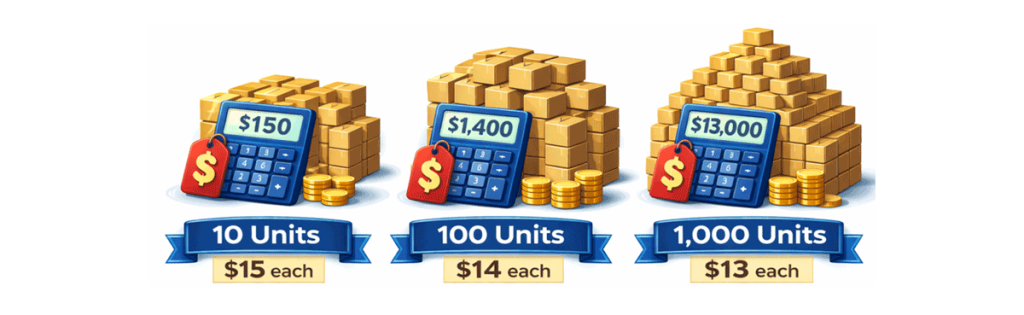
Although the initial investment is higher you have the opportunity to make an extra $1 or $2 per item and enjoy a discounted rate. When extrapolated into higher sales volume, the opportunities for profit are lucrative.
So if you can afford to buy more and have done your market research that bears out a demand for the product, it could be beneficial to buy more at once.
There are numerous profitable goods that you can import from China. We’ve provided a list of the most common that you can resell for a profit.
These categories are profitable due to consistent demand, low freight costs, and the potential for bundling multiple associated items.
If you plan to import electronics from China for resale, you’ll need to be aware of regulatory measures affecting semiconductors that were put into place in January 2026. These measures include a 25% tariff on imported semiconductors with limited exceptions.
For assistance with customs clearance issues like estimating duties, HTS classification, and complying with CBP regulations, call us at (855) 912-0406 for a free quote and information about importing.
Sources
Harmonized Tariff Schedule, Revision 7, United States International Trade Commission, 2026
SUPREME COURT OF THE UNITED STATES, LEARNING RESOURCES, INC., ET AL. v. TRUMP, PRESIDENT OF THE UNITED STATES, ET AL., 2/20/26
Section 232 of the Trade Expansion Act of 1962, Kitamura, Kyla H., 2/12/2026
U.S. Customs and Border Protection, updated 2026
ADJUSTING IMPORTS OF SEMICONDUCTORS, SEMICONDUCTOR MANUFACTURING EQUIPMENT, AND THEIR DERIVATIVE PRODUCTS INTO THE UNITED STATES, The White House, January 14, 2026
 Copy URL to Clipboard
Did you find this article helpful?
See more of our coverage on Google.
Add usacustomsclearance.com as a preferred source!
Add usacustomclearance.com as a preferred source!
See more of our coverage in Google's Top Stories.
Get Customs, Tariffs, and Compliance Alerts at Your Fingertips
Sign up for VIP email alert access.
Licensed customs support for importers across a wide range of U.S. entry needs. USA Customs Clearance provides Customs Bonds, Consulting, Customs Brokerage, Manifest Confidentiality, Importer of Record support, and Guides & Resources to help importers prepare for U.S. Customs and Border Protection (CBP) requirements and customs clearance with regulatory compliance, greater clarity, and confidence.
With licensed broker support, transparent service information, and secure checkout, we help importers take the right next step.

We know the importing process and requirements can be confusing, but they don't have to be.
We're here to help.
When purchasing a product from our website, you can feel confident knowing our team can help if you accidentally select the wrong product. We'll guide you through the correct purchase and any applicable refund process.
Important Refund Policy Information
Eligible refunds are subject to a $50 processing fee, which will be deducted from your original purchase amount. Please allow up to 90 days for refunds to be processed, as refunds are handled quarterly by our Accounting Department.
Refunds are available only if you have not yet:
Additional Refund Terms
You have 90 days from the date of purchase to submit your bond application. After 90 days, bond fees are forfeited and are nonrefundable.
All eBook sales are final and nonrefundable.
Add your first comment to this post