
IOR ENFORCEMENT IS NOW IN EFFECT | REVIEW MY IOR



In This Article:


Importing to the US is the regulated process of bringing foreign goods into the country for sale or use under U.S. Customs and Border Protection (CBP) oversight. The Importer of Record (IOR) files entry documents, classifies the goods under the Harmonized Tariff Schedule (HTS), pays applicable duties and fees, secures any required customs bond, and satisfies federal agency requirements before CBP releases the shipment.
Many first-time importers underestimate how structured and regulated this process is. CBP enforces detailed documentation, valuation, classification, and filing requirements. Missing or inaccurate information can result in shipment delays, added costs, or refused release.
This guide breaks the importing process into 10 clear, compliance-driven steps, from registration to release, so you know what to file, when to file it, and how to prepare before your shipment arrives.
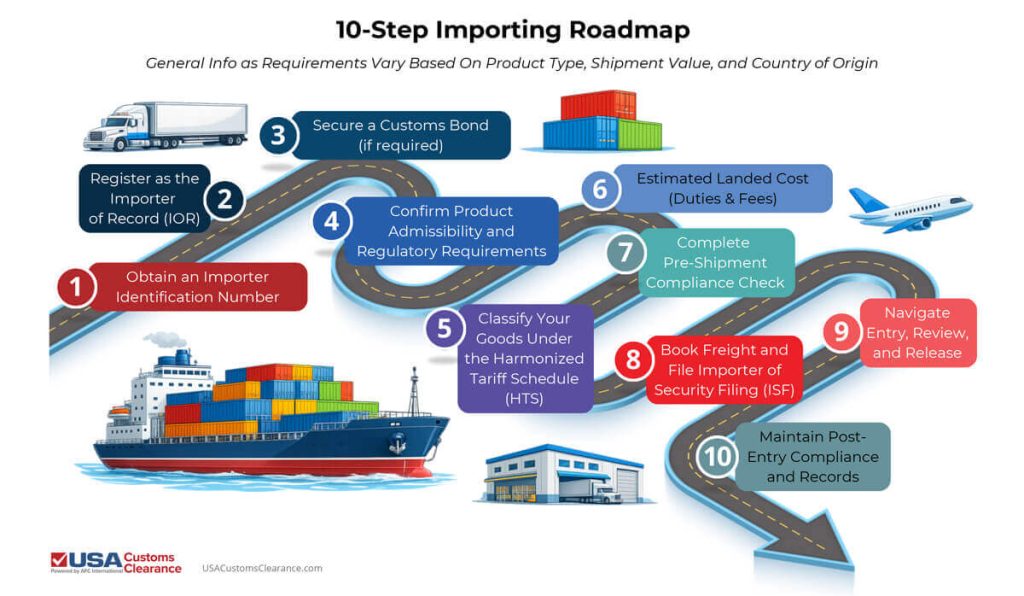
The following sections explain each step in the required order and identify where professional customs guidance protects your shipment from compliance errors.
An importer identification number is the unique number U.S. Customs and Border Protection (CBP) uses to identify the Importer of Record on customs entry filings. CBP requires this number before you can file any customs entry or clear a shipment.
Most businesses use an Employer Identification Number (EIN) issued by the Internal Revenue Service (IRS). Individuals may use a Social Security Number (SSN). Foreign importers without a US tax ID can request a CBP-assigned importer number (CAIN).
First-time importers often delay this step or assume a supplier’s number can be used instead. However, the Importer of Record must provide their own valid identification number that matches the entry documentation.
Without an importer identification number in place, the customs process cannot begin. Once secured, the next decision is determining who will serve as the Importer of Record to accept legal responsibility for the shipment.
An Importer of Record is the individual or business legally responsible for customs compliance on a shipment. The IOR files the customs entry, pays applicable duties and fees, and maintains required import records.
A customs broker may assist with filling, but the named Importer of Record retains legal responsibility for the accuracy of the information submitted.
First-time importers sometimes assume a freight forwarder, supplier, or customs broker automatically becomes the Importer of Record. That assumption can create confusion and compliance risk because the IOR must be clearly identified before the shipment is filed with CBP.
Confirm who will act as the Importer of Record early in the purchasing process so documentation is prepared correctly.
The consignee is the party listed to receive the shipment, but they’re not automatically the Importer of Record. The IOR is the party legally responsible for customs compliance, duty payment, and record accuracy.
In many shipments, the consignee and the IOR are the same entity. In other cases, they’re different. Make sure the right party is listed as the Importer of Record before filing entry docs so your shipment isn’t delayed or rejected.
To serve as the Importer of Record, CBP must have your company’s information on file. New importers submit CBP Form 5106 to establish or update their importer profile.
A Licensed Customs Broker prepares and files this form on your behalf after receiving a signed power of attorney (POA). However, the Importer of Record remains legally responsible for the information submitted.
A customs bond is a financial guarantee required by U.S. Customs and Border Protection that ensures duties, taxes, and fees will be paid and that imported goods comply with federal regulations.
A customs bond creates a three-party agreement between:
If the Importer of Record does not meet compliance or payment requirements, the bond company may compensate CBP under the agreement.
A customs bond is generally required for:
Note: Shipments valued under $2,500 typically qualify as informal entries and don’t require a customs bond unless the product is regulated or subject to additional regulatory oversight.
After confirming a bond is required, select the appropriate bond type.
If a bond is required, importers typically choose between a single-entry bond and a continuous bond.
A single-entry bond covers one shipment and applies only to that specific entry. It’s often used by importers bringing goods into the US on a limited or one-time basis.
A continuous bond remains active for one year and covers all formal entries filed during that period. Importers who plan to file multiple entries throughout the year generally benefit from a continuous bond.
Selecting the correct bond type depends on your expected shipment volume, entry frequency, and long-term importing plans. Evaluating these factors before purchasing a bond prevents unnecessary costs and administrative changes later.
Once the appropriate bond type is confirmed, the next step is verifying that your product meets all admissibility and regulatory requirements.
Before calculating duties or filing entry documents, confirm that your product is legally admissible into the US. Some goods are prohibited, restricted, or subject to additional regulatory review.
In addition to U.S. Customs and Border Protection, certain products are regulated by Partner Government Agencies (PGAs). These agencies may require permits, prior notices, certifications, or inspections before goods are released.
Separate from product-based restrictions, certain goods may also be restricted based on country of origin. US sanctions programs administered by the Office of Foreign Assets Control (OFAC) can prohibit or limit imports from specific countries or entities.
Common examples include:
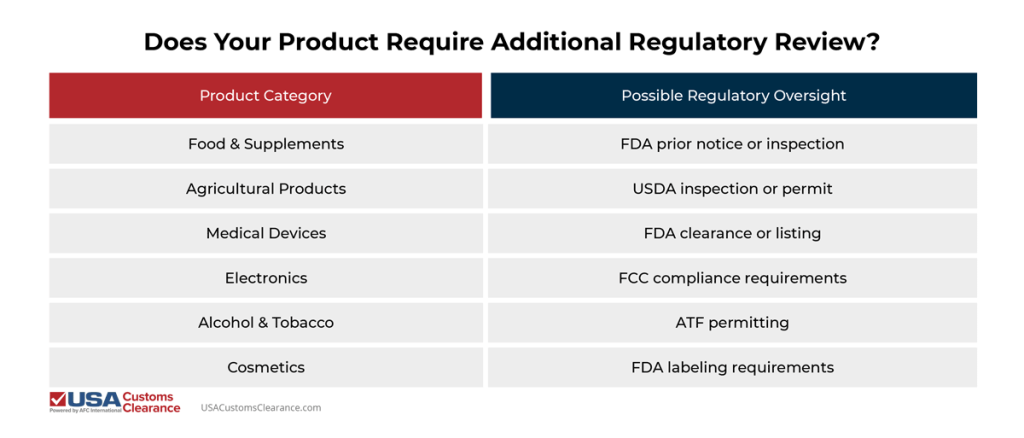
Confirm regulatory requirements before purchase commitments are finalized.
Depending on the product, you may need to:
Early regulatory review reduces the risk of examination, detention, or refused entry.
To confirm compliance before shipment:
Addressing these requirements before shipment strengthens compliance and improves clearance predictability.
With admissibility confirmed, accurate tariff classification determines duty exposure and regulatory treatment. Many importers schedule a Customs Compliance Consultation at this stage to verify classification and regulatory alignment before entry filing.
The Harmonized Tariff Schedule is the official US tariff classification system used to determine duty rates and identify applicable requirements for imported items.
Each imported good is classified under a specific 10-digit HTS code based on its objective characteristics at the time of importation.
Accurate classification directly affects duty liability, trade program eligibility, and regulatory oversight. The HTS code determines:
Misclassification can result in an underpayment or overpayment, entry corrections, or post-entry compliance issues.
For example, two visually similar pairs of shoes may fall under different HTS classifications depending on the material of the upper or sole. Footwear with textile uppers may carry a significantly different duty rate than footwear with leather uppers. Small classification differences can significantly affect duty liability and total landed cost.
Accurate classification requires review of the following factors:
Classification is based on a product’s objective characteristics at the time of importation, not on marketing descriptions or future use.
Accurate classification is the foundation for estimating duty liability and total landed cost. Verify classification before filing entry.
Import duties are government-imposed charges assessed on imported goods based on their HTS classification, declared customs value, and country of origin. Estimating duties before shipment allows first-time importers to understand financial exposure and prepare for total landed cost.
Import duties are calculated based on:
In addition to standard duty rates, certain products may be subject to additional tariffs or trade remedies.
Landed cost is the total cost required to move imported goods from the supplier to their final destination after customs clearance.
Landed cost typically includes:
For example, a shipment with a purchase price of $20,000 and a 10% duty rate carries $2,000 in duty before freight, insurance, fees, and brokerage costs are added. Without accounting for these additional expenses in advance, profit margins can narrow quickly.
Estimated landed cost before shipment protects margin and reduces unexpected duty liability at arrival. Importers who want a structured estimate can use our Landed Cost Calculator to evaluate total projected costs before purchasing or shipping goods.
With duties and total landed cost estimated, it’s time to confirm that all documentation and compliance elements are accurate before shipment departure.
A pre-shipment compliance review is a structured verification process completed before goods depart the supplier to confirm documentation accuracy and regulatory readiness.
A thorough review confirms:
Continuous bond amounts are typically based on estimated annual duties, taxes, and fees. Significant increases in shipment volume or duty liabilities may require bond adjustments to maintain compliance.
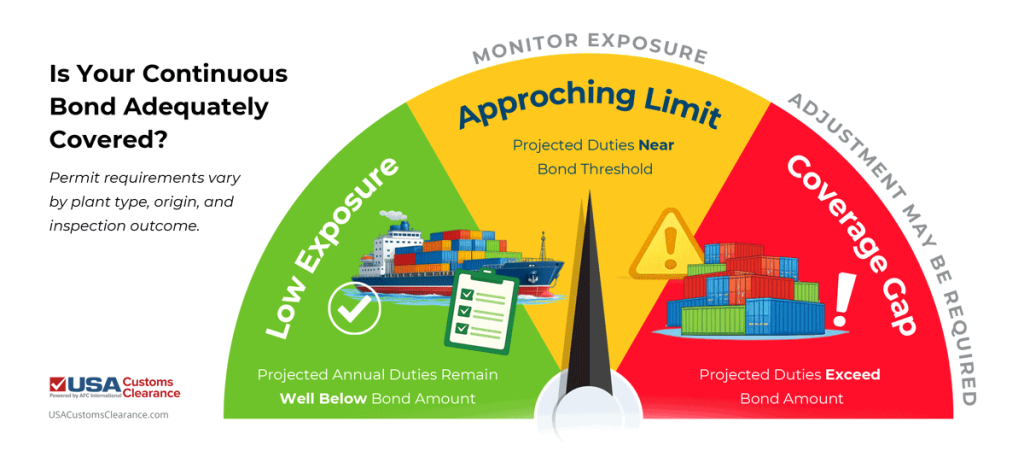
Errors discovered after departure are harder and more costly to correct. Verifying documentation and bond accuracy before shipment improves customs clearance predictability at arrival.
Reviewing documentation with a Licensed Customs Broker before shipment identifies mistakes that lead to delays, additional duties, or entry corrections.
This structured pre-shipment review is where experienced compliance teams prevent most clearance problems before they start.
Shipment coordination is the process of arranging transportation and completing required import filings before goods arrive in the US. Timely and accurate filings reduce the risk of customs clearance delays upon arrival.
Freight may move by ocean, air, rail, or truck, depending on the origin, urgency, and cargo type. Although transportation methods differ, required import filings must be completed before the shipment arrives.
For ocean shipments, importers must submit an Importer Security Filing (ISF) before the cargo is loaded onto the vessel at the foreign port of departure.
The ISF must be filed at least 24 hours before loading. Failure to file accurately and on time may result in penalties or shipment holds.
Your ISF provides CBP with advance shipment data, including:
Submitting required filings accurately and on time reduces the likelihood of examinations and arrival delays.
Coordinating freight and documentation together keeps the shipment moving efficiently from origin to the US port of entry.
Partnering with a Licensed Customs Broker and a freight forwarder during this stage aligns transportation schedules with required regulatory filings.
Customs entry is the formal review process by which U.S. Customs and Border Protection uses to evaluate submitted documentation for admissibility, classification accuracy, and duty payment.
The entry filing includes:
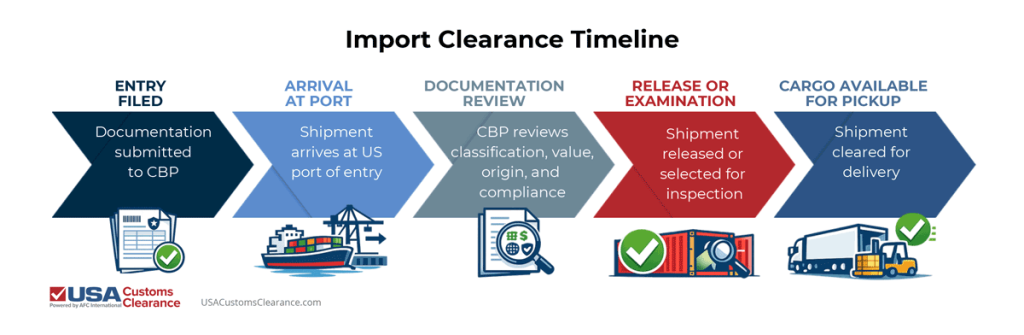
CBP may release the shipment, request additional documentation, or select the cargo for examination. Examinations verify classification, declared value, country of origin, or regulatory compliance.
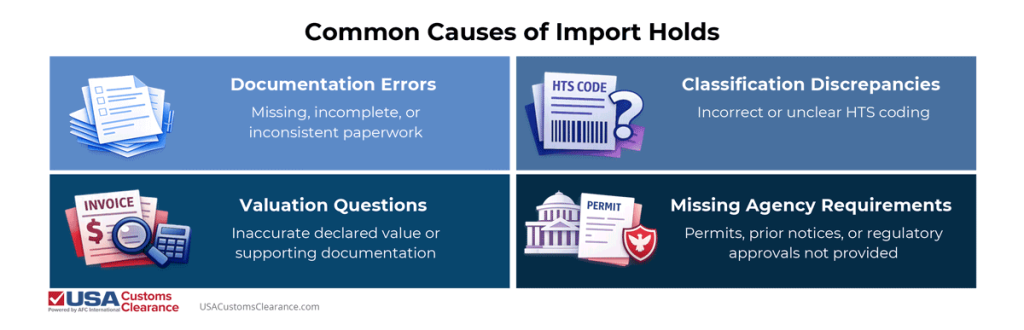
Most shipments are released without issue when docs are accurate and filings are timely. Once released, goods may proceed to their final destination.
Maintaining accurate documentation throughout the import process significantly improves the likelihood of smooth customs clearance. Coordinating closely with your Customs Broker during entry review ensures CBP requests are addressed promptly and accurately.
Post-entry compliance is the ongoing obligation to maintain accurate records and correct errors after a shipment has been released. U.S. Customs and Border Protection requires importers to retain entry records for at least five years from the date of entry.
Importers should maintain:
When errors are identified after release, corrective filings are required to adjust classification, value, or duty payment.
Post-entry compliance responsibilities include:
Regularly reviewing import activity identifies mistakes early and maintains ongoing compliance.
Establishing a consistent compliance process, managed internally or supported by a Licensed Customs Broker, reduces the risk of penalties and operational disruptions over time.
1) Confirm HTS classification and admissibility based on accurate product specifications
2) Establish or update your Importer of Record profile and complete Form 5106 registration
3) Determine bond requirements and secure the appropriate customs bond
4) Review documentation for customs valuation accuracy and country-of-origin compliance
5) Coordinate Importer Security Filing (ISF) and customs entry submission with CBP
6) Monitor entry review, respond to CBP requests, and guide your shipment through release
7) Support post-entry compliance, recordkeeping, and corrective filings
Typical timeline: We begin reviewing your documentation within 1 business day of receipt and align filings with your shipment schedule to reduce clearance delays.
What you’ll need: Commercial invoice, packing list, detailed product descriptions, material composition, quantities, country of origin, supplier information, and transportation details.
Why choose us: As a CBP-permitted customs brokerage firm, our Licensed Customs Brokers have deep regulatory experience and structured compliance processes developed over decades of managing complex import transactions. Our proven track record helps importers avoid unnecessary delays, penalties, and unanticipated duty liability.
Expected outcome: Your goods are properly classified, compliant at entry, and cleared efficiently, minimizing risk and protecting margin.
Start your import process today or speak directly with a Licensed Customs Specialist at (855) 912-0406.
A customs bond is required for formal import entries valued at $2,500 or more and for shipments regulated by Partner Government Agencies (PGAs), regardless of value.
Importers who ship regularly often obtain a continuous bond based on projected annual duty liability. Determining the correct bond type before shipment reduces the risk of clearance disruptions and unexpected costs.
If a shipment is selected for examination, U.S. Customs and Border Protection (CBP) may review documentation more closely or physically inspect the cargo. Examinations are used to verify classification, declared value, country of origin, or regulatory compliance.
While many examinations are routine, they can extend customs clearance time and may result in additional costs. Accurate documentation and pre-shipment review reduce the likelihood of exam selection.
Customs clearance time varies based on shipment type, documentation accuracy, and whether the cargo is selected for examination. Many properly documented shipments are released shortly after arrival. Delays most often occur when docs are incomplete, filings are late, or regulatory approvals are missing.
Importers are legally permitted to file customs entries on their own. However, the Importer of Record (IOR) remains fully responsible for classification accuracy, duty payment, regulatory compliance, and recordkeeping. Many first-time importers work with a Licensed Customs Broker to reduce risk, improve filing accuracy, and avoid costly entry corrections.
The most common causes of delays include:
Conducting a structured pre-shipment compliance review significantly reduces these risks.
 Copy URL to Clipboard
Did you find this article helpful?
See more of our coverage on Google.
Add usacustomsclearance.com as a preferred source!
Add usacustomclearance.com as a preferred source!
See more of our coverage in Google's Top Stories.
Licensed customs support for importers across a wide range of U.S. entry needs. USA Customs Clearance provides Customs Bonds, Consulting, Customs Brokerage, Manifest Confidentiality, Importer of Record support, and Guides & Resources to help importers prepare for U.S. Customs and Border Protection (CBP) requirements and customs clearance with regulatory compliance, greater clarity, and confidence.
With licensed broker support, transparent service information, and secure checkout, we help importers take the right next step.

We know the importing process and requirements can be confusing, but they don't have to be.
We're here to help.
When purchasing a product from our website, you can feel confident knowing our team can help if you accidentally select the wrong product. We'll guide you through the correct purchase and any applicable refund process.
Important Refund Policy Information
Eligible refunds are subject to a $50 processing fee, which will be deducted from your original purchase amount. Please allow up to 90 days for refunds to be processed, as refunds are handled quarterly by our Accounting Department.
Refunds are available only if you have not yet:
Additional Refund Terms
You have 90 days from the date of purchase to submit your bond application. After 90 days, bond fees are forfeited and are nonrefundable.
All eBook sales are final and nonrefundable.
Add your first comment to this post