
IOR ENFORCEMENT IS NOW IN EFFECT | REVIEW MY IOR


In This Article:


A partner government agency (PGA) is a U.S. federal agency that works with Customs and Border Protection (CBP) to enforce laws and regulatory requirements affecting imported goods. To find out which PGA regulates a specific commodity, importers can start by identifying their goods according to name, purpose, and constituent materials before searching a list of CBP’s import partners.
Importers should first document the characteristics that determine how a product is classified and regulated, including its material composition, intended use, ingredients, technical capabilities, and intended users. These characteristics can affect both Harmonized Tariff Schedule (HTS) classification and PGA requirements.
HTS classification itself is governed by the General Rules of Interpretation (GRIs), relevant section and chapter notes, and the legal language of the HTS. With this information at the ready, importers can begin excluding agencies that don’t have regulatory authority over that particular class of goods.
For instance, it is reasonable to assume that the Food and Drug Administration (FDA) has no regulatory authority over imported iron ore.
The GRI lists the following data points for importers to use during the product identification process:
Failure to take all of these factors into account can lead to misclassification, which in turn could cause a negligent importer to misidentify the PGA or PGAs that regulate their goods. For instance, a standard cosmetic product might not always trigger FDA involvement, but cosmetics that claim medical benefits likely will, since the medical claim falls squarely into the “drug” part of the FDA’s regulated imports.
Material composition, intended use, origin, and even the intended user base of the product can trigger PGA regulations. The following chart displays some practical examples of product and material characteristics, what PGA involvement they might trigger, and commodities that display those characteristics.
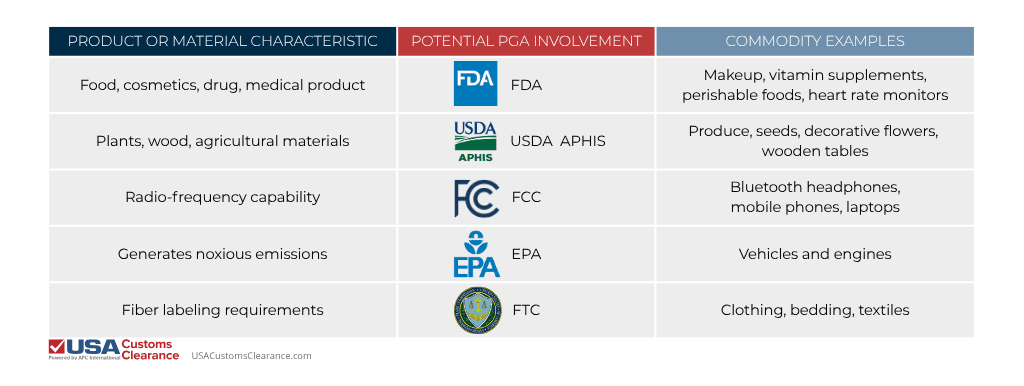
While the previous products show only one PGA’s involvement, it is possible for one imported good to be regulated by two or more agencies.
Yes. A single imported product can trigger requirements administered by multiple PGAs. A simple example of overlapping regulatory authority is a children’s product that generates or receives radio signals, such as kid’s tablets.
Importers must take reasonable care to ensure their goods meet the regulatory standards set by any and all relevant government agencies. Otherwise, it’s possible to import goods that are fully compliant with one agency’s requirements while not meeting others, resulting in lost time and even lost cargo.
Importers don’t necessarily need an HTS code to identify the PGAs that regulate their goods, but the processes of product identification and HTS classification are similar enough that skilled HTS interpreters have an upper hand in PGA identification.
A material benefit of accurate HTS classification is that some commodities are flagged in CBP’s Automated Commercial Environment (ACE) for PGA involvement. This doesn’t necessarily identify every PGA with oversight on a given commodity, but it adds an extra layer of verification for uncertain importers.
PGA flags are indicators associated with tariff classifications that make importers, filers, and brokers aware of a PGA’s potential import requirements and regulations.
FDA flags on HTS codes, for example, identify foodstuffs, medicines, or medical devices that may require additional documentation or scrutiny to be legally imported.
Importers and customs brokers can encounter PGA flags in the aforementioned ACE system. Inputting a specific HTS code will show relevant flags from CBP’s partner agencies. It’s important to remember that CBP uses multiple flag tiers, so seeing a flag on an HTS code in ACE doesn’t automatically mean the relevant PGA has full oversight. The FDA provides another practical example here as salt used for seasoning food is distinguished from salt used for other purposes like de-icing roads.
With the correct PGAs identified, the next step is to determine that agency’s specific requirements for the commodities in question. These requirements can include permits, licenses, certifications of product testing, specific types of labeling, and filing prior notice.
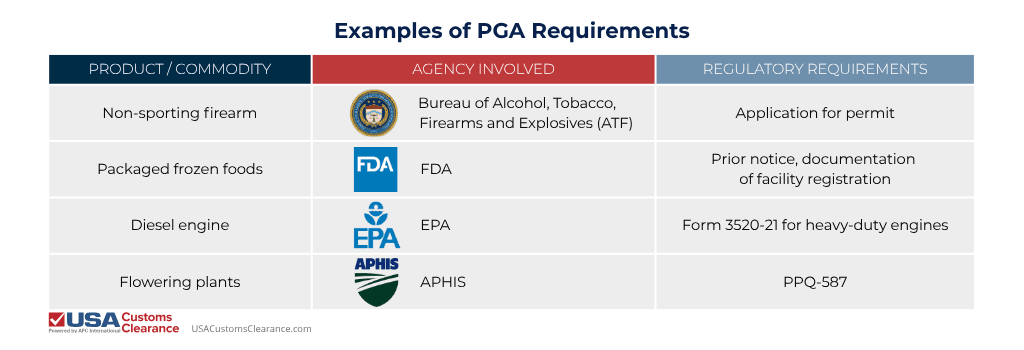
Some agency requirements can restrict who can be permitted to import goods, making such goods more challenging to import when compared to less strictly-regulated commodities. A customs broker’s assistance will prove beneficial when identifying PGA requirements, as mistakes in documentation and licensure can result in expensive fines and loss of cargo for inexperienced importers.
Restricted goods can be imported by qualified importers with the proper permits, licenses, or other additional requirements specified by the relevant PGA, but prohibited goods are effectively unavailable to commercial importers.
The following scenarios show the difference between a relatively simple restriction and an effective prohibition.
Restricted
A U.S. business wants to import 1,000 vehicle engines from Japan. Since these are emissions-generating devices, the Environmental Protection Agency (EPA) requires importers to complete EPA Standard Form 3520-1 to ensure the engines meet federal emissions standards and can be legally imported into the U.S.
The additional form requirement is only prohibitive in terms of excluding engines that don’t meet or exceed the EPA standard. Compliant engines can be imported and resold with little additional complication. Therefore, this situation is more of a restriction and doesn’t negate the commodity’s potential commercial applications, like resale and public use.
Prohibited
An importer wants to bring certain controlled substances regulated by the U.S. Justice Department’s Drug Enforcement Administration (DEA) into the country. These substances are not intended for general commercial resale, and businesses must register with the DEA before they can transact such goods in the first place.
Approved business types in this scenario include pharmacies, laboratories, and treatment programs, and registered businesses must fill out DEA Form 357 to apply for an importer permit and DEA Form 236 to declare such imports.
These are commodity and importer-level restrictions that, working together, effectively prohibit most commercial businesses from importing controlled substances.
Before finalizing information on customs documentation such as CBP Form 7501 and the Importer Security Filing (ISF), importers can use this checklist of questions to help ensure their goods comply with relevant PGAs:
If you’re uncertain about this information, or unfamiliar with the products you plan to import, consider consulting with a Licensed Customs Broker from USA Customs Clearance. Our decades of experience can make the difference between crippling CBP penalties and trouble-free customs clearance.
Call us at (855) 912-0406 or fill out a contact form to get started today.
Importation of Motor Vehicles and Motor Vehicle Engines Subject to Federal Air Pollution Regulations, United States Environmental Protection Agency, 2024
Application for Permit to Import Controlled Substances for Domestic and/or Scientific Purposes, U.S. Department of Justice/Drug Enforcement Administration
Entry Summary, Department of Homeland Security, U.S. Customs and Border Protection, 2026
 Copy URL to Clipboard
Did you find this article helpful?
See more of our coverage on Google.
Add usacustomsclearance.com as a preferred source!
Add usacustomclearance.com as a preferred source!
See more of our coverage in Google's Top Stories.
Licensed customs support for importers across a wide range of U.S. entry needs. USA Customs Clearance provides Customs Bonds, Consulting, Customs Brokerage, Manifest Confidentiality, Importer of Record support, and Guides & Resources to help importers prepare for U.S. Customs and Border Protection (CBP) requirements and customs clearance with regulatory compliance, greater clarity, and confidence.
With licensed broker support, transparent service information, and secure checkout, we help importers take the right next step.

We know the importing process and requirements can be confusing, but they don't have to be.
We're here to help.
When purchasing a product from our website, you can feel confident knowing our team can help if you accidentally select the wrong product. We'll guide you through the correct purchase and any applicable refund process.
Important Refund Policy Information
Eligible refunds are subject to a $50 processing fee, which will be deducted from your original purchase amount. Please allow up to 90 days for refunds to be processed, as refunds are handled quarterly by our Accounting Department.
Refunds are available only if you have not yet:
Additional Refund Terms
You have 90 days from the date of purchase to submit your bond application. After 90 days, bond fees are forfeited and are nonrefundable.
All eBook sales are final and nonrefundable.
Add your first comment to this post